
Vehicle collisions shatter storefront glass because the kinetic energy of a moving vehicle concentrates force on a small area of brittle material, exceeding the glass’s tensile strength in milliseconds. Standard storefront glass is designed to resist wind loads and thermal stress, not the sudden, concentrated force of a two-ton vehicle. When that force hits, the glass does not bend. It fails catastrophically, sending shards across the interior at dangerous speeds. Understanding why vehicle impact breaks storefront glass is the first step toward protecting your property, your employees, and anyone inside when it happens.
Why vehicle impact breaks storefront glass
Glass fails under impact because it is brittle, not ductile. Steel bends under force. Glass does not. When a vehicle strikes a storefront panel, the energy transfers instantly to a small contact point. The glass cannot redistribute that stress across the panel fast enough, so it fractures from the point of contact outward.

The type of glass installed determines how it fails, not whether it fails. Tempered glass, the most common choice for commercial storefronts, shatters into hundreds of small cubes. Laminated glass, which bonds two panes with a plastic interlayer, holds fragments in place after breaking. Neither type stops a vehicle. Both types break. The difference is what happens to the glass after it gives way.
Vibrational fatigue compounds the problem over time. Traffic vibrations create stress cycles on storefront glass with every passing vehicle on a nearby road. These cycles widen microscopic surface cracks that are invisible to the naked eye. A panel weakened by years of vibration requires far less impact force to shatter than a fresh installation.
Pro Tip: Ask your glazier to inspect storefront panels for edge chips and surface micro-cracks during any scheduled maintenance visit. These small defects concentrate stress and dramatically lower the force needed to cause a full panel failure.
Key physical causes of glass breakage from vehicle impacts include:
- Force concentration: A vehicle bumper or corner contacts a small surface area, spiking local stress far beyond the glass’s tensile limit.
- Brittleness: Glass has almost no ability to deform before fracturing, unlike metals or plastics.
- Pre-existing micro-cracks: Visible chips or edge damage accelerate fracture propagation even without new impacts.
- Glass type mismatch: Standard annealed glass used in older storefronts offers the least resistance and produces the most dangerous large shards.
- Chemically strengthened glass: High-strength glass propagates cracks faster along boundaries, which affects how it performs in high-traffic commercial zones.
How driver errors and parking lot design increase crash risk
The leading cause of vehicle-to-storefront collisions is not reckless driving. It is pedal error. Pedal mistakes and poor parking lot design are the primary contributors to storefront crashes, particularly in angled head-in parking spaces that point vehicles directly at glass facades.
The geometry of a standard parking lot works against storefront safety. When a driver confuses the gas pedal for the brake, the vehicle accelerates forward rather than stopping. In a head-in angled space, that forward direction leads straight into the building. The distance between the parking space and the glass is often less than 20 feet, leaving almost no time for correction.
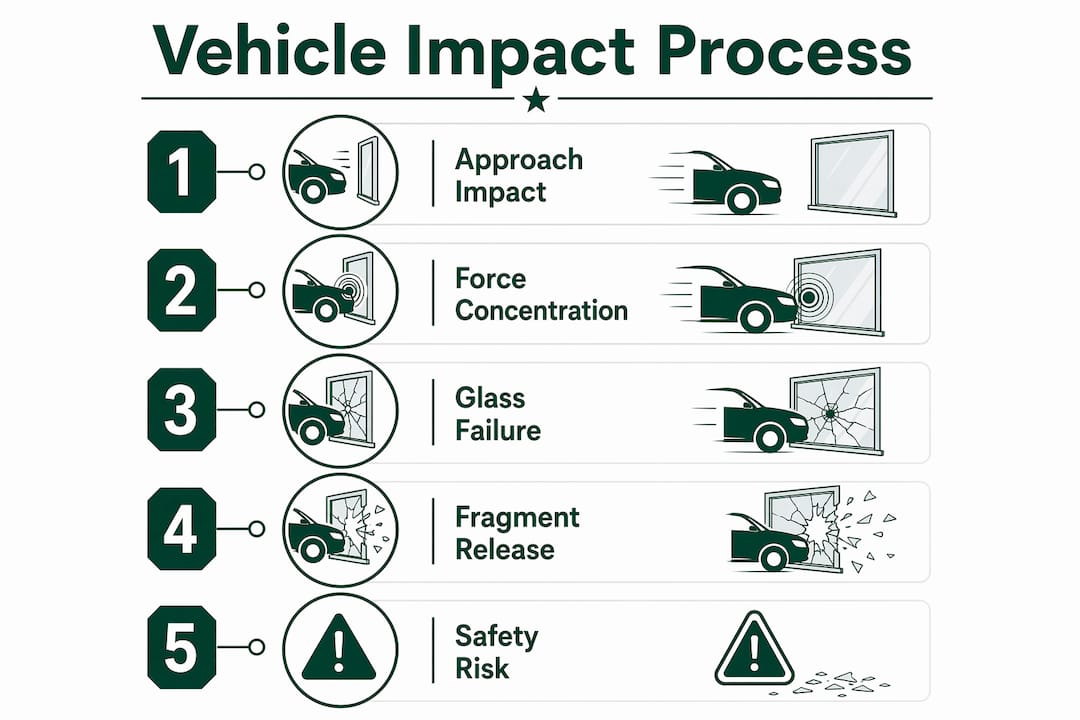
Environmental conditions make pedal errors more likely. Poor parking lot lighting and the absence of visual datum points increase the frequency of driver mistakes during nighttime parking. Drivers rely on visual cues to judge distance and stopping points. Remove those cues and error rates climb.
The sequence of events in a typical storefront crash follows a predictable pattern:
- Driver enters a head-in angled parking space facing the storefront.
- Driver applies what they believe is the brake pedal.
- Vehicle accelerates instead of stopping.
- Low curbs or wheel stops fail to arrest the vehicle’s momentum.
- Vehicle contacts the glass panel directly.
- Glass shatters, sending fragments into the building interior.
Low curbs are a particularly common false security measure. Simple curbs fail to stop vehicles once the wheels roll over them because they lack the height and energy absorption needed to halt forward momentum. A vehicle traveling even 5 miles per hour carries enough kinetic energy to clear a standard parking curb without slowing significantly.
What happens inside the glass at impact?
Glass failure is not a single event. It is a cascade. The moment a vehicle contacts the panel, a stress wave radiates outward from the contact point. If the glass has any pre-existing micro-cracks, those cracks become the path of least resistance. The fracture follows them, branching and spreading faster than the eye can track.
Microscopic inclusions inside tempered glass add another failure risk that most property managers never consider. Nickel sulfide inclusions ranging 50–500 microns are invisible without specialized inspection equipment. These particles expand over time and can trigger spontaneous breakage without any external impact at all. A vehicle collision on a panel already stressed by a nickel sulfide inclusion requires far less force to cause total failure.
Glass failures labeled as “spontaneous” typically result from cumulative stress cycles over weeks or months. A vehicle impact is often just the final trigger on a panel that was already compromised. Treating glass as a high-energy hazard rather than a passive wall changes how you approach inspection and replacement schedules.
The secondary hazard from glass breakage is often more dangerous than the vehicle itself. Glass fragment sprays can travel dozens of feet into the building interior, turning a parking lot accident into a serious injury event for employees and customers standing well away from the point of impact.
The table below shows how glass type affects the breakage pattern and injury risk during a vehicle collision.
| Glass type | Breakage pattern | Fragment behavior | Injury risk |
|---|---|---|---|
| Annealed (standard) | Large irregular shards | Scatter widely | High |
| Tempered | Small cube fragments | Spray across interior | Moderate to high |
| Laminated | Cracks but holds shape | Fragments stay bonded | Lower, but panel still fails |
| Chemically strengthened | Rapid crack propagation | Unpredictable spread | Variable |
How can you protect your storefront from vehicle impacts?
The most effective single investment a property manager can make is crash-rated bollards. Bollards installed 4–6 feet from the glass line stop vehicle momentum before it reaches the facade. They are anchored deeply into the ground and tested to absorb the force of a vehicle impact. A low curb cannot do this. A bollard can.
Effective storefront protection combines physical barriers with layout changes and glass upgrades. The right combination depends on your parking configuration, foot traffic, and budget.
- Crash-rated bollards: Install them at 4–6 feet from the glass line, spaced to prevent a vehicle from passing between them. Decorative bollards that are not crash-rated offer no meaningful protection.
- Parking layout reconfiguration: Redirect head-in angled spaces so vehicles park parallel to the building or at an angle that points away from glass panels. This single change removes the direct collision path.
- Security glazing or window film: Window film applied after breakage holds shattered fragments together, reducing the injury risk from flying glass. Retrofit film does not prevent breakage but significantly reduces the secondary hazard.
- Improved lighting: Add lighting at parking lot entry points and along the facade. Clear visual datum points help drivers judge distance and reduce pedal error frequency.
- Regular glass inspection: Small chips or damage that go unrepaired propagate fractures and lower the force threshold for catastrophic failure. Schedule inspections at least twice a year.
Pro Tip: When specifying new bollards, request the ASTM F3016 or ASTM F2656 test rating from your supplier. These are the recognized American standards for vehicle impact resistance. A bollard without a test rating is a decorative object, not a safety barrier.
Reconfiguring a parking lot is often cheaper than a single storefront replacement. A glazing contractor or commercial property consultant can model the vehicle approach angles for your specific layout and identify which spaces pose the highest risk.
Key Takeaways
Vehicle impact breaks storefront glass because brittle panels cannot absorb concentrated kinetic energy, and pre-existing micro-cracks, poor parking design, and inadequate barriers compound the risk at every stage.
| Point | Details |
|---|---|
| Glass is brittle by nature | It fractures instead of bending, making any concentrated vehicle force catastrophic. |
| Pedal error drives most crashes | Head-in angled parking spaces pointing at glass facades are the highest-risk configuration. |
| Pre-existing damage lowers the threshold | Chips and micro-cracks concentrate stress and cause panels to fail with less force. |
| Crash-rated bollards are the top defense | Install them 4–6 feet from the glass line, rated to ASTM F3016 or ASTM F2656 standards. |
| Laminated glass reduces injury risk | It holds fragments in place after impact, but does not prevent the panel from breaking. |
Storefront safety is not a design problem. It is a priority problem.
After working with commercial properties across the Kansas City area, the pattern I see most often is not ignorance of the risk. It is the decision to defer it. Property managers know their parking lot is poorly configured. They know the curbs are too low. They know the glass has a chip in the corner that has been there for two years. The problem is that nothing has gone wrong yet, so the fix stays on next quarter’s list.
The uncomfortable truth is that storefront glass does not give you a warning before it fails. Glass failures labeled as spontaneous are almost always the result of cumulative stress that built up quietly over months. By the time a vehicle provides the final trigger, the panel was already compromised. Waiting for an incident to justify the investment is the most expensive strategy available.
The other mistake I see regularly is spending money on the wrong layer of protection. Decorative bollards that are not crash-rated. Window film applied to annealed glass that should have been replaced years ago. These are comfort measures, not safety measures. The right investment sequence is: fix the parking geometry first, install rated bollards second, then upgrade the glass. Doing it in reverse order means you are protecting a compromised panel with an inadequate barrier.
The good news is that the engineering here is well understood. The solutions are not experimental. Crash-rated bollards, laminated glass, and proper parking layout changes are proven tools. The only variable is whether you act before or after an incident.
— Artem
Star-ws commercial glass services for Kansas City property managers
When a vehicle impact leaves your storefront exposed, the priority is fast, professional replacement that restores both security and appearance.
Star-ws specializes in commercial storefront glass replacement for business owners and property managers across the Kansas City area. The team handles everything from emergency board-up coordination to full panel replacement with tempered or laminated glass upgrades. Every project includes a thorough assessment of the existing frame condition and glass specification, so the replacement performs better than what was there before. Star-ws also advises on glass type selection based on your specific parking layout and risk profile. Contact Star-ws for a free estimate and get your storefront secured without delay.
FAQ
Why does storefront glass shatter instead of crack cleanly?
Glass is brittle and cannot deform under stress. When vehicle impact force exceeds the tensile strength of the panel, it fractures outward from the contact point in multiple directions simultaneously rather than producing a single clean crack.
What glass type is safest for a storefront facing a parking lot?
Laminated glass is the safest option for storefronts exposed to vehicle traffic. It holds fragments in place after impact, reducing the injury risk from flying shards, though it does not prevent the panel from breaking under a direct vehicle collision.
Can window film prevent glass breakage from a vehicle impact?
Window film does not prevent breakage. It holds shattered fragments together after the panel fails, which significantly reduces the secondary injury hazard from flying glass inside the building.
How far should bollards be placed from storefront glass?
Crash-rated bollards should be installed 4–6 feet from the glass line. This distance allows the bollard to absorb vehicle momentum before the bumper or body of the vehicle reaches the facade.
How often should storefront glass be inspected for damage?
Inspect storefront glass at least twice a year. Small chips and edge damage concentrate stress and lower the force required for a full panel failure, making early detection and repair the most cost-effective maintenance strategy available.