
Six hardware families cover nearly every commercial opening: locksets (cylindrical, mortise, deadbolt, electronic), panic and exit devices, hinges/closers/strikes, electrified access-control hardware, cylinders and keying systems, and protective trim. For a primary storefront entry, start with a mortise lock or a Grade 1 cylindrical lever, adding electric latch retraction if the door ties into access control. For corridor and office doors, the closer and hinge selection matters more than the lock. For any door serving 50 or more people in an assembly or educational space, panic hardware isn’t optional under the International Building Code.
Every choice below traces back to three reference points: ANSI/BHMA grading, IBC egress rules, and ADA operating-force limits. Get those three right and most spec errors disappear.
- Locks: cylindrical, mortise, deadbolt, electronic/smart, knob
- Exit devices: rim, surface vertical rod, concealed vertical rod, mortise, multi-point
- Supporting hardware: hinges, closers, latches, strikes
- Electrified hardware: maglocks, electric strikes, electrified trim and panic devices
- Cylinders: conventional pin, interchangeable core, master-keyed systems
Pro Tip: Before you compare products, decide the door’s function first — storeroom, passage, classroom, or privacy — because that function narrows the hardware list faster than any brand comparison will.
Key Takeaways
Matching hardware grade, device type, and code requirement to the specific opening prevents most of the specification failures that surface at inspection or after early hardware failure.
| Point | Details |
|---|---|
| Match lock type to door use | Mortise for heavy-duty entrances, cylindrical lever for interior/light-duty doors, deadbolts only as secondary security. |
| Know the panic vs. fire exit distinction | Mechanical dogging is prohibited on rated doors; use electric latch retraction instead. |
| Spec by grade and traffic, not price | Grade 1 costs more upfront but avoids early failure on high-cycle commercial entrances. |
| Coordinate electrified hardware early | Bring in the electrical and fire-alarm contractor before the frame order ships. |
| Get professional installation for critical hardware | Star-ws handles commercial door hardware replacement and repair, including prep for mortise and concealed exit devices, across the Kansas City area. |
Table of Contents
- Comparing Commercial Door Hardware Types at a Glance
- What Are the Main Types of Commercial Door Locks?
- Which Panic and Exit Devices Fit Your Doors?
- Hinges, Closers, and the Hardware That Controls Durability
- How Does Electrified Hardware Fit Into Access Control?
- Choosing Between Cylinder and Core Formats
- What Do ANSI/BHMA Grades and Code Terms Actually Mean?
- How Do You Specify Hardware Without Costly Mistakes?
- What Determines Hardware Lifespan and Maintenance Needs?
- Why Do Panic Hardware and Fire Codes Sometimes Conflict?
- The Most Useful Standards to Check Before You Spec
- What the Data Actually Tells Specifiers
- Getting the Right Hardware Installed the First Time
- Frequently Asked Questions About Commercial Door Hardware Types
- Sources
Comparing Commercial Door Hardware Types at a Glance
The seven categories below cover almost every commercial opening you’ll spec this year, and the right pick usually comes down to traffic volume and security exposure rather than brand preference.
| Hardware type | Typical application | Durability/grade | Security level | Installation complexity | Electrification compatibility | Lifecycle cost driver |
|---|---|---|---|---|---|---|
| Cylindrical lever lock | Interior offices, light exterior | Grade 1–2 | Moderate | Low (standard bore prep) | Limited to electrified trim | Cycle count on lever |
| Mortise lock | Primary entrances, heavy-use doors | Grade 1 | High | High (pocket prep) | Full electrified trim support | Prep cost offset by longevity |
| Deadbolt/auxiliary lock | Secondary security, storage rooms | Grade 1–2 | High (paired with latch) | Low | Rarely electrified | Rekey frequency |
| Exit devices (rim/SVR/CVR/mortise) | Egress doors, storefronts, pairs | Grade 1 | High | Moderate to high (CVR/mortise) | Electric latch retraction, alarms | Door prep and rod maintenance |
| Maglock/electric strike | Access-controlled entries | N/A (rated by holding force/cycles) | Depends on fail-safe setup | Moderate (wiring required) | Native | Power supply and fire-alarm interface |
| Hinges and closers | All commercial doors | Grade 1 for heavy traffic | Indirect (affects alignment) | Low to moderate | Closers can be electrified | Cycle rating vs. actual traffic |
| Multi-point hardware | High-security or windstorm-rated pairs | Grade 1 | Very high | High | Compatible with select systems | Higher upfront, lower failure rate |
Pro Tip: Size hardware to expected traffic cycles, not sticker price. A Grade 2 lockset on a high-frequency entrance will fail years before a Grade 1 unit earns back its cost difference.
What Are the Main Types of Commercial Door Locks?
Five lock families handle nearly every commercial opening, and picking the wrong one is the single most common spec mistake facility managers make.
Cylindrical lever locks are the workhorse of interior doors. They install through a face-bored hole roughly 2 1/8 inches across, with an edge bore near 1 inch for the latch, a straightforward prep that most door shops handle in minutes. That simplicity is also their limit: cylindrical locks sit on the surface of the door rather than inside it, which makes them fine for offices, restrooms, and light exterior use but a weak match for a door that takes heavy abuse or faces forced-entry risk.
Mortise locks solve that problem by moving the lock body into a pocket cut directly into the door edge. That inset placement gives mortise hardware meaningfully better resistance to forced entry than a face-bored cylindrical lock, which is why nearly every heavy-duty primary entrance, main lobby door, or high-traffic stairwell door in institutional buildings specifies mortise. The tradeoff is upfront cost and prep complexity. Cutting a mortise pocket in the field is slower and less forgiving than a cylindrical bore, so factory-prepped doors are worth the lead time whenever mortise hardware is on the schedule.
Deadbolts and auxiliary locks rarely stand alone on a commercial door. They’re layered on top of a latch or exit device to add secondary security, typically on storage rooms, IT closets, or after-hours entries where you want a second locking point beyond the primary latch. Because they don’t provide egress function, deadbolts should never substitute for a properly rated exit device on a code-required egress door.
Electronic and smart locksets have moved from novelty to standard spec on tenant suites, server rooms, and any door that needs an audit trail. Electrified trim and electric latch retraction let a mechanical lockset tie into an access-control panel, so a credential read at the reader can release the latch without a mechanical dogging feature. The tradeoff is coordination: someone has to route low-voltage wiring to the frame or hinge, decide on fail-safe versus fail-secure behavior, and confirm the door has (or can get) power transfer hardware. Skipping that coordination early is the most common reason electrified openings get delayed at closeout.
Knob sets still show up on light-duty interior doors, but most facility standards have phased them out in favor of ADA-compliant levers, since a round knob requires grasping and twisting, which fails accessible-route requirements in many jurisdictions.
Matching lock function to door use avoids most callback issues:
- Storeroom function — locked from outside, always unlocked from inside (utility rooms, storage).
- Passage function — always unlocked, latch only (low-security interior doors).
- Privacy function — lockable from inside without a key (restrooms, single-occupant offices).
- Classroom function — locked or unlocked from outside with a key, inside lever always operable (classrooms, exam rooms).
Pro Tip: If a supplier can’t tell you the lock function by name, storeroom, passage, privacy, or classroom, they haven’t actually reviewed the opening. Ask before you buy.
Which Panic and Exit Devices Fit Your Doors?
Four device types cover almost every egress configuration you’ll encounter: rim, surface vertical rod (SVR), concealed vertical rod (CVR), and mortise, plus multi-point hardware for high-security or wind-load pairs. Rim devices are the simplest and most maintainable, latching directly into a strike on the frame, and they’re the default choice for single doors. Paired doors usually need SVR or CVR hardware, which latches into the head and sill rather than the frame side. CVR devices disappear into the door, a look many architects want on narrow-stile glass storefront entrances, but they require factory door preparation and get expensive fast if you try to retrofit them into an existing frame. Multi-point devices combine vertical rods with a rim latch for three-point engagement, typically reserved for openings that need extra security or wind-load resistance.
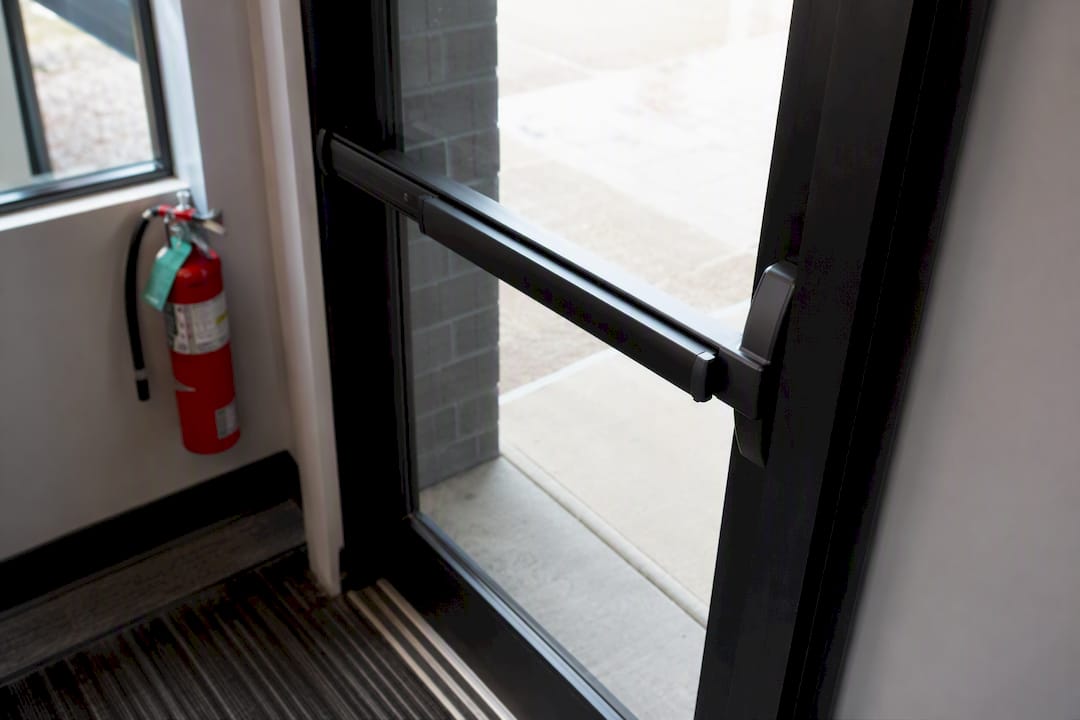
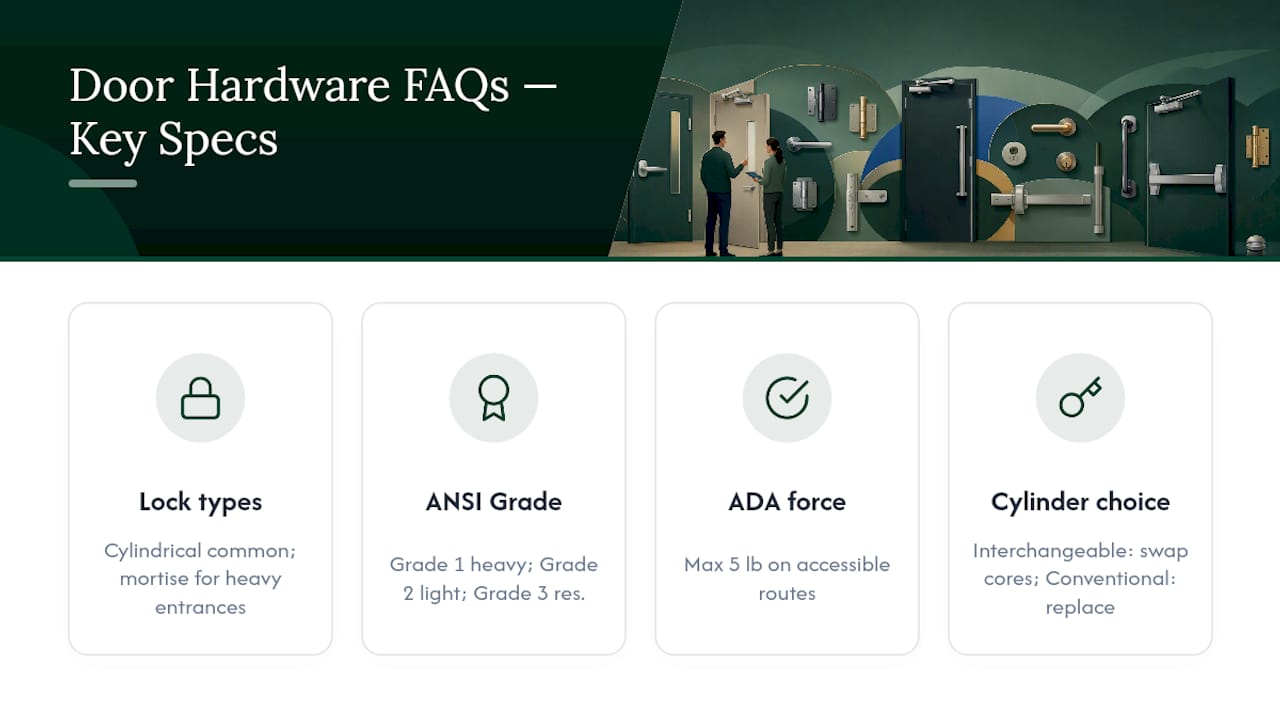
Code, not preference, decides where panic hardware is mandatory. The IBC requires panic hardware on doors serving Assembly and Educational occupancies with 50 or more people, along with all High Hazard occupancies, regardless of occupant count. ADA rules cap operating force at 5 pounds on any accessible route, which rules out stiff, poorly maintained crossbars on those doors.
Here’s the distinction that trips up more specifiers than any other: standard panic hardware and fire-rated exit hardware are not interchangeable products. Panic hardware permits mechanical dogging, holding the latch retracted for push-pull operation during business hours. Fire-rated exit hardware prohibits that feature entirely, because a rated door has to positively latch every single time it closes. If you need push-pull convenience on a rated opening, electric latch retraction is the code-compliant substitute, not a dogging cylinder.
A simple door-elevation sketch showing rod placement makes SVR versus CVR obvious in about five seconds, worth attaching to any spec package covering paired doors.
Pro Tip: On rated openings, spec electric latch retraction from day one rather than discovering at inspection that your dogging feature has to come out.
Hinges, Closers, and the Hardware That Controls Durability
Locks and exit devices get the attention, but hinges, closers, latches, and strikes decide whether a door still swings straight in five years.
Hinge selection starts with door weight and cycle count. Two hinges suffice on light interior doors; three hinges are standard on most commercial entrances; heavier doors, or ones exposed to wind load, often move to continuous hinges or offset pivots that spread stress across the full door edge instead of three points. A door that sags at the hinge side will bind against the strike, chew through weatherstripping, and eventually take the closer with it.
Closers come in surface-mounted, concealed, and floor-mounted formats, and sizing them by door weight and width, not a generic “one size fits all” spring setting, is what keeps a heavy exterior door from slamming or drifting open. On doors paired with panic hardware, coordinate closer arm selection early. A closer arm that conflicts with an exit device’s crossbar geometry is a common field surprise that costs a return trip.
Latches and strikes need to match the device family. A rim exit device needs a rim strike; a mortise lock needs a mortise-compatible pocket. Reinforce the strike area on any door expecting heavy daily traffic. A hollow-metal frame with a thin strike plate will eventually loosen under repeated slamming, even if the lock itself is rated Grade 1.
Materials and finishes matter more in commercial settings than most spec sheets admit. Stainless steel and heavy plated finishes hold up against constant hand contact and cleaning chemicals better than lighter anodized finishes, which is why entrance-level hardware on public buildings skews toward brushed stainless or oil-rubbed bronze over painted alternatives.
A short maintenance routine keeps high-cycle openings out of the repair queue:
- Lubricate hinges on a set schedule, not just when they start to squeal.
- Check closer spring tension and adjust for seasonal temperature swings.
- Inspect exit-device rods and latches for alignment drift every few months on paired doors.
- Confirm strike plates haven’t loosened on doors seeing daily heavy traffic.
How Does Electrified Hardware Fit Into Access Control?
Electrified hardware bridges mechanical locks and building-wide access-control systems. The common options are magnetic locks (maglocks), electric strikes, electric latch retraction on exit devices, and electrified lever trim or panic hardware that accepts a credential signal to release.
Egress requirements shape almost every electrified decision. Maglocks hold a door shut with electromagnetic force rather than a mechanical bolt, which means they typically require either a monitored egress system or panic hardware wired to break power on activation. That’s a fire and life-safety requirement, not a suggestion. On rated doors, electric latch retraction replaces mechanical dogging as the way to get push-pull convenience without compromising the positive-latching requirement.
Wiring decisions determine whether the installation goes smoothly or turns into a punch-list nightmare. Confirm power supply locations before the frame goes in, decide fail-safe (unlocks on power loss) versus fail-secure (stays locked on power loss) based on the door’s role in the life-safety plan, and loop in the fire-alarm contractor if the door needs to release on alarm activation. A partner resource on access-control coordination covers the wiring basics in more depth if your team is new to electrified specs.
Pro Tip: Bring the electrical and fire-alarm contractors into the hardware conversation before the frame order goes out, not after. Retrofitting power to a frame that’s already installed is one of the most expensive change orders on a commercial door job.
Choosing Between Cylinder and Core Formats
Cylinder format decides how flexible your keying system will be for the life of the building. Small-format interchangeable cores (SFIC) and large-format interchangeable cores (LFIC) let a technician swap the core in seconds without pulling the whole lock apart, which matters enormously for facilities with high tenant turnover or frequent contractor access. Conventional pinned cylinders cost less upfront but require a full cylinder replacement, not just a core swap, when a key needs to be voided.
Masterkeying makes sense once a building has more than a handful of doors under one operator’s control: a grandmaster key opens everything, submasters open a wing or floor, and individual change keys open single doors. Facilities with high security exposure, data centers, pharmacies, sometimes isolate certain doors from the master system entirely, accepting the inconvenience of a separate key for the sake of containment.
A quick keying guide by door type:
- Service and mechanical rooms — isolate from tenant masterkey, limit distribution.
- Tenant suites — submaster per tenant, grandmaster for building staff.
- Emergency egress doors — never key-restrict from the inside; free egress overrides keying convenience.
What Do ANSI/BHMA Grades and Code Terms Actually Mean?
Grade numbers on a spec sheet aren’t marketing fluff. They’re a Builders Hardware Manufacturers Association rating tied to cycle testing and load resistance. Grade 1 is rated for heavy commercial and institutional use, the standard for hospitals, schools, and high-traffic public entrances. Grade 2 covers light commercial applications, back offices, low-traffic interior doors. Grade 3 is residential-grade and has no business on a commercial egress door regardless of how the price looks.
The grade a door carries predicts its lifespan far more reliably than its price tag. A Grade 2 lockset on a door that gets used two hundred times a day will wear out and need replacement long before a Grade 1 unit shows the same fatigue, and the labor cost of that early replacement usually erases whatever was saved buying down a grade.
Fire ratings add a second layer of requirements that grade alone doesn’t cover. Rated door assemblies are tested under UL 10C and must maintain positive latching, which is why mechanical dogging is explicitly off the table for fire-rated exit hardware. Any dogging feature has to come out, or the hardware has to be swapped for a rated exit device with electric latch retraction instead.
ADA compliance is the third piece. Operating force on any door along an accessible route can’t exceed 5 pounds, a number that shows up on inspection checklists more often than most specifiers expect. Before a spec sheet goes final, confirm:
- Grade matches expected daily traffic, not just the budget line.
- Fire rating on the door matches the hardware’s own listing, not just the frame’s.
- Operating force on accessible-route doors stays under the 5-pound ADA ceiling.
- Any electrified component has a documented fail-safe/fail-secure decision on file.
How Do You Specify Hardware Without Costly Mistakes?
A short checklist catches most of the errors that show up during inspection or, worse, during an actual break-in attempt.
Run through these before finalizing any commercial door hardware package:
- Opening type (single, pair, glass storefront, fire-rated) and door material.
- Expected daily traffic cycles.
- Security risk level for that specific opening.
- Required ANSI/BHMA grade based on traffic, not budget.
- Electrification needs and who owns the wiring scope.
- Fire-rating requirements and whether dogging is even legal on that door.
- Finish and keying system, tied to the building’s existing master key structure.
Before signing off, ask your hardware supplier and installer directly: what door prep does this require, and is it field-cut or factory-prepped? Does the exit hardware carry a UL label matching the door’s fire rating? Where’s the power coming from for electrified components, and what’s the fail-safe behavior on alarm or power loss? What does the warranty actually cover, and how do rekey visits get billed?
Three red flags mean the spec needs a second look before it goes out for bid: mechanical dogging specified on a door that’s fire-rated, a Grade 2 lockset going onto a door with heavy public traffic, and electrified hardware with no documented coordination between the door supplier, electrician, and fire-alarm contractor.
Pro Tip: If a supplier’s quote doesn’t mention UL labeling on exit hardware for a rated door, ask directly. Silence on that point is usually a sign the product wasn’t matched to the opening.
What Determines Hardware Lifespan and Maintenance Needs?
Installation choices made on day one echo through the entire lifecycle of the door. Factory-prepped doors reduce field rework significantly compared with cutting mortise pockets or vertical-rod channels on site, and paired doors nearly always need a door coordinator to keep the astragal and latch order correct. High-security hardware also demands frame reinforcement; a Grade 1 lock bolted into an unreinforced hollow-metal frame will eventually pull the strike loose under repeated force.
A basic maintenance routine, run on a schedule rather than reactively, extends hardware life across the board:
- Lubricate hinges and check for sag every few months on high-traffic doors.
- Adjust closer tension seasonally as temperature swings affect hydraulic fluid viscosity.
- Cycle-test panic devices to confirm the latch retracts and reseats cleanly.
- Rekey cylinders on a set interval, especially after staff turnover.
- Increase inspection frequency on doors seeing more than a few hundred cycles a day.
Lifespan tracks directly with grade and traffic match. A properly matched Grade 1 entrance door can run for many years of heavy public use before hardware replacement becomes necessary, while undersized hardware on the same door often fails within a fraction of that time. For heavy public entrances, the lifecycle math almost always favors paying for Grade 1 upfront over absorbing early failure costs later.
Why Do Panic Hardware and Fire Codes Sometimes Conflict?
Panic hardware and fire exit hardware look nearly identical on the shelf, but they’re built for opposite priorities: one allows the latch to be held open for convenience, the other requires it to reset and lock every single time the door closes. Confusing the two on a rated opening is one of the most common and costly specification errors in commercial construction.
The fix isn’t complicated once you know it’s coming. Electric latch retraction gives a rated door the same push-pull convenience that mechanical dogging gives a non-rated one, without breaking the positive-latching requirement that keeps a fire door doing its job during an actual fire.
Build these into every spec package covering rated openings:
- Confirm the exit hardware’s UL label matches the door assembly’s own fire rating.
- Specify electric latch retraction wherever push-pull function is requested on a rated door.
- Loop in the authority having jurisdiction (AHJ) before finalizing hardware on any high-occupancy rated opening.
- Verify at inspection that no dogging cylinder or dogging feature made it onto a rated door by mistake.
The Most Useful Standards to Check Before You Spec
For grading questions, start with ANSI/BHMA. For egress and occupancy thresholds, go to the IBC panic hardware provisions. For the panic-versus-fire-exit distinction in plain language, the I Dig Hardware Q&A is the clearest resource available. Installers should also confirm UL 10C listings directly with the hardware manufacturer before ordering.
What the Data Actually Tells Specifiers
Most guidance on commercial door hardware treats grade, code compliance, and electrification as three separate conversations. They aren’t. A Grade 1 lockset on a door that’s also fire-rated and also tied into access control has to satisfy all three requirements at once, and the failure point is almost always the seam between them, not any single spec line.
The conventional advice to “buy the highest grade you can afford” misses the actual lesson here: grade should be sized to traffic cycles, not to budget ceiling or blanket caution. Overspecifying Grade 1 hardware on a low-traffic interior door wastes money that would matter more spent reinforcing the frame on the one entrance that actually takes abuse all day.
If there’s one thing worth prioritizing above all else, it’s catching the panic-versus-fire-exit conflict before bid, not at inspection. That single distinction, mechanical dogging allowed on one product family and prohibited on the other, causes more change orders and failed inspections than any grade or finish decision combined. Get that right first, and the rest of the spec falls into place.
Getting the Right Hardware Installed the First Time
A spec sheet is only as good as the door it goes into, and that’s where a lot of commercial hardware projects run into trouble. Concealed vertical rod devices and mortise locks both need precise door prep, and retrofitting that prep into an existing frame in the field is where costs and delays pile up. Star-ws handles commercial door hardware replacement throughout the Kansas City area, matching hardware grade and device type to the opening instead of defaulting to whatever’s in stock.
If your storefront entrance needs a narrow-stile glass door with concealed hardware, that’s a coordination job between the hardware and the glazing, and Star-ws also handles commercial glass replacement for storefront entrances so the door prep and the glass work happen on the same timeline instead of two separate trips. Property managers dealing with a door that’s already showing wear, loose strikes, sagging hinges, a closer that won’t hold its arc, can get a straightforward assessment and a free estimate before committing to a full hardware overhaul.
Frequently Asked Questions About Commercial Door Hardware Types
What is the most common type of commercial door lock?
Cylindrical lever locks are the most widely used because of their simple bore-and-install prep, but mortise locks remain the standard for primary entrances and heavy-traffic doors that need stronger forced-entry resistance.
What’s the difference between panic hardware and fire exit hardware?
Panic hardware allows mechanical dogging for push-pull convenience. Fire exit hardware prohibits dogging because rated doors must positively latch every time they close; electric latch retraction is the code-compliant workaround.
What ANSI/BHMA grade should I specify for a commercial entrance?
Grade 1 is the standard for heavy commercial and institutional entrances; Grade 2 suits light commercial interior doors, and Grade 3 belongs on residential doors only.
When does a commercial door legally require panic hardware?
The IBC requires it on Assembly and Educational occupancies with 50 or more people and on all High Hazard occupancies, regardless of headcount.
What’s the difference between a rim, SVR, and CVR exit device?
Rim devices latch into a frame-mounted strike and suit single doors. SVR devices use exposed rods to latch top and bottom on paired doors. CVR devices hide those rods inside the door for a cleaner look on storefronts but need factory prep.
How much operating force can commercial door hardware require under ADA?
No more than 5 pounds on any accessible route, a limit that applies to lever locks, panic hardware, and closers alike.
Should I choose interchangeable core cylinders or conventional pin cylinders?
Interchangeable cores make sense for buildings with frequent tenant turnover or contractor access since a technician can swap the core without disassembling the lock; conventional cylinders cost less but require full replacement to void a lost key.
Sources
- How to choose the right commercial door hardware – Rocky Mountain Hardware
- IBC panic hardware – US Made Supply
- Q&A: Panic hardware vs fire exit hardware – I Dig Hardware
- Builders hardware specification: door hardware types, standards, and code rules – Build Construct