
There are a handful of door closer families worth knowing: surface-mounted, concealed overhead, floor spring, concealed-in-door, shoe/heel, spring hinge, and powered operators. Pick by application, not looks. Fire rating and traffic level (ANSI/BHMA grade) come first, then mounting geometry and features like hold-open or delayed action. Get those two right and the rest of the decision falls into place fast.
TL;DR:
- Concealed and floor spring closers are ideal for high-end, heavy glass, or aesthetic-sensitive applications but raise costs and complicate future maintenance.
- Correctly sizing a closer requires matching the fire rating, door weight, and traffic level, with Grade 1 UL-listed closers mandatory for fire-rated doors.
- The arm type significantly affects performance, with parallel arms reducing force loss and slide-track arms easing ADA compliance but possibly needing larger sizes.
- Retrofit installations often face floor or header space constraints, making surface-mounted closers the practical choice unless professional help is involved.
- Field adjustments of hydraulic valves can resolve most latching issues, but safety-critical and high-traffic doors demand professional sizing and installation.
Table of Contents
- What Are the Main Types of Door Closers?
- Surface-Mounted Closers: How Arm Choice Changes Performance
- Are Concealed and Floor-Spring Closers Worth the Extra Cost?
- Rack-and-Pinion, Cam-Action, or Spring-Only: Which Mechanism?
- Which Closer Size and Grade Do You Actually Need?
- Understanding Valve Functions and Field Adjustments
- How Do You Choose the Right Door Closer?
- Retrofit Reality: What Installers Actually Run Into
- Get Professional Help With Door and Hardware Installation
- Sources
- FAQ
What Are the Main Types of Door Closers?
Most doors you walk through daily fall into one of these families, each built for a different combination of budget, traffic, and appearance.
- Surface-mounted closers attach to the door and frame face. They cost less, install fast, and cover most retrofit jobs in both homes and offices.
- Overhead concealed closers hide inside the door head or frame for a clean look. They cost more and take longer to service, which is why you see them mostly in upscale lobbies.
- Floor spring closers sit in a pocket cut into the floor slab, usually paired with pivot hardware. Heavy glass entrances and all-glass storefronts lean on these.
- Concealed-in-door closers live inside the door leaf itself, offering discreet operation without floor work, though they demand a thicker door section.
- Shoe/heel closers are a compact surface variant often used on aluminum storefront doors where a full arm assembly would look bulky.
- Spring hinges replace a standard hinge with a self-closing spring version. Cheap and simple, they suit light interior doors like closets or utility rooms.
- Automatic operators power the door open and closed electronically, mostly for ADA-mandated entries and high-traffic public buildings.
Residential settings mostly use spring hinges and light-duty surface closers. Commercial buildings lean on surface-mounted units for interior doors and reserve floor springs or concealed overhead closers for entrances where appearance or heavy glass demands it.
Surface-Mounted Closers: How Arm Choice Changes Performance
Surface-mounted units come in four arm styles, and the one you pick changes how the door feels to push and how vandal-resistant the hardware is.
- Regular arm (standard arm): mounted on the pull side with the closer body on the door and the arm reaching to the frame. Full closing power, minimal force loss.
- Parallel arm: the arm runs parallel to the door face for a lower profile and less projection into hallways. It cuts effective closing force by roughly 20 to 25 percent, so many specifiers size up one increment to compensate.
- Top-jamb mount: the closer sits on the frame head instead of the door, useful when door face space is limited or the door swings past 180 degrees.
- Slide-track (cam-action): replaces the standard arm with a sliding track, cutting initial opening resistance. This is a common pick for ADA-compliant openings where push force limits are strict.
Before ordering, check the frame’s top rail depth, whether the door swings inward or outward, and how much clearance the header allows for arm projection.
Pro Tip: If a corridor sees carts, gurneys, or heavy foot traffic, choose parallel arm for the lower profile, but confirm the installer has sized the closer up to offset the force reduction.
Are Concealed and Floor-Spring Closers Worth the Extra Cost?
Architects specify overhead concealed closers when exposed hardware would clash with a lobby, healthcare interior, or high-end storefront design. The trade-off is service access. Because the mechanism sits inside the frame or door head, a technician has to open up the assembly for adjustments or repairs, which raises labor cost over the life of the door.
Floor springs earn their keep on heavy glass entrances and pivot doors, where a surface closer simply cannot handle the weight or swing radius. Installing one means coring the floor slab, which is not a retrofit-friendly step and usually requires floor prep work ahead of the closer install itself.
- Concealed units complicate fire-door compliance checks since inspectors need to verify hold-open release without removing the whole assembly.
- Budget and long-term serviceability often pull owners back toward surface-mounted Grade 1 closers even after a concealed option gets specified early in design.
- Plan a maintenance schedule and confirm warranty terms before committing, since parts sourcing for concealed models depends on matching the exact model number.
Rack-and-Pinion, Cam-Action, or Spring-Only: Which Mechanism?
Rack-and-pinion mechanisms convert the door’s swing into rotation against a piston, giving you multiple hydraulic valves to fine-tune sweep, latch, and closing force independently. This is the standard for most commercial-grade closers because it holds up to heavy cycling and lets a technician dial in performance after installation.
Cam-action, or slide-track, closers use a shaped cam to vary resistance through the swing, which lowers the opening force needed at the start of the arc. That is exactly why they show up on ADA-sensitive doors.
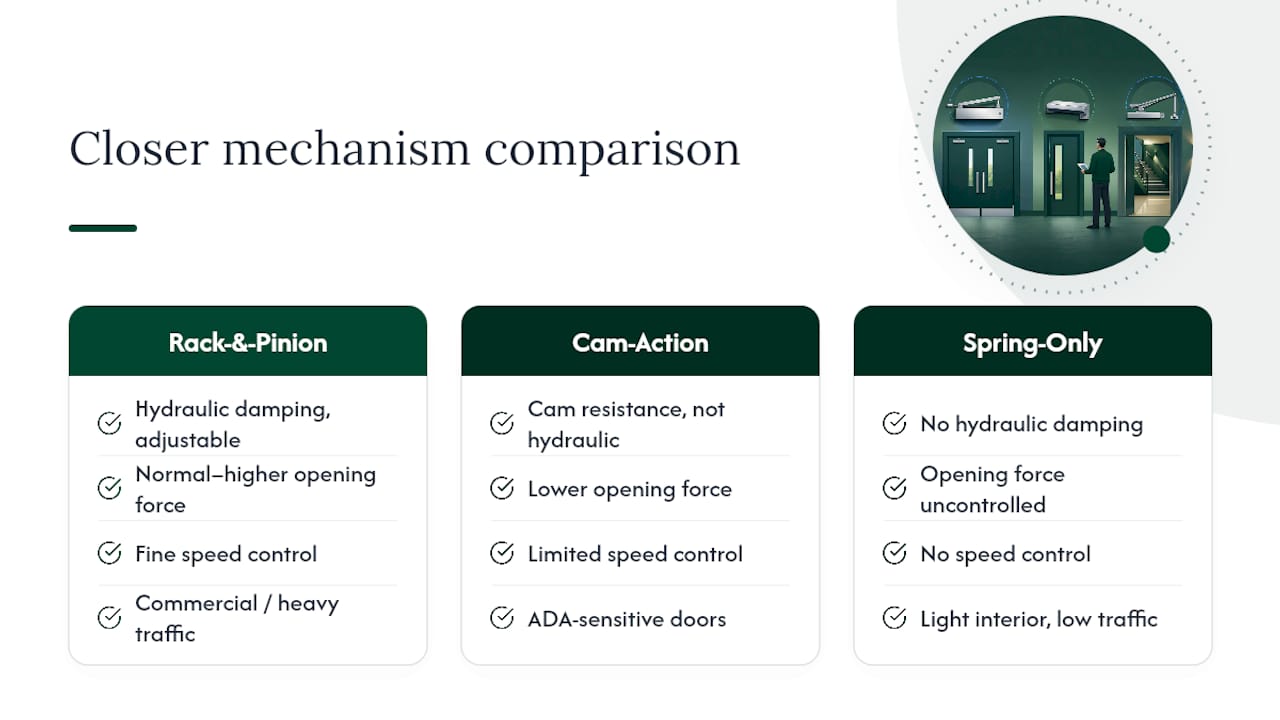
Spring-only or tail-spring mechanisms skip hydraulic damping entirely. They close fast, offer no speed control, and belong only on light interior doors that see minimal traffic. Heavier doors or anything exposed to wind need the damping a hydraulic mechanism provides.
Which Closer Size and Grade Do You Actually Need?
Manufacturers rate closers on two separate scales, and mixing them up is the most common specification mistake.
- Size (1 through 6) matches door width and weight. A standard 36-inch interior commercial door typically calls for Size 3, while exterior doors exposed to wind usually need one size larger.
- ANSI/BHMA grade measures durability. Grade 1 closers are rated for roughly 2,000,000 cycles and are required on fire-rated assemblies and heavy-traffic commercial entries. Grade 2 fits moderate-traffic interior doors, and Grade 3 covers light residential use.
- Exterior doors need all-weather hydraulic fluid, since standard fluid thins in heat and can cause slow or erratic latching once temperatures climb.
- Adjustable multi-size closers let installers tune spring strength on-site instead of stocking a fixed unit for every opening, which cuts inventory headaches on multi-door retrofit jobs.
Any door on a fire-rated assembly needs a UL-listed Grade 1 closer. There is no substitute grade that satisfies that code requirement.
Understanding Valve Functions and Field Adjustments
Every hydraulic closer worth buying gives you at least a few adjustable valves, and knowing what each one controls saves a callback.
- Sweep speed controls how fast the door moves through most of its swing. Set it slow enough to avoid slamming but fast enough to actually latch.
- Latch speed governs the final few degrees of closing, where the door needs a firm push to seat the latch into the strike.
- Backcheck cushions the door near full open to stop it from being flung into a wall. Engage it on doors that see aggressive or careless opening.
- Delayed action holds the door open briefly before it starts closing, giving someone with a cart or a cane extra time to clear the opening.
- Hold-open locks the door open at a set angle, but fire-rated doors generally cannot use hold-open unless it releases automatically on alarm.
Pro Tip: If a door isn’t latching reliably, check latch speed before assuming the closer is failing. A quarter turn on that valve fixes most complaints. If the fix doesn’t hold, the latch mechanism itself may need attention.
How Do You Choose the Right Door Closer?
Work through this order and you will avoid the two most expensive mistakes: wrong fire rating and undersized closers.
- Confirm code requirements first. If the door sits on a fire-rated assembly, you need a UL-listed Grade 1 closer, full stop.
- Match grade and size to traffic level and door specs, using the door’s width, weight, and exposure to pick the right number on the 1 to 6 scale.
- Check mounting geometry and pick an arm type, sizing up if you choose parallel arm to offset the force reduction.
- Select the mechanism and features you need, including delayed action for accessibility, all-weather fluid for exterior exposure, and hold-open where code allows it.
- Verify warranty terms and service access before installation, especially for concealed or floor-spring units where future repairs cost more.
Retrofit Reality: What Installers Actually Run Into
Frame prep is where retrofit plans stall. Top-rail clearance rarely matches what a new closer needs, and floor-spring installs almost always mean cutting into the slab, which turns a quick swap into a multi-day job. That is why surface-mounted units remain the practical default for most retrofits: they work with existing frames and avoid structural changes. For anything involving fire-rated assemblies, ADA-limited opening force, or concealed hardware, bring in a professional rather than guessing at sizing, and check a specifier’s guide to commercial hardware before ordering.
— Artem
Get Professional Help With Door and Hardware Installation
Star-ws handles the retrofit headaches this guide just walked through, from frame prep to hardware selection, so you are not the one coring a floor slab or guessing at closer size.
If your building needs a closer swap, a full door replacement, or hardware that finally matches the traffic your entry actually sees, Star-ws covers door replacement and hardware installation for homeowners, property managers, and contractors across the Kansas City area. Commercial storefront entries with ADA or fire-code constraints get the same attention through the commercial storefront doors and windows service line, and straightforward hardware swaps run through hardware replacement. Every job starts with a free estimate, and financing options may be available for larger retrofit projects. Get in touch through Star-ws to schedule a walkthrough and get a real number before committing to a mounting type or grade.
Sources
- Commercial Door Closers Types Guide: ANSI Grades, Arms and Selection | Security Parts
- How to Select a Commercial Door Closer by Size and Arm Type | CDF Distributors
- Door Closer Size Chart: How to Choose the Right Size | Doors For Pros
FAQ
What Are the Different Types of Door Closers?
The main families are surface-mounted, overhead concealed, floor spring, concealed-in-door, shoe/heel, spring hinge, and powered automatic operators. Surface-mounted units cover the majority of both residential and commercial doors, while floor springs and concealed models handle heavier glass or appearance-driven installs.
What Are the Different Types of Fire Door Closers?
Fire door closers must be UL-listed and rated Grade 1 under ANSI/BHMA A156.4, which certifies them for about 2,000,000 cycles. They can be surface-mounted, concealed, or floor-spring models, but any hold-open feature must release automatically when a fire alarm activates.
What Are the Key Differences Between Grade 1 and Grade 2 Door Closers?
Grade 1 closers are built for heavy institutional and fire-rated use, rated for around 2,000,000 cycles. Grade 2 targets moderate-traffic interior doors and is not accepted on fire-rated assemblies, where code requires Grade 1 regardless of the door’s apparent traffic level.
How Do I Know Which Door Closer I Need?
Start with code requirements: confirm whether the door needs a fire rating, which forces a UL-listed Grade 1 closer. From there, match size to door width and exposure using a size chart, then pick an arm type based on frame geometry and how much projection the space allows.
Do I Need a Professional to Install a Door Closer?
Simple surface-mounted swaps on standard interior doors are manageable for a handy homeowner. Fire-rated assemblies, ADA-limited entries, floor springs, and concealed units call for a professional since sizing mistakes and code violations get expensive to fix later, and services like Star-ws can handle sizing and installation directly.