
Window repair scheduling is the structured process property managers use to receive, classify, assign, and complete window maintenance requests across a property portfolio. Done correctly, it protects tenants, satisfies legal habitability standards, and keeps repair costs predictable. Done poorly, it produces missed deadlines, angry tenants, and expensive liability exposure. The core of how property managers schedule window repairs rests on three pillars: urgency triage, standardized intake, and proactive planning. Each pillar builds on the others, and skipping any one of them breaks the entire system.
How property managers schedule window repairs: urgency tiers explained
The first decision in any window repair workflow is classification. Not every broken window is an emergency, and treating all requests equally wastes resources and delays genuinely urgent fixes.
The industry standard recognizes four urgency tiers for window repairs:
| Tier | Example Window Issues | Target Response | Completion Target |
|---|---|---|---|
| Emergency | Broken glass, security breach, weather exposure | Immediate (within hours) | Within 24 hours |
| Urgent | Cracked pane, failed lock, significant draft | Same day acknowledgment | 48–72 hours |
| Routine | Fogged IGU, minor seal failure, sticking sash | Within 2 hours acknowledgment | 3–5 business days |
| Cosmetic | Paint peeling on frame, minor screen damage | Scheduled batch | Next unit turn or quarterly window |
Emergency repairs involve broken glass that exposes the unit to weather, intruders, or injury. These require same-day vendor dispatch and resolution within 24 hours. Routine issues like a fogged insulating glass unit (IGU) seal do not threaten safety, so they fit into a scheduled batch. Cosmetic repairs, such as a scuffed frame, can wait for the next unit turnover without any tenant impact.
Clear triage protects you legally. A tenant who reports a broken window and waits five days has grounds for a habitability complaint. A tenant who reports a fogged pane and receives a scheduled appointment within the week does not. The tier system creates a defensible paper trail from the first moment a request arrives.
How do property managers intake and triage window repair requests efficiently?
The intake stage is where most property management repair processes break down. Requests arrive by text, email, phone call, and sticky note. Each channel creates a separate data silo with no timestamp, no audit trail, and no way to confirm receipt.

The fix is a single, standardized intake channel. A centralized online portal timestamps every submission automatically, prevents data loss, and feeds directly into your work order system. Tenants who submit through the portal get an immediate confirmation. You get a searchable, dated record.
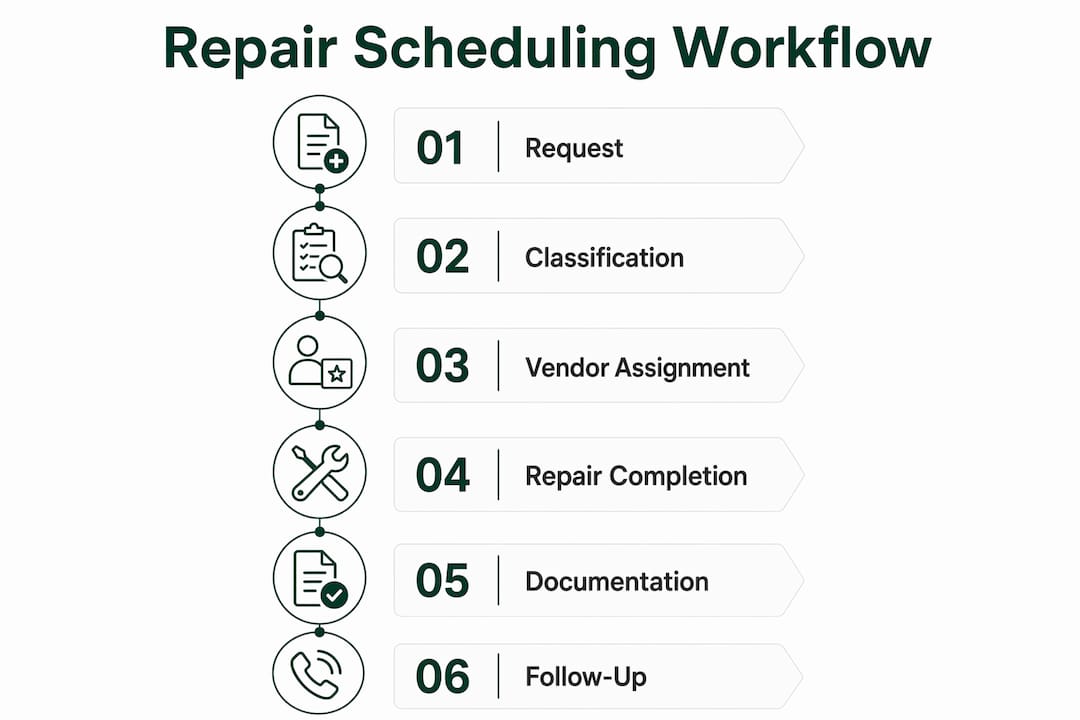
Here is the six-stage workflow that property managers use to move a window repair from request to resolution:
- Intake. Tenant submits request through the designated portal or form. The system timestamps the submission and sends an auto-confirmation.
- Triage. Automated keyword detection scans the request for terms like “broken glass” or “shattered.” Keyword-triggered alerts flag emergency issues within 60 seconds and route them to the emergency queue.
- Assignment. The system matches the request to a qualified vendor based on availability, location, and repair type. Automated vendor dispatch cuts assignment time from 4 hours to under 15 minutes.
- Scheduling confirmation. The vendor confirms the appointment window. The system notifies the tenant with the date, time, and access instructions.
- Execution. The vendor completes the repair and uploads photos and a written report through the vendor portal.
- Documentation. The system closes the work order, logs completion time, and stores all records in the tenant file.
Pro Tip: Set your automated acknowledgment to fire within 2 hours of any request. Acknowledging requests within 2 hours reduces tenant follow-up calls by up to 80%, which frees your team to focus on actual repairs rather than status updates.
The six-stage workflow model is not optional. Skipping documentation or triage leads to disputes over habitability and unpaid repairs. Every stage exists because a real failure mode occurs when it is missing.
What are best practices for communicating with tenants and vendors during scheduling?
Communication failures cause more tenant dissatisfaction than slow repairs. A tenant who knows their window repair is scheduled for thursday at 10 a.m. is far more patient than one who submitted a request and heard nothing.
Effective communication during window repair scheduling follows a clear pattern:
- Acknowledge immediately. Send an automated confirmation the moment a request is received. Include the ticket number, the urgency tier assigned, and the expected response window.
- Confirm the appointment. Once a vendor is assigned, notify the tenant with the specific date, time range, and any access requirements. If the unit needs to be vacant or a key needs to be left, say so clearly.
- Send a day-before reminder. A short automated message the evening before the appointment reduces no-shows and access issues.
- Update on completion. When the vendor closes the work order, send the tenant a completion notice and ask for a brief confirmation that the issue is resolved.
- Follow up on quality. A 48-hour post-repair check-in catches issues the vendor may have missed and signals to the tenant that you take maintenance seriously.
Pro Tip: Require vendors to upload at least two photos through the vendor portal: one before the repair and one after. This creates visual documentation that protects you in any dispute and gives you a quality check without a site visit.
Vendor communication deserves equal attention. Vendors who receive clear work orders with photos, access instructions, and contact details complete jobs faster and with fewer callbacks. A vendor portal where technicians can accept jobs, log arrival times, and submit completion reports removes the need for back-and-forth phone calls entirely.
How can property managers plan large-scale or preventive window repair projects?
Reactive repairs are always more expensive than planned ones. A broken window in january costs more to fix than the same window replaced during a scheduled fall project, because emergency labor rates and material rush fees add up fast.
Scheduling large-scale window projects months ahead of peak seasons, specifically spring and fall, gives vendors flexibility to schedule crews, order materials at standard pricing, and avoid the bottlenecks that come with reactive demand. Property managers who plan major window replacements in february for a march or april start date consistently get better pricing and faster turnaround than those who call in june after a storm.
Preventive window maintenance scheduling reduces emergency costs across the board. Key practices include:
- Quarterly IGU inspections. IGU seal failures appear as fogging between panes. Catching them during a scheduled inspection avoids the higher cost of an emergency replacement when the unit fully fails.
- Unit turn batching. When a tenant vacates, inspect every window in the unit. Cosmetic repairs, hardware replacements, and minor seal issues are far cheaper to address during a turn than after a new tenant moves in.
- Annual property-wide audits. Walk every exterior window once a year. Log frame condition, seal integrity, hardware function, and glass clarity. This audit feeds your annual maintenance budget and flags issues before they become emergencies.
- Seasonal weatherproofing checks. Before winter, verify that all window seals and weatherstripping are intact. A failed seal in november becomes a heating cost problem and a tenant complaint by december.
Budget management ties directly to proactive scheduling. When you know in march that six units need window frame rot repair by fall, you can allocate funds across quarters rather than absorbing a large unplanned expense in october.
What documentation and legal considerations matter when scheduling window repairs?
Documentation is the only legal defense a property manager has when a tenant claims a repair was ignored or delayed. Courts and insurance adjusters look for timestamps, written records, and photo evidence. Without them, your position is weak regardless of what actually happened.
Every window repair file should contain:
- Request timestamp. The exact date and time the tenant submitted the repair request, pulled directly from your intake system.
- Acknowledgment record. Proof that the tenant received a response within your stated timeframe.
- Assignment log. The date and time the work order was created and sent to the vendor.
- Vendor confirmation. Written or portal-based confirmation that the vendor accepted the job and the scheduled appointment time.
- Completion report. The vendor’s written summary, before and after photos, and the date and time the repair was finished.
- Tenant sign-off. A record that the tenant confirmed the issue was resolved, or a note explaining why sign-off was not obtained.
Failing to document repair requests and completions creates major legal liability. Proper records are the primary defense against habitability lawsuits and insurance disputes. A property manager who can produce a complete file for every repair request is in a fundamentally different legal position than one who relies on memory or scattered emails.
Integrated maintenance software automates most of this documentation. Every stage of the six-stage workflow generates a timestamped record automatically, which removes the human error risk of manual logging. The software also makes records searchable, so pulling a complete repair history for a specific unit takes seconds rather than hours.
| Documentation Element | Purpose | Risk if Missing |
|---|---|---|
| Request timestamp | Proves when issue was reported | Tenant claims delay; no counter-evidence |
| Completion photo | Confirms repair quality | Dispute over whether work was done |
| Tenant confirmation | Closes the loop on satisfaction | Reopened complaints with no resolution record |
| Vendor assignment log | Shows timely response | Habitability claim with no defense |
Key takeaways
Effective window repair scheduling requires a six-stage workflow, urgency-based triage, and complete documentation at every step to protect tenants, meet legal standards, and control costs.
| Point | Details |
|---|---|
| Urgency tiers drive timelines | Classify every request as emergency, urgent, routine, or cosmetic before assigning a vendor. |
| Single intake channel is non-negotiable | A centralized portal timestamps every request and prevents data loss from scattered channels. |
| Automation cuts assignment time dramatically | Automated dispatch reduces vendor assignment from 4 hours to under 15 minutes. |
| Proactive scheduling saves money | Plan large window projects months before peak seasons to avoid rush costs and vendor bottlenecks. |
| Documentation is your legal defense | Every repair file needs timestamps, photos, and tenant confirmation to withstand a habitability dispute. |
What I have learned from watching property managers get this wrong
After years of working with property managers across residential and commercial portfolios, the pattern I see most often is not a technology problem. It is a process problem that technology gets blamed for.
The managers who struggle most with window repair scheduling are the ones who treat every request the same. They respond to a fogged IGU with the same urgency as a broken ground-floor window, which burns out their maintenance team and still leaves tenants unhappy because nothing feels prioritized. The urgency tier system is not bureaucracy. It is the only way to allocate limited resources correctly.
The second failure I see constantly is intake fragmentation. A text here, an email there, a voicemail that gets written on a sticky note. When a tenant later claims their broken window was never addressed, there is no record to dispute it. The property management repair process lives or dies on its intake system.
What actually works is boring and consistent. A single portal, a clear tier system, automated acknowledgments, and a vendor who uploads photos when the job is done. The managers I have seen run the tightest operations are not using the most sophisticated software. They are using whatever system they have with complete discipline. Proactive scheduling, especially for seasonal window projects, is the one area where I think most managers leave the most money on the table. Planning a fall window replacement project in july instead of september is not a minor efficiency gain. It is often the difference between standard pricing and emergency rates.
— Artem
Window repair support from Star-ws for Kansas City properties
Property managers who need a reliable partner for scheduled and emergency window repairs in the Kansas City area work with Star-ws. Star Windows Solutions handles everything from commercial window replacement on large multi-unit buildings to single-unit glass repairs, with free estimates and transparent pricing that fits into a maintenance budget.

Star-ws serves both residential and commercial property portfolios, with services covering glass replacement, frame rot repair, hardware replacement, and advanced glass solutions. Whether you are scheduling a quarterly inspection batch or responding to an emergency broken window, Star-ws provides the documentation and photo records your maintenance files require. Contact Star-ws directly to discuss scheduling support for your property portfolio and get a free estimate on any window repair or replacement project.
FAQ
What urgency tier applies to a broken window?
A broken window is an emergency repair requiring vendor dispatch within hours and completion within 24 hours. It exposes the unit to weather, security risk, and injury liability.
How quickly should property managers acknowledge window repair requests?
Acknowledging requests within 2 hours reduces tenant follow-up calls by up to 80%. Send an automated confirmation immediately through your intake portal so tenants know their request is in the system.
When should property managers schedule large window replacement projects?
Schedule major window projects months before spring or fall peak seasons. Proactive scheduling gives vendors flexibility, avoids rush pricing, and prevents the bottlenecks that come with reactive demand.
What records does a property manager need for each window repair?
Every repair file needs a request timestamp, acknowledgment record, vendor assignment log, completion report with photos, and tenant confirmation. These records are the primary defense in habitability disputes and insurance claims.
What is an IGU and why does it matter for window maintenance scheduling?
An IGU (insulating glass unit) is the sealed double or triple pane assembly in most modern windows. IGU seal failures appear as fogging between panes and are best caught during scheduled quarterly inspections before they require costly emergency replacement.