
Privacy glass comes in six main forms: frosted, etched, patterned (rolled), tinted, mirrored and electrically switchable. They differ in how much they blur a view, how much daylight they pass, how they behave at night, and how much care they need. The right pick depends on the room, the direction the window faces and whether you want privacy all the time or only some of the time.
Below is a plain comparison of each type, a section on bathrooms (where most people start), maintenance notes, and a short way to test a sample before you commit.
TL;DR
- Frosted, etched and patterned glass give privacy around the clock. Tinted and mirrored glass mostly work in daylight and fade once lights go on inside.
- For a bathroom window, frosted or satin-style glass is the usual starting point, and patterned glass is a strong second choice.
- Switchable (smart) glass gives you clear and private on demand, but it is powered, so ask about certification, wiring and the grade of the product before ordering.
- Textured glass collects grime and frosted glass shows fingerprints, so think about cleaning before you choose the look.
- Look at a full-size sample in the actual room, at night and in daylight, before you order.
Table of Contents
- The main privacy glass types at a glance
- Frosted glass
- Etched glass
- Patterned and rolled glass (the obscure glass family)
- Tinted and mirrored glass
- Switchable (smart) privacy glass
- Which glass is best for a bathroom window?
- Cleaning and durability: what each type asks of you
- Privacy is not the only job a window does
- How to test privacy before you buy
- Our perspective
- Get privacy glass installed in Kansas City
- FAQ
- Sources
The main privacy glass types at a glance
Residential privacy glass includes tinted, frosted, etched, rolled, patterned, mirrored and electronically switchable glass. The table puts them side by side. Treat the privacy ratings as relative: they describe how the types compare, not a lab score.
| Type | How it works | Privacy by day | Privacy at night | Daylight | Upkeep |
|---|---|---|---|---|---|
| Frosted | Surface treatment that blurs images | High | High | Reduced compared with clear | Shows fingerprints and smudges |
| Acid-etched | Chemically matte surface that diffuses light | High | High | Stays high on low-iron glass | Needs gentle cleaners |
| Patterned / rolled | Texture pressed into the glass as it is made | Low to high, depends on pattern | Same as day | Diffused | Texture can hold dirt |
| Tinted | Color in the glass body limits what you see from outside | Moderate | Poor with lights on | Reduced | Easy, like clear glass |
| Mirrored | Reflective surface | High | Poor with lights on | Reduced | Coating care required |
| Switchable (PDLC) | Electric current switches it between frosted and clear | On demand | On demand | Clear when on | Powered, wiring needed |
Frosted glass
Frosted glass blurs what is behind it. You see light and shapes, not faces or details. It admits less daylight than clear glass, but far more than a curtain or a closed blind, which is why it is a favorite for bathrooms, entry sidelights and interior doors.
Its weak spot is touch. The same source notes that frosted glass can show fingerprints, dust and smudges, and can be harder to clean than ordinary glass. On a window you rarely touch that matters little. On a shower door or a pantry door it matters a lot.
Frosted can also be done without replacing the glass. A frosted film applied to an existing pane is a low-cost way to test the look, and how window clings hold without glue is worth understanding if you want something removable for a rental or a temporary space. Film is not a permanent substitute for a glass unit, though. If the glass is already fogged, cracked or failing, replacing the unit solves both problems at once.
Etched glass
Etching uses acid or abrasion to give the surface a fine matte finish. Acid-etched glass is smoother and more uniform than most frosted looks, and it has a quieter, more refined appearance.
There is a technical point worth knowing. Vitro Architectural Glass explains that when acid etching is specified on a low-iron base glass, it gives a more color-neutral, visually consistent matte finish that keeps high visible light transmission. In plain terms: standard glass has a slight green edge, and low-iron glass removes it, so the etched surface looks whiter and lets through more light. If you are privacy-glazing a dark hallway or a small bathroom, that extra light is the reason to ask for it.
People often use “frosted” and “etched” interchangeably, and many suppliers do too. Ask exactly how the finish is made, whether it is on one or both sides, and how it should be cleaned.
Patterned and rolled glass (the obscure glass family)
Patterned glass, also called rolled, figured or obscure glass, is made by shaping molten glass between two metal surfaces so a texture is embossed into it. That texture bends light in different directions and hides what is behind it.
This is the widest family, so the choice matters:
- Fine, dense textures (often sold under names like rain, delta frost or glue chip) hide almost everything while passing a lot of light.
- Linear patterns such as reed or fluted glass blur shapes in one direction. They look modern, and privacy depends on how tightly spaced the lines are and how far the person is from the glass.
- Decorative or heavy patterns (Flemish and similar) give the highest obscurity and a traditional look, often seen in older homes and entry doors.
The general rule: the more complex the pattern, the more privacy. The tradeoff is maintenance. Textured rolled glass can collect dirt and grime and need more frequent cleaning.
In a replacement window, patterned glass is one of the easiest upgrades, because the sealed unit is simply made with the patterned lite on the interior or exterior side. Ask which face carries the texture, because that decides how easy it is to wipe down.
Tinted and mirrored glass
This is the answer to a common question: is privacy glass the same as tinted windows? No. Tinting is one privacy option among several, and it behaves differently. Tinted glass can make it difficult to see inside during the day but loses some effectiveness at night when your interior lights are on. Mirrored glass follows the same logic: great in daylight, much less so after dark.
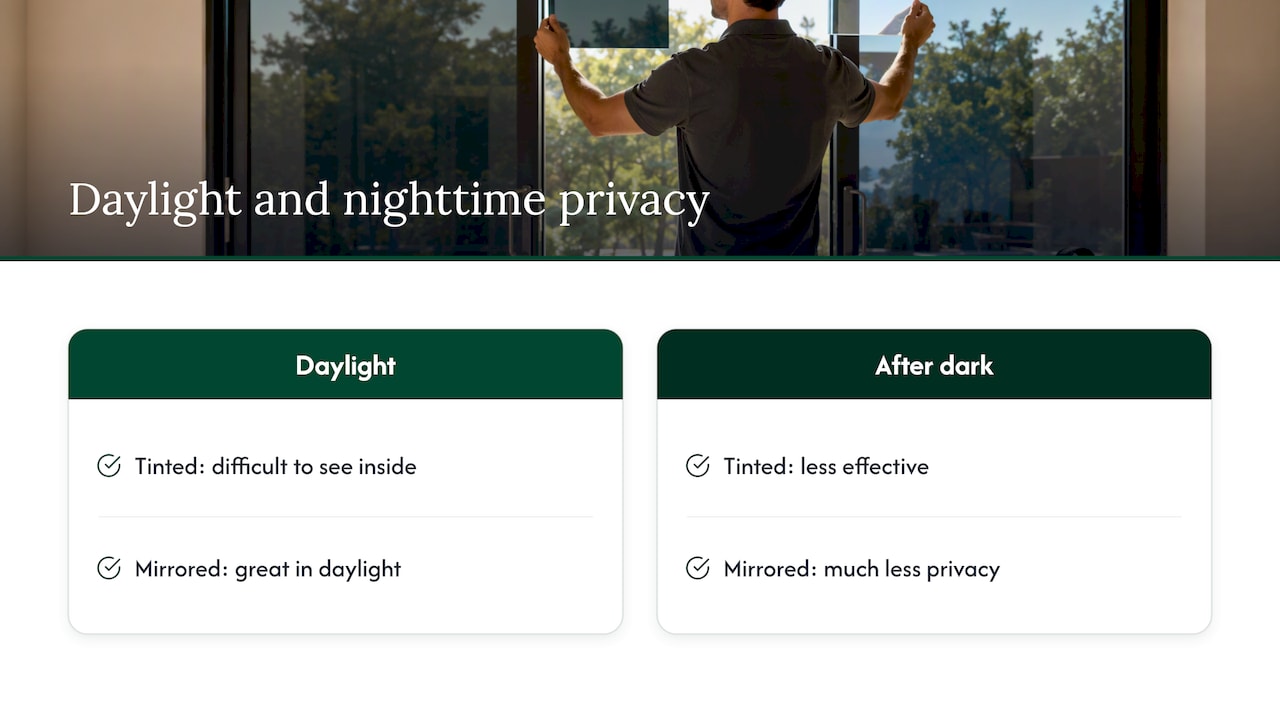
That makes both a poor fit for a bathroom or bedroom, and a decent fit for a south-facing office, a storefront or a sunroom where the main goal is daytime glare and curb-side visibility.
One detail on how tint is made: body-tinted glass uses metal oxides dispersed through the glass itself, and it is non-conductive and does not interfere with radio waves, unlike some metallic film applications. If you rely on a strong cell signal inside, that is a reason to prefer tint in the glass over a metallic film.
Switchable (smart) privacy glass
Switchable glass uses polymer dispersed liquid crystal (PDLC) technology. With power off, the crystals scatter light and the glass looks frosted. With power on, they align and the glass turns clear. For homeowners this means a bathroom window or shower partition that is private when you need it and see-through when you do not.
Before you order, check four things:
- Power-off state. Most PDLC products are frosted without power. Confirm what it looks like during an outage.
- Certification. Ask for the electrical listing of the product (such as ETL or UL) and confirm the installation meets the National Electrical Code.
- Grade. Film laminated into glass and cheaper add-on film are not the same thing in clarity, haze or lifespan.
- Wet areas. Ask the installer how edges, wiring and the driver are protected from moisture in a bathroom.
Smart glass can go almost anywhere in a home, but it costs more than every other option in this article. For a real number, see our breakdown of Kansas City smart glass pricing and the per square foot switchable glass cost guide. For how it behaves day to day, our installer perspective on smart glass windows covers what homeowners and property managers ask most.
Which glass is best for a bathroom window?
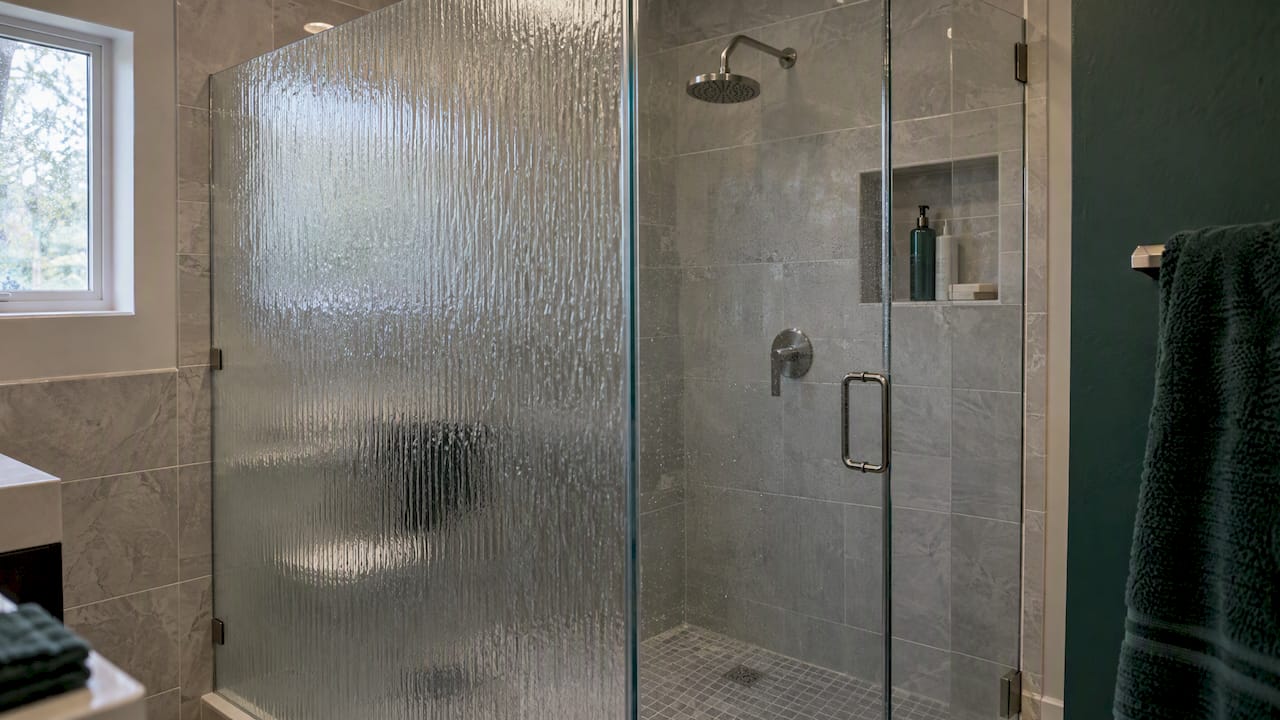
For most bathrooms, frosted or satin-etched glass is the safest answer: it gives full privacy day and night with a clean look, and it is commonly used in bathroom windows and shower partitions. Patterned glass is also used for bathroom windows and shower screens, and it hides more at close range and hides smudges better than a smooth frosted finish.
Use this quick guide:
- Small window over a tub or shower: fine pattern or acid-etched glass. Choose a finish that wipes clean after steam and soap.
- Window facing a neighbor close by: dense pattern or etched. Avoid tint alone, since the lights are on when you use the room at night.
- Window in a room you also want to view out of at times: switchable glass.
- Rental or short-term fix: frosted film now, replacement later.
Showers need safety glass
If the glass is part of the shower enclosure itself, this is a safety question as much as a style one. The National Glass Association notes that safety glazing is often required by building codes for shower enclosures, with impact requirements such as Category II of CPSC 16 CFR 1201. The same guide says patterned glass in frameless showers should be installed with the smooth side facing inward so it is easier to clean and collects less debris. Your local code and the installer decide what applies to your project, so ask for glass marked as safety glazing before you sign.
Cleaning and durability: what each type asks of you
Privacy glass is a cleaning decision as much as a design one.
- Patterned glass: wipe with a soft cloth and mild soap. Deep textures trap grime, so choose a smoother pattern for kitchens and baths.
- Frosted glass: expect fingerprints on any surface you touch. Place the frosted face where hands do not reach.
- Etched glass: treat it gently and test any product on a small corner first.
- Tinted and mirrored glass: clean like regular glass, but watch for coatings.
- Switchable glass: use soft, non-abrasive wipes, and keep water away from the edges and electrical connections.
The NGA’s cleaning guidance is clear on what to avoid: abrasive cleaners, acidic or vinegar-based solutions and bleach can cause irreparable damage to glass surfaces or protective coatings. That includes the popular vinegar-and-water recipe, which is worth knowing if your cleaning routine leans on it.
If you are not sure whether a reflective coating sits on a given surface, the NGA describes a simple pencil test: if the pencil’s reflection meets the pencil point, the coating is on that side. Know that before you scrub. The same guidance says regular cleaning prevents surface damage, with frequency depending on site conditions.
Privacy is not the only job a window does
Glass has to balance several functions at once. Industry technical updates describe the trade between daylighting, energy efficiency, acoustics, privacy and safety. A few practical consequences:
- Light: every privacy finish costs you some clarity. Etched on low-iron glass loses the least.
- Energy: privacy treatment is usually added to a sealed insulated unit. Ask your installer whether the privacy lite changes the unit’s performance, and ask for the numbers in writing.
- Security: privacy is not protection. If you also want break-in resistance, ask about laminated glass for security.
- Fire and code: in some commercial walls and corridors, fire-rated glazing may be required, and it is a separate product from decorative privacy glass. See our page on fire-rated glass in Kansas City.
How to test privacy before you buy
A catalog photo tells you little. Do this instead:
- Get a full-size sample and hold it in the actual window opening.
- Check it in daylight and at night with the room lights on. This is where tint and mirrored glass fail.
- Stand outside at the distance a neighbor or passer-by would be. Patterns that look opaque at six inches can show silhouettes at ten feet.
- Look at it with the sun behind and in front of the glass. Backlighting reveals shapes.
- Wipe it. Smudge it with a finger and clean it the way you would at home.
Our perspective
Most privacy glass calls we get start with a style question and end with a practical one. Someone wants a frosted look, then realizes the window is cracked, the seal has failed and fogged, or the frame is soft from rot. Putting new privacy glass into a failing window wastes money, so we look at the frame, the seal and the hardware first.
Our view is simple. For most bathrooms, pick a patterned or etched glass that is easy to wipe, and put the smooth face where you will clean it. Save switchable glass for places where you truly want both states, such as a bathroom that borders a bedroom, a conference room or a street-facing shower. Treat privacy and security as separate jobs, and buy each one on purpose.
We also like doing the whole job with one crew: glass, frame repair, hardware and caulking, so you are not coordinating three vendors. That is the reason we offer standard and specialty glass, from privacy patterns to smart glass, under one roof.
— Artem
Get privacy glass installed in Kansas City
If you want privacy glass in a home or commercial building in the Kansas City area, we offer free estimates and financing options. We replace glass in existing frames, replace whole windows and doors, repair rotted framing, and install smart glass in Kansas City. If a window is only tired, our Tune Up Your Windows service starts from $99. See our glass replacement services, or go to the Star Windows Solutions services page to request an estimate.
For offices and shops, our commercial storefront doors and windows team handles privacy glazing for conference rooms, medical offices and entrances.
FAQ
Is privacy glass the same as tinted windows?
No. Tinted glass is one type of privacy glass, and it works mainly in daylight. At night, with lights on inside, people outside can often see in. Frosted, etched and patterned glass hide the view in both conditions.
Which glass is best for a bathroom window?
Frosted or satin-etched glass is the usual choice, because it gives privacy day and night and looks clean. Patterned glass is a good alternative if you want to hide smudges or need stronger obscurity. If the glass is part of a shower enclosure, make sure it is safety glazing under your local code.
Does frosted glass block light?
It lets in less light than clear glass, but it still brightens a room far more than a curtain or closed blind. Acid-etched glass made on a low-iron base keeps visible light transmission high, so it is the better pick for dark or small rooms.
Is smart glass worth it for a bathroom?
It is worth it when you want a clear view some of the time and privacy the rest. It costs more than frosted or patterned glass and needs power, so check the product’s electrical certification, how it looks without power, and how the installer protects the connections from moisture.
Can I add privacy to a window I already have?
Yes. Frosted film is a low-cost way to add privacy to existing glass, and it is a good way to test a look. If the glass is fogged, cracked or the frame is rotting, replacing the glass or window is the better long-term fix.
Sources
- What is Residential Privacy Glass?
- Low-Iron Acid-Etched Glass, Vitro Architectural Glass
- The Evolution of Tinted Glass, Vitro Architectural Glass
- Frameless Shower Enclosures Design Guide, NGA
- Proper Procedures for Cleaning Architectural Glass Products, NGA
- Balancing the Many Functions of Glazing, NGA