
Expect to pay between $50 and $150 per square foot installed for smart glass in the Kansas City area, with most homeowners landing near $100 per square foot depending on technology and window size. Retrofit smart film sits at the low end of that range, while factory-integrated smart glass and electrochromic panels push toward the top. Star Windows Solutions offers free on-site estimates for both residential and commercial projects across the metro.
TL;DR:
- Kansas City homeowners should expect to pay roughly $70 to $120 per square foot for installed smart glass, depending on technology and project complexity.
- Factory-integrated systems tend to be more expensive than retrofit films, due to involved fabrication and longer lead times, especially for custom shapes or large projects.
- PDLC film offers a low-cost, quick solution for privacy needs, while electrochromic glass provides longer-term solar control at higher prices.
- Price differences between bids often stem from electrical and installation costs, which can add 20 to 40 percent to the overall project budget.
- Accurate quotes require on-site measurements, clear itemization of costs, and consistent questions about warranties, lead times, and electrical requirements.
Table of Contents
- How much does smart glass cost in Kansas City?
- What are the different types of smart glass and film?
- What drives the price on a smart glass quote?
- How long does smart glass installation take in Kansas City?
- How do you get an accurate local quote?
- How does Star Windows Solutions price smart glass projects?
- What actually matters when you’re comparing smart glass quotes
- Ready to get a firm number for your project?
- Sources
How much does smart glass cost in Kansas City?
Material-only smart film runs cheaper than most people expect, but the installed number is what actually matters for budgeting. Nationally, installed smart glass typically ranges from $50 to $150 per square foot, with many quotes clustering around $70 to $120 depending on the technology and the complexity of the install. Factory-integrated systems, where the smart layer is sealed inside the insulated glass unit itself, commonly land between $70 and $150 or more per square foot because the fabrication process is more involved than applying a retrofit film.
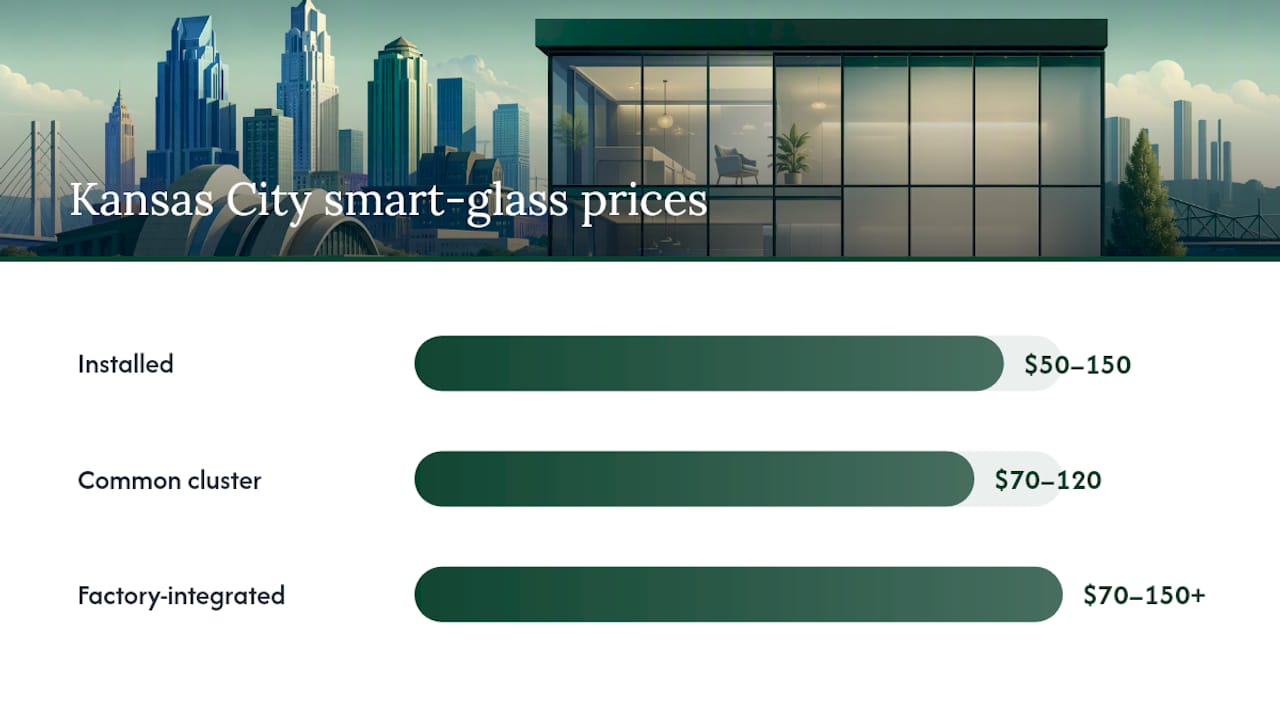
Kansas City buyers should expect the middle of that range rather than the extremes. Local labor rates run below coastal markets, but shipping smart glass panels and specialty film from out-of-state fabricators adds lead time and sometimes freight cost that nudges the total upward.
Here is a generalized estimate example for three common window sizes based on typical national per-square-foot ranges, scaled accordingly.
A few things move those numbers around in practice:
- Custom shapes (arched, angled, or oversized panels) add fabrication time and cost.
- Multi-window commercial storefronts often qualify for volume pricing on materials.
- Fabrication and shipping lead times for factory-integrated units can stretch several weeks longer than a local film retrofit.
What are the different types of smart glass and film?
Not every “smart glass” product does the same job, and the price tag reflects that. Smart tint film is the retrofit option applied directly to existing glass. PDLC (polymer dispersed liquid crystal) film or panels flip between clear and frosted at the flick of a switch, making it the go-to for privacy. SPD (suspended particle device) glass tints gradually and controls glare more precisely. Electrochromic glass changes tint using a low electrical charge and is the slowest but most gradual option, often used for solar control.
- Smart tint film: cheapest, retrofit-friendly, good for quick privacy upgrades.
- PDLC: fast on/off privacy switching, popular for bathrooms and conference rooms.
- SPD: finer tint control, better for glare and solar management.
- Electrochromic: highest cost, best long-term solar and energy performance.
For a Kansas City bathroom or a storefront that needs privacy on demand, PDLC film usually wins on value. West-facing windows baking in summer sun are a better match for SPD or electrochromic glass, since factory-integrated panels cost more but perform better against heat gain over time.
Pro Tip: If you’re only trying to solve a privacy problem, don’t pay for full electrochromic glass. Retrofit PDLC film solves it for a fraction of the cost and installs in a day.
What drives the price on a smart glass quote?
A clean quote breaks down into distinct line items, and knowing them helps you compare bids apples to apples instead of guessing which installer is padding their number.
- Material cost — the film, panel, or IGU itself, priced per square foot.
- Fabrication — cutting, laminating, or sealing the smart layer into glass.
- Labor — removal of old glass or sash, mounting, and sealing.
- Electrical and controls — wiring, transformers, switches, or app integration.
- Shipping — freight for specialty panels, often quoted separately.
- Permits — rarely required for glazing alone, but commercial jobs may need electrical permits.
- Disposal — removal and hauling of old glass or sashes.
Labor and electrical work commonly add 20 to 40 percent to the total installed cost, which is the single biggest reason two quotes for the “same” glass can differ by hundreds of dollars.
When you request quotes, ask for material-only and fully-installed pricing as separate lines. That split shows you exactly what you’re paying for labor and controls, and it makes future smart-home integration easier to plan since electrical scope is already spelled out. Always ask what warranty covers the electrical components separately from the glass itself. Some fabricators offer bulk material discounts on larger orders, but installation and transformer setup are almost always quoted on top of that material price.
How long does smart glass installation take in Kansas City?
A retrofit film job on existing windows usually wraps up in one to three days, since it doesn’t require removing sashes or frames. A full smart glass replacement, where the entire window unit is swapped out, typically takes one to two weeks once you include fabrication lead time. That lead time is often the real bottleneck, not the on-site labor.
A few things commonly complicate timelines and cost:
- Second-floor or hard-to-access windows add labor time and sometimes equipment rental.
- Custom shapes or non-standard sizes extend fabrication scheduling.
- Concealed wiring for a cleaner look adds electrical labor hours.
- Transformer placement and zoning matter more on commercial storefronts with multiple panels.
- Permits are rarely needed for glazing work alone, but commercial buildings may require electrical permits or building department sign-off.
How do you get an accurate local quote?
The lowest bid isn’t always the best value, especially once you factor in warranty coverage and how the electrical work is scoped. A few steps make quotes genuinely comparable.
- Measure each window opening and photograph the frame condition. Rot or warping affects both cost and whether retrofit film is even viable.
- Request an on-site measurement instead of relying on phone estimates. Frame condition changes the labor number more than most homeowners expect.
- Ask each installer the same set of questions: expected lead time, where the transformer will be mounted, whether controls integrate with existing smart-home systems, what the warranty covers, and whether financing is available.
- Compare itemized quotes, not single lump-sum numbers, so you can see where labor, electrical, and material costs land separately.
Pro Tip: Walk away from any quote that’s a single line item with no breakdown. A vendor unwilling to separate material from labor and electrical is usually hiding where the markup lives.
Watch for red flags: vague or verbal-only warranties, no site visit before quoting, missing electrical scope on a project that clearly needs wiring, or pressure to sign before you’ve gotten a second bid. Homeowners commonly use contractor-matching apps to gather multiple local quotes before committing, which is a reasonable way to sanity-check pricing before calling installers directly.
How does Star Windows Solutions price smart glass projects?
Star Windows Solutions builds quotes around the same four buckets serious homeowners should expect from any installer: materials, installation labor, electrical and controls, and warranty coverage. That structure makes it straightforward to see exactly what you’re paying for and to compare against other bids.
- Free on-site estimates for both residential and commercial smart glass projects in the Kansas City area.
- Financing options available for larger installations, including full storefront or multi-window jobs.
- Warranty terms provided upfront, covering glass and, where applicable, electrical components.
For homeowners weighing a bathroom privacy upgrade against a business owner planning a storefront retrofit, that itemized approach at Star Windows Solutions’ smart glass page removes most of the guesswork before you even schedule a visit.
What actually matters when you’re comparing smart glass quotes
Most pricing guides hand you a national range and call it a day. That’s not wrong, but it’s incomplete for anyone trying to budget a real project in Kansas City, because the range hides more than it reveals. A $50 per square foot quote and a $150 per square foot quote can both be honest numbers. They’re just describing different products, different labor scopes, and different warranty terms.
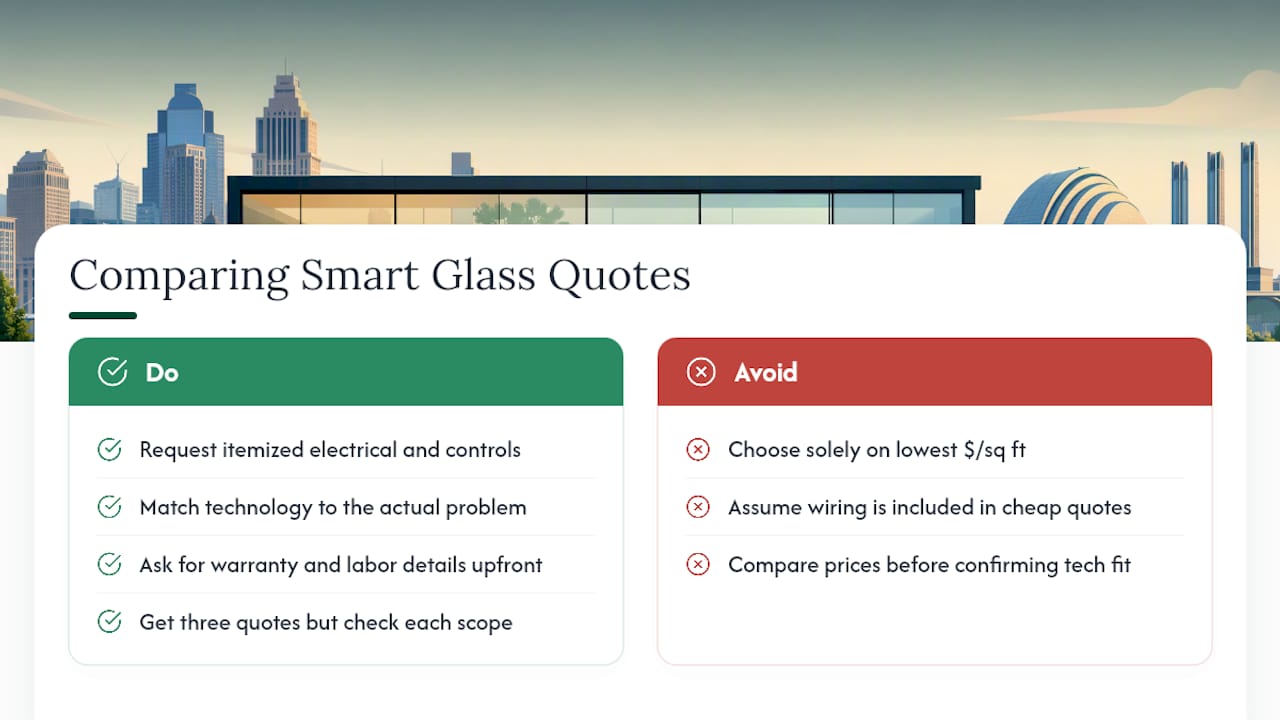
The conventional advice, get three quotes and pick the middle one, misses the actual lever that matters: whether each quote itemizes electrical and controls separately from the glass itself. A cheap material quote with a vague electrical line item can end up costing more once wiring and transformer work get added mid-project. Homeowners who ask for that breakdown upfront consistently avoid the change-order surprises that inflate final invoices.
If there’s one thing to prioritize, it’s this: match the technology to the actual problem before comparing prices. A bathroom that needs privacy doesn’t need electrochromic solar control, and a west-facing storefront baking in July sun doesn’t need PDLC film that does nothing for heat gain. Get the technology right first. The price comparison only makes sense after that.
— Artem
Ready to get a firm number for your project?
Star Windows Solutions turns these national pricing ranges into an actual number for your address, not a rough estimate pulled from a national average. If you’re comparing a retrofit film upgrade against a full smart glass replacement, the fastest way to know which one fits your budget is a free on-site estimate rather than guessing from a per-square-foot chart.
Before you call, snap a few photos of the windows you’re considering and jot down rough measurements. That alone speeds up the quote process. On the visit, ask directly about financing options and what the warranty covers on both the glass and the electrical components. If your project also touches frame condition or an older sash that needs attention, it’s worth mentioning during the same visit since window glass replacement and smart glass upgrades are often bundled into one job. Commercial property managers coordinating a storefront retrofit can request the same itemized approach for multi-panel jobs.
Ready to see what your project actually costs? Request a free estimate for smart glass installation and get a quote built around your windows, not a national average.
Sources
- How Much Does Smart Glass Cost? 2026 Data | Angi
- Smart Glass Windows Cost (2026): Price per Sq. Ft. + Key Factors
- Smart Glass Cost Per Square Foot: Practical Price Range and Drivers 2026 – Current Cost