
No federal tax credit exists for windows placed in service in 2026. The 25C Energy Efficient Home Improvement Credit ended for any property installed after December 31, 2025. If you installed qualifying windows in 2025, you can still claim a tax credit covering a portion of the product cost, up to a capped maximum, on the return you file in 2026. Gather your paperwork now, or start checking state and utility rebates for 2026 work.
TL;DR:
- The federal tax credit for windows expired after December 31, 2025, so only windows installed in 2025 or earlier qualify for the 25C credit.
- Qualifying windows must be ENERGY STAR Version 7.0 Most Efficient models, certified with NFRC labels, manufacturer PINs, and itemized invoices separating material from labor costs.
- The IRS credit covers 30% of product costs up to a maximum of $600 per year, with a total cap of $1,200 for all building envelope improvements annually.
- Filing must be based on the installation date; installing in 2026 or later disqualifies the federal credit, regardless of purchase date.
- For 2026 projects, homeowners should prioritize utility rebates, which often offer higher incentives, require pre-approval, and depend on specific product thresholds.
Table of Contents
- What Changed for 2026: The Law and the Timeline
- Which Windows Actually Qualified
- How the 30% Calculation and Caps Actually Work
- Filing Form 5695: Timing and the Documentation Checklist
- Where to Look Instead for 2026 Window Projects
- Common Mistakes That Cost Homeowners Money
- How Star Windows Solutions Approaches Window Projects in 2026
- What Homeowners Should Actually Prioritize Now
- Get Documentation Handled Right From the Start
- Sources
What Changed for 2026: The Law and the Timeline
Congress moved the sunset date for the windows and skylights credit up to December 31, 2025, cutting short what many homeowners assumed would run for a longer period. ENERGY STAR’s guidance confirms the credit applied only to products purchased and installed between January 1, 2023, and December 31, 2025. After that window closes, there’s no federal 25C credit for windows, period, regardless of how efficient the product is.
The phrase that trips people up is “placed in service.” It doesn’t mean the date you signed a contract or paid a deposit. It means the date installation was complete and the window was actually functioning in your home. A window ordered in November 2025 but installed in January 2026 does not qualify. A window installed on December 30, 2025, does.
That date determines which tax year you file for, not the year you happen to be filing in:
- Installed in 2023, 2024, or 2025: you claim it on that specific year’s return using IRS Form 5695.
- Installed in 2026 or later: no federal window credit exists, full stop.
- Filing a 2025 return in early 2026: this is exactly the scenario where late-2025 installs still qualify.
If your contractor’s invoice shows a 2025 completion date but you’re only now filing, you’re not too late. You’re right on schedule.
Which Windows Actually Qualified
Not every energy-efficient window met the bar. The federal credit required products certified under ENERGY STAR Version 7.0, specifically models meeting the Most Efficient tier rather than the base ENERGY STAR label. That distinction matters because plenty of “ENERGY STAR qualified” windows sold at big-box stores never cleared the Most Efficient threshold, which sets tighter U-factor and solar heat gain coefficient (SHGC) limits by climate zone.
Three pieces of documentation prove eligibility, and homeowners routinely lose the credit by missing one of them.
- The NFRC label: photograph it before installation crews haul away the packaging. You need the U-factor, SHGC, and the climate-zone performance grid printed on the sticker.
- The manufacturer PIN or QMID: this is the product identification number tying your specific window model to its ENERGY STAR certification. It usually appears on the invoice, the product spec sheet, or a manufacturer certification statement your installer can request.
- An itemized invoice: it has to separate product cost from labor cost. The IRS only credits the window itself.
That labor exclusion catches people off guard almost every filing season. If your invoice reads “$14,000 for windows” as one lump sum, you cannot substantiate the 30% calculation, because you don’t know what portion was material versus installation.
Pro Tip: Ask your installer for a manufacturer certification statement at the time of purchase, not months later during tax season. Some manufacturers stop issuing them for discontinued models, and hunting for a PIN after the fact can cost you weeks.
How the 30% Calculation and Caps Actually Work
The math is straightforward once you separate the pieces. The IRS credit pays 30% of the qualifying product cost, capped at $600 for windows and skylights combined. That $600 figure sits inside a larger $1,200 annual cap covering all “building envelope” improvements, insulation, doors, and windows together, and windows and skylights can’t exceed their own sub-cap within that envelope.
Two examples show how this plays out:
- Single-window replacement: a $1,500 ENERGY STAR Most Efficient window, product cost only. 30% of $1,500 is $450, under the $600 cap, so you claim the full $450.
- Whole-house replacement: $8,000 in qualifying product costs across 12 windows. 30% of $8,000 is $2,400, but the windows/skylights cap stops you at $600 regardless of how much product you bought.
The credit is nonrefundable. If your tax liability for that year is smaller than your credit, you lose the difference. There’s no carryforward to next year and no refund check for the unused portion, which is why phasing large projects across two tax years sometimes captured more total credit than doing everything at once, back when the credit was still active.
Filing Form 5695: Timing and the Documentation Checklist
You claim the credit on IRS Form 5695, filed with your federal return for the exact tax year the windows were placed in service. If you installed in 2025 and haven’t filed yet, this is your form. If you already filed your 2025 return without claiming it, you can amend.
Before you sit down with a preparer or tax software, pull together five things:
- An itemized invoice showing product cost separately from labor cost.
- Photos or copies of the NFRC label from each installed window.
- The manufacturer PIN or QMID for the specific model installed.
- A manufacturer certification statement confirming ENERGY STAR Most Efficient status.
- Written confirmation from your installer of the completion date.
The most common filing mistakes are entirely avoidable. People claim the wrong tax year because they go by purchase date instead of installation date. They lose the credit because nobody photographed the NFRC label before the old windows and packaging went to the dump. They lump labor into the product cost and either overclaim or get flagged.
On recordkeeping, the IRS generally recommends keeping tax records for at least three years from the filing date, longer if you underreported income or filed a claim for a loss. For a credit tied to physical documentation like NFRC labels, keep everything for at least that long. Digital photos in a labeled folder beat a shoebox of paper receipts every time an auditor actually asks.
Where to Look Instead for 2026 Window Projects
With the federal credit gone, DSIRE remains the best public database for finding state and utility incentives that still exist. It’s maintained for exactly this purpose: tracking programs that come and go by state, utility territory, and even zip code.
Utility rebate programs work differently than the old federal credit did, and the rules vary by provider:
- Many require pre-approval before you sign a contract, sometimes within a specific window after installation.
- Rebates often apply only when a participating contractor performs the work, not any licensed installer.
- Programs frequently set their own U-factor thresholds that differ from ENERGY STAR Most Efficient criteria.
- Rebate amounts vary widely, from flat per-window credits to percentage-based formulas similar to the old federal structure.
Income-qualified programs deserve a separate look. The Weatherization Assistance Program (WAP) and newer Home Efficiency Rebates target lower-income households and often cover a larger share of project cost, but they come with income verification and application lead times that can stretch weeks or months.
Pro Tip: Call your utility before you order windows, not after. Several programs require proof of pre-approval dated before installation begins, and a rebate claimed after the fact gets denied no matter how qualified the product is.
Ask any contractor quoting your job to confirm in writing whether their crew is on your utility’s approved list and whether the products they’re proposing meet the specific U-factor your utility requires.
Common Mistakes That Cost Homeowners Money
The errors that sink claims are almost always avoidable with a little planning. Claiming labor costs alongside product costs is the single most common one. Installing outside the qualifying date window, then trying to claim it anyway, is the second. Missing PIN documentation or NFRC labels is the third, and it’s the hardest to fix retroactively once old windows are gone.
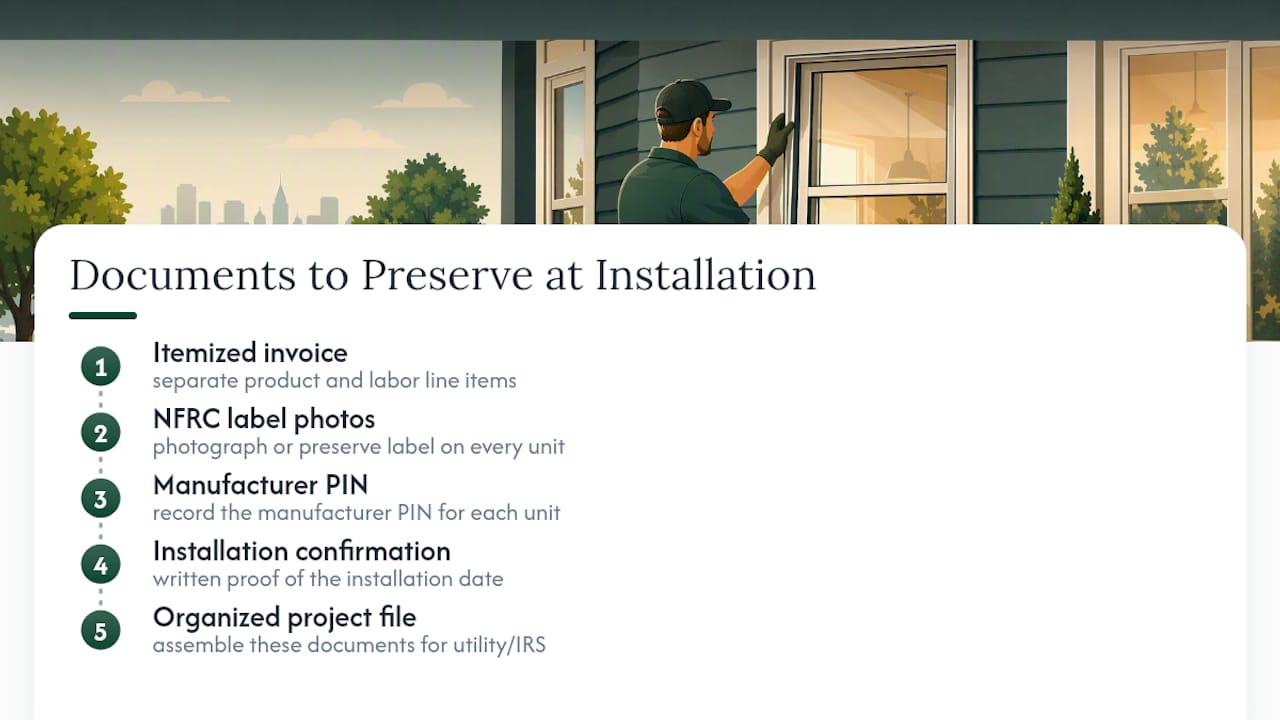
Before installation day, request that your contractor photograph or preserve the NFRC label on every unit and provide an invoice itemized by product versus labor. If a utility or the IRS later asks for proof, you need exactly those documents: the itemized invoice, label photos, the manufacturer PIN, and written confirmation of the installation date. Homeowners who assemble this file at the time of installation rarely have trouble later. Homeowners who wait until tax season almost always do.
How Star Windows Solutions Approaches Window Projects in 2026
Even without a federal credit on the table for new installs, the paperwork habits that used to support 25C claims still matter for utility rebates and for your own records. Star-ws builds documentation into the installation process rather than treating it as an afterthought.
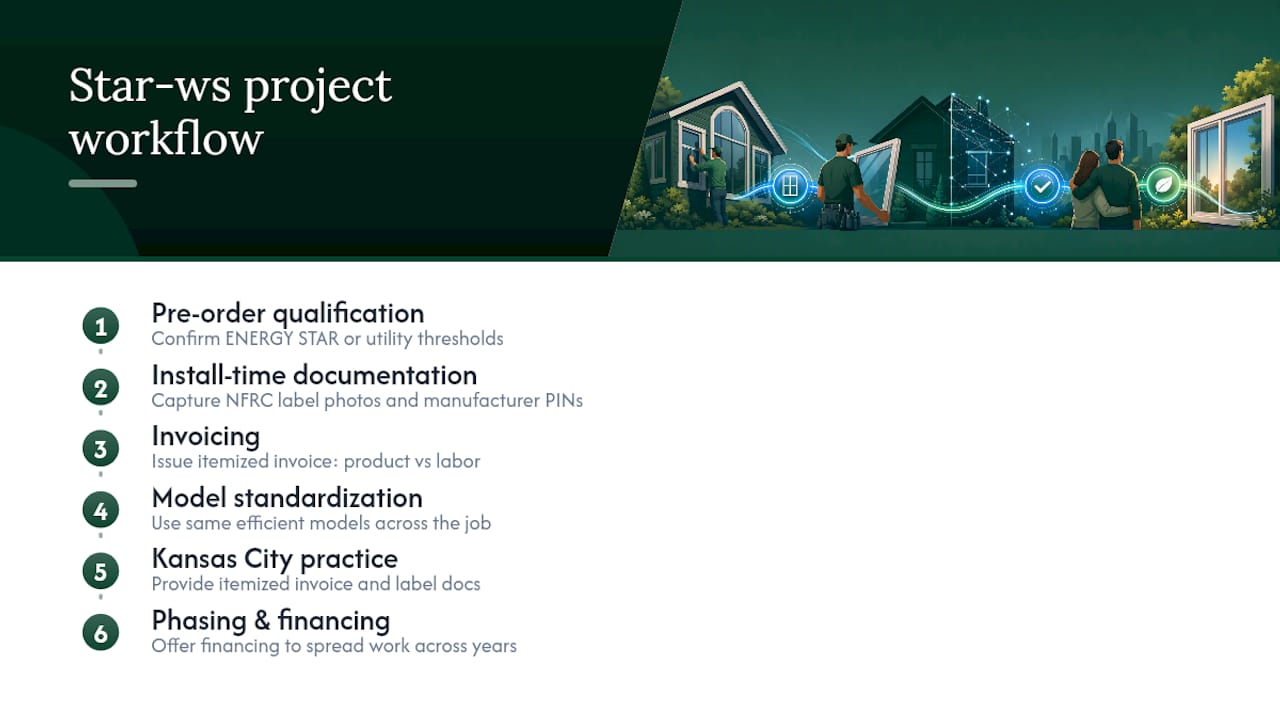
That means confirming which models qualify for ENERGY STAR Most Efficient or your utility’s specific threshold before ordering, capturing NFRC label photos and manufacturer PINs at the time of install, and issuing invoices that separate product cost from labor cost by default. For homeowners planning a multi-window or whole-house project, standardizing on efficient models across the job also simplifies rebate applications, since utilities often want consistent U-factor documentation across every unit.
Kansas City homeowners working with Star-ws get an itemized invoice and label documentation as standard practice, whether or not a rebate program is involved. If you’re planning to spread a larger project across two calendar years to manage cost or match utility program cycles, financing options can help you phase the work without waiting on a full year’s savings first.
What Homeowners Should Actually Prioritize Now
The federal credit’s expiration gets treated online like a tragedy, and honestly, it’s overblown. Six hundred dollars on a window project running into the thousands was never the deciding factor for most homeowners, it was a nice bonus. The bigger financial lever, both before and after the sunset, was always product quality and correct installation, not a tax form.
Where I think the conventional advice falls short: most guides obsess over squeezing every dollar out of expired federal caps while glossing over the fact that utility rebate programs frequently pay more per project and remain active right now. DSIRE searches take fifteen minutes. Too few homeowners bother.
If you installed in 2025, your priority is simple: get the PIN, the label photo, and the itemized invoice before you file, then move on. If you’re planning 2026 work, skip the nostalgia for 25C and call your utility first. That single phone call, made before signing a contract, does more for your budget than any federal form ever will.
— Artem
Get Documentation Handled Right From the Start
Star-ws is the straightforward alternative to piecing together your own paperwork after the fact for a window project in the Kansas City area: model verification, itemized invoices, and NFRC label documentation happen automatically as part of the installation, not as a scramble before tax season or a rebate deadline.
Whether you need a full commercial window replacement or a smaller residential upgrade, Star-ws provides free estimates and financing options for Kansas City area homeowners and property managers. This is local, hands-on service, not a national rebate processing outfit, which means the person documenting your installation is the same person who did the work. If you’re weighing a 2026 project, request a free estimate through Star-ws and ask about ENERGY STAR Most Efficient options before you commit to a contractor.