
Window film is defined as a thin polyester laminate applied directly to glass surfaces to hold shattered fragments together after breakage, reducing injury risk and slowing forced entry. The role of window film after breakage is not to prevent glass from shattering. Its job is to manage what happens next. Two distinct categories exist: safety film, which meets ANSI Z97.1 and CPSC 16 CFR 1201 standards for fragment retention, and security film, which adds forced-entry delay through greater thickness and perimeter attachment systems. Choosing the wrong type, or skipping the attachment system entirely, leaves a property exposed in ways most homeowners never anticipate.
How does window film hold broken glass together?
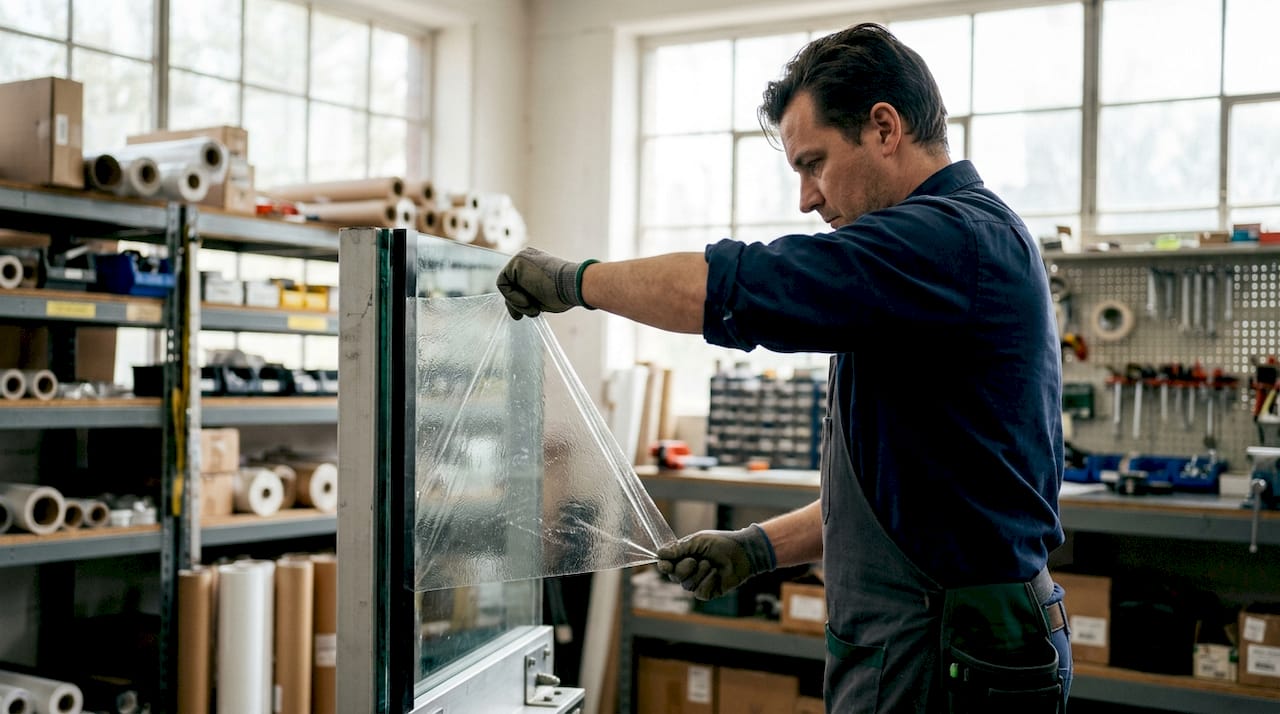
Window film holds broken glass together through a combination of multi-layer polyester construction and a pressure-sensitive adhesive that bonds directly to the glass surface. When an impact fractures the glass, the film stretches and absorbs energy rather than tearing apart. The shards stick to the adhesive layer instead of scattering across the floor or flying toward people nearby.
Multi-layer polyester security films adhere glass shards to the film, reducing flying debris and injury risk after breakage. That adhesion is what separates a filmed window from an unfilmed one: the glass breaks, but it stays in place rather than becoming a projectile hazard.
The tensile strength of the film determines how much force it can absorb before tearing. Thicker films stretch further and hold more weight of broken glass. Thinner safety films handle accidental impacts well but reach their limit faster under repeated blows.
- Multi-layer polyester core: Provides tensile strength and tear resistance across the full pane surface.
- Pressure-sensitive adhesive: Bonds shards to the film immediately on fracture, preventing scatter.
- Energy absorption: The film stretches on impact, distributing force rather than concentrating it at one point.
- Fragment retention: Shards remain attached to the film sheet, making cleanup safer and faster.
Pro Tip: Apply film to the interior glass surface whenever possible. Interior application keeps the adhesive layer protected from weather and UV exposure, which extends the film’s effective lifespan significantly.
What are the differences between safety film and security film?
Safety film and security film share the same basic mechanism but serve different purposes. Selecting the right film requires matching the film type to the actual threat: accidental breakage, weather events, or deliberate forced entry.
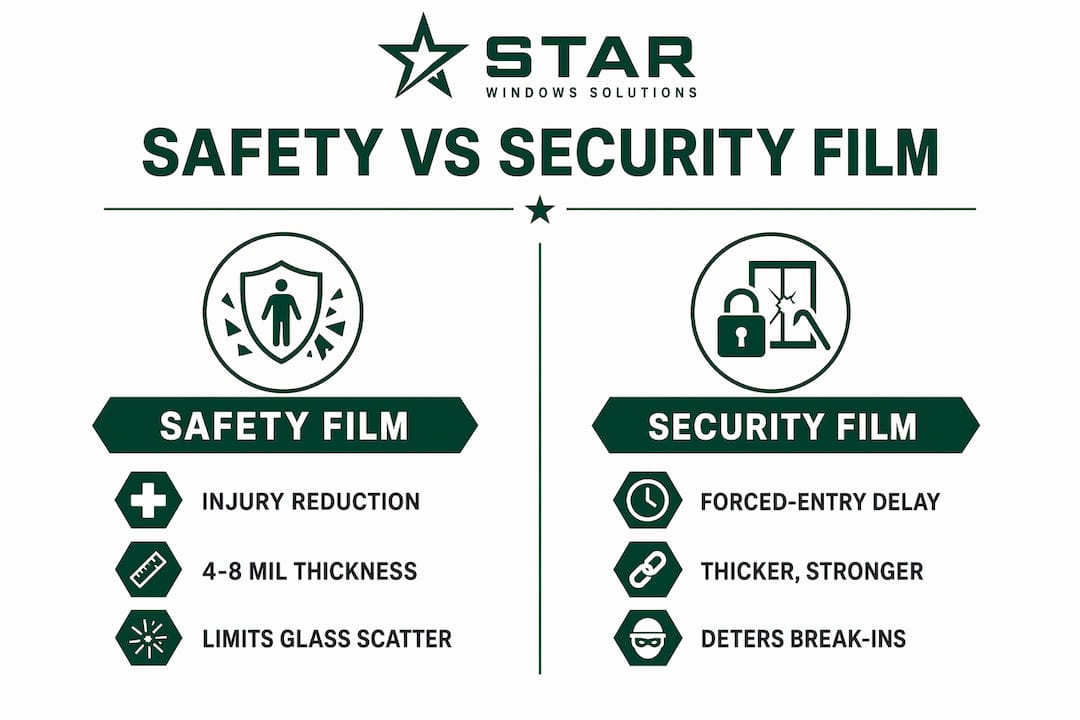
Safety film: injury reduction first
Safety film primarily reduces injury risk by limiting glass fragment scatter during breakage from accidental or weather-related impact. It is the right choice for interior spaces with high foot traffic, children’s rooms, or ground-floor windows in low-crime areas. Basic safety film is often sufficient to reduce laceration hazards and cleanup complexity after accidental breakage. It does not provide meaningful resistance to deliberate forced entry.
Security film: forced-entry delay
Security film is thicker, stronger, and designed to make breaking through a window take significantly more time and effort. Window films vary in thickness from 4-mil for basic safety to 14-mil for high security, and that thickness directly affects impact resistance and durability. A 14-mil film on a framed window with a structural adhesive attachment system creates a barrier that requires repeated, noisy impacts to penetrate.
| Feature | Safety film | Security film |
|---|---|---|
| Primary purpose | Fragment retention, injury reduction | Forced-entry delay, fragment retention |
| Typical thickness | 4–8 mil | 8–14 mil |
| Perimeter attachment needed | Rarely | Always for high-risk use |
| Best use case | Accidental breakage, weather events | Burglary deterrence, commercial storefronts |
| Standards reference | ANSI Z97.1, CPSC 16 CFR 1201 | Same, plus forced-entry test protocols |
Pro Tip: Property managers overseeing multiple units should default to security film on ground-floor and entry-adjacent windows. The cost difference over safety film is modest, but the deterrence value is substantially higher.
Why does the attachment system matter after glass breaks?
The attachment system is the single most overlooked factor in window film performance. Film alone holds shards together, but it does not anchor the glass pane to the window frame. Without a structural adhesive connecting the film edge to the frame, the entire filmed pane can pop out as one unit under high impact.
Failure to use a perimeter attachment system can cause the entire filmed glass pane to pop out under high impact, negating safety benefits entirely. Lack of attachment is the most common failure point in security film installations. Fragment retention alone does not keep the pane in the frame when force is applied at the edges.
Perimeter attachment systems using structural adhesives are required for high-risk security installations. The adhesive is applied between the film edge and the window frame, creating a mechanical bond that transfers impact energy into the frame rather than allowing the pane to dislodge.
Key installation considerations for homeowners and property managers:
- Structural adhesive at the perimeter: Bonds the film edge to the frame, preventing pane dislodgement under sustained impact.
- Frame condition assessment: Rotted or damaged frames cannot hold a structural adhesive bond. Address window frame issues before film installation.
- Professional application: Correct adhesive selection and application technique require experience. Improper installation leaves gaps that defeat the attachment system.
- Blast and high-pressure scenarios: Industry guidance for blast-rated installations always specifies both film thickness and a fully bonded perimeter attachment.
The attachment system does not change how the film looks or performs under normal conditions. Its value only becomes apparent when the window takes a serious hit.
What practical benefits does window film provide after glass breaks?
The window film benefits after breakage fall into four categories: injury reduction, forced-entry deterrence, property downtime reduction, and safer cleanup. Each matters differently depending on whether you manage a home or a commercial property.
Injury reduction
Flying glass is the primary hazard when a window breaks. Film keeps shards bonded to the polyester sheet rather than projecting into the room. This matters most in kitchens, bathrooms, storefronts, and any space where people stand close to glass regularly.
Forced-entry deterrence
Security window film acts as a time-delay layer that increases intruder noise and effort, improving detection chances and decreasing successful break-ins. Security professionals call this the time-delay principle. The goal is not to make the window unbreakable. The goal is to make breaking through it take long enough that the intruder gives up or gets caught.
A security film installation can extend forced-entry attempts from seconds to over a minute, often causing intruders to abandon the attempt entirely. That time gap is what triggers alarms, alerts neighbors, and gives law enforcement a chance to respond.
Reduced property downtime
A filmed window that breaks stays in one piece long enough for a property owner to arrange glass replacement services without an emergency board-up. The pane holds together, the opening stays covered, and the property remains weather-tight until a professional arrives. For commercial properties, that continuity can mean the difference between staying open and closing for a day.
Safer cleanup
- The broken pane remains attached to the film sheet as a single unit.
- Cleanup involves removing the film sheet with shards attached rather than sweeping loose fragments from floors and furniture.
- Disposal is safer because the shards are contained rather than scattered.
- Workers and residents face significantly lower laceration risk during the removal process.
Security film is a cost-effective retrofit primarily aimed at mitigating hazards and delaying break-ins rather than replacing structural upgrades. It does not bulletproof a window. It makes the window substantially safer and harder to breach than unfilmed glass.
Key Takeaways
Window film after breakage holds shattered glass together, reduces injury risk, and delays forced entry, but only when the right film type and a proper perimeter attachment system are installed together.
| Point | Details |
|---|---|
| Film holds shards, not glass | Window film keeps fragments bonded to the polyester sheet, preventing scatter and injury. |
| Safety vs. security film | Safety film handles accidents; security film (8–14 mil) delays deliberate forced entry. |
| Attachment system is critical | Without structural adhesive at the perimeter, a filmed pane can still pop out under impact. |
| Time-delay principle | Security film extends break-in attempts from seconds to over a minute, deterring intruders. |
| Professional installation matters | Correct adhesive application and frame assessment are required for the film to perform as rated. |
What I’ve learned from watching film installations fail
Most homeowners assume that applying any window film gives them full protection. That assumption is the most expensive mistake I see in this field. Film without an attachment system is like a seatbelt without an anchor point. It looks right, but it fails at the moment it matters most.
The second mistake is choosing film based on price alone. A 4-mil safety film costs less than a 12-mil security film, and for a second-floor bedroom window, that trade-off is perfectly reasonable. For a ground-floor entry window or a commercial storefront, it is not. The threat model has to drive the specification.
UV exposure causes degradation and discoloration in lower-quality window films over time, leading to hazing or yellowing that reduces clarity and aesthetics. I have seen property managers skip warranty verification to save a few dollars, then replace the film within three years because it turned yellow and started peeling. A manufacturer warranty against optical defects is not a luxury. It is a baseline quality indicator.
The technology in window film has improved considerably. Thicker films are now more optically clear than they were a decade ago, and structural adhesives have become easier to apply correctly. But the fundamentals have not changed: right film, right attachment, right installation. Get those three right and the film performs. Skip any one of them and you are back to unprotected glass.
— Artem
Window film and glass replacement services from Star-ws
Window film performs best when the underlying glass and frame are in good condition. A cracked frame or compromised seal undermines even the best film installation before it starts.

Star-ws provides residential and commercial glass replacement across the Kansas City area, with options to add protective film as part of the replacement process. Whether you need a broken vertical window replaced with a security-film-ready unit or a full commercial storefront upgrade, Star-ws handles the assessment, installation, and warranty documentation from start to finish. Free estimates are available, and financing options make it straightforward to address safety and security upgrades without delay. Contact Star-ws to schedule a consultation and get the right solution specified for your property.
FAQ
What does window film actually do after glass breaks?
Window film holds shattered glass fragments together on the polyester sheet, preventing scatter and reducing injury risk. It does not stop the glass from breaking but manages the aftermath by keeping shards bonded in place.
Is safety film the same as security film?
Safety film and security film are different products. Safety film (4–8 mil) reduces injury from accidental breakage, while security film (8–14 mil) adds forced-entry delay through greater thickness and a perimeter attachment system.
Does window film work without an attachment system?
Window film without a perimeter attachment system can still hold shards together, but the entire pane may pop out of the frame under high impact. A structural adhesive attachment is required for full post-breakage protection.
How long does window film delay a break-in?
Security film can extend a forced-entry attempt from a few seconds to over a minute, which is often enough to trigger alarms and cause intruders to abandon the attempt.
Can window film be added to existing windows?
Window film is a retrofit product applied directly to existing glass surfaces. Professional installation is recommended to verify frame condition, select the correct adhesive, and apply the perimeter attachment system correctly.