
Impact-resistant glass is laminated, multi-layer glazing engineered to crack on impact but stay in place, keeping wind, water, and intruders out even after the outer pane breaks. The industry term you’ll see on certifications and test reports is laminated impact glazing, and it describes a system, not just a glass type. The glass, the frame, and the anchorage all get tested together.
Act now if any of these apply to you:
- You live in a hurricane zone, coastal area, or high-wind corridor
- Your home has original single-pane or older annealed windows
- You want year-round security, noise reduction, or lower energy bills
- You’re missing documentation proving your current windows are impact-rated
Table of Contents
- What is impact resistant glass and how is it built?
- What types of impact glass are available for your home?
- How is impact glass tested and certified in the U.S.?
- What are the real benefits of impact resistant glass for homeowners?
- How can you tell if your windows are already impact-rated?
- Should you replace windows or retrofit, and what does installation involve?
- Questions to ask before you sign any impact window contract
- Key Takeaways
- The case for treating impact glass as infrastructure, not an upgrade
- Star-ws handles impact glass replacement in Kansas City
- Useful sources
What is impact resistant glass and how is it built?
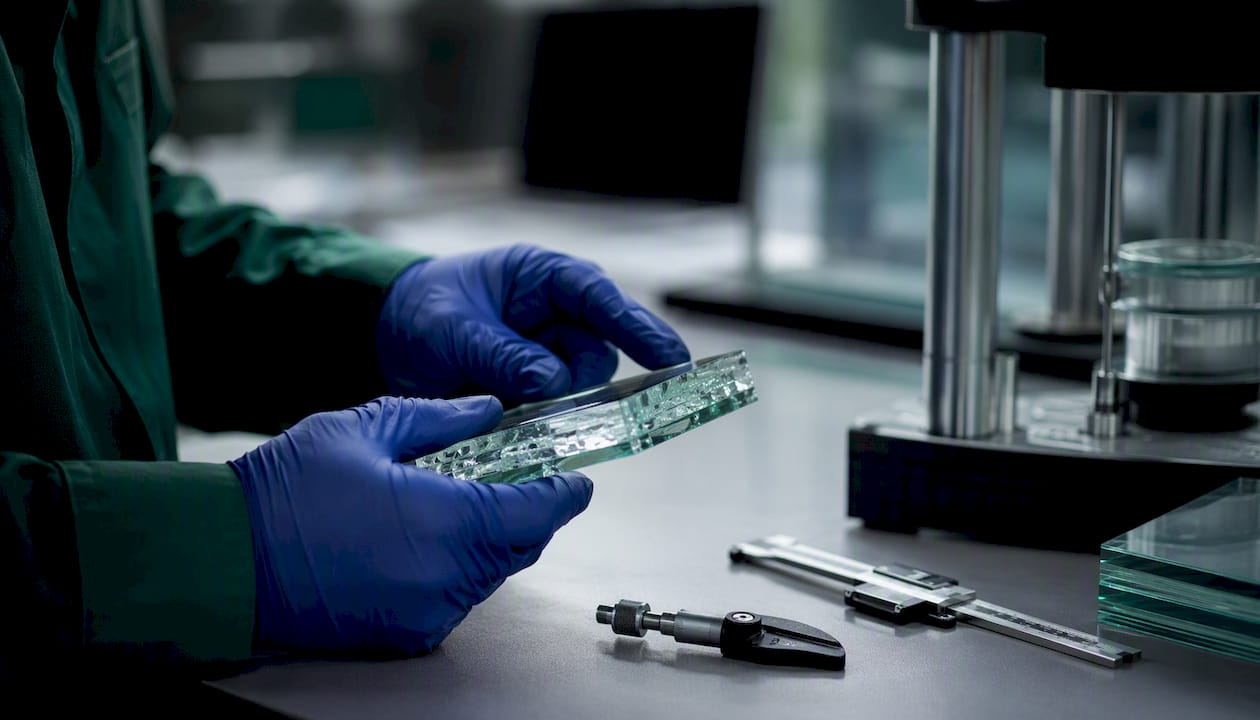
The interlayer is what separates impact-resistant glazing from everything else. Two or more glass panes are bonded to a plastic interlayer, typically polyvinyl butyral (PVB) or the stiffer SentryGlas® Plus (SGP), creating a laminated unit similar in concept to a car windshield but built to far stricter building-code tests. When something strikes the glass hard enough to crack it, the interlayer holds the fragments in place and keeps the opening sealed. That’s the whole point: the barrier stays intact even when the glass doesn’t.
The mechanics work through energy absorption. The outer pane cracks and distributes kinetic energy across the interlayer. The interlayer stretches and grips the shards. The building envelope, the continuous shell that keeps weather and intruders out, remains closed. A cracked pane after a storm isn’t necessarily a failure; it can be evidence the system did exactly what it was designed to do.
How impact glass compares to other glass types:
| Glass type | Failure mode | Typical use |
|---|---|---|
| Annealed (standard) | Breaks into large, sharp shards | Older residential windows |
| Tempered | Shatters into small cubes | Shower doors, some commercial glazing |
| Laminated impact | Cracks but stays bonded to interlayer | Hurricane zones, security, sound control |
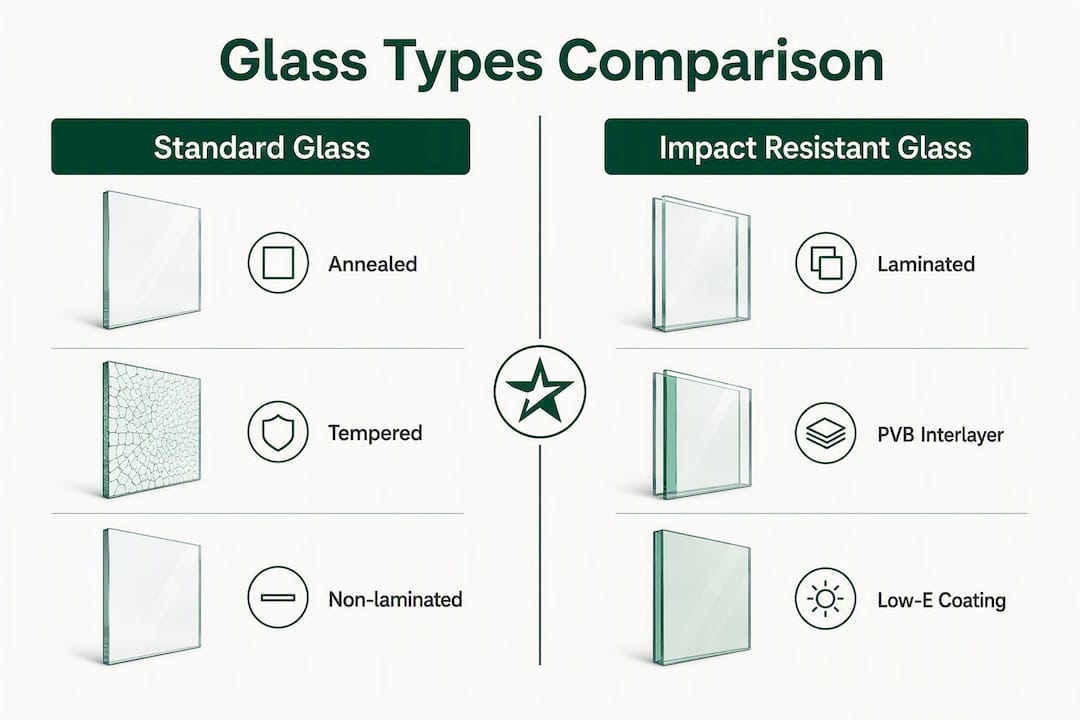
Tempered glass is stronger than annealed, but when it breaks, it’s gone. There’s no interlayer to hold the opening. Laminated impact glass trades some raw strength for the ability to stay in place after a strike, which is the property that actually matters during a storm or a forced-entry attempt.
One important clarification: impact glass is not bulletproof. Bullet-resistant glazing is a separate engineering category with much thicker multi-layer laminations designed for ballistic threats. Don’t let a salesperson conflate the two.
What types of impact glass are available for your home?
The category covers several distinct constructions, each with a different performance profile and price point.
| Type | Construction | Pros | Cons | Best use | Cost shape |
|---|---|---|---|---|---|
| PVB laminated | Two lites + PVB interlayer | Proven, widely available, UV blocking | Less stiff than SGP under high loads | Most residential hurricane zones | Low–medium |
| SGP laminated | Two lites + SentryGlas® interlayer | Stiffer, better post-breakage retention | Higher cost, fewer fabricators | Large spans, high-wind zones | Medium–high |
| Toughened + laminate | Tempered outer + laminated inner | High initial strength | More complex fabrication | Commercial facades, high-traffic areas | Medium–high |
| Impact IGU | Laminated lite + air/gas space + second lite | Energy performance + impact protection | Heavier, requires robust frame | Year-round energy savings + storm zones | High |
| Security glazing | Thick multi-ply laminate | Forced-entry resistance | Heavy, expensive | Ground-floor security, storefronts | High |
| Retrofit laminate film | Applied to existing glass | Low upfront cost | Does not meet impact certification | Sound/UV upgrade on non-critical openings | Low |
Laminated glass with Low-E coatings reduces solar heat transfer and blocks nearly all UV radiation, which protects interior finishes from fading. For more information, see this Energy Efficient Windows Guide for Ontario Homes – Proplas. That combination, an impact IGU with a Low-E coating, is the most capable option for homeowners who want storm protection and year-round energy performance in a single unit.
Pro Tip: If your home is in a hurricane zone and you’re also paying high cooling bills, choose an impact IGU with a Low-E coating rather than a single laminated lite. The added cost is real, but you get certified storm protection and meaningful energy savings from one product instead of two.
Retrofit laminate film is worth mentioning because it’s frequently oversold. It can reduce UV exposure and add minor security value, but it does not turn a standard window into a certified impact assembly. Use it only for non-critical openings where full replacement isn’t feasible.
How is impact glass tested and certified in the U.S.?
Certification is where most homeowners get confused, and where some contractors cut corners. The key standards to know:
- ASTM E1886 — the test method: a large missile (a 9-pound 2×4 fired at 50 ft/s) strikes the assembly, followed by cyclic pressure loads simulating a hurricane. The test covers the full assembly, glass plus frame plus anchorage.
The critical point: the impact-resistant rating belongs to the system, not the glass alone. A certified pane installed in an uncertified frame with wrong anchor spacing is not a certified system. This is how homeowners end up with windows that look right but fail inspection or, worse, fail in a storm.
Contractor documentation checklist:
- NOA number or Florida Product Approval number (verify at miamidade.gov)
The most reliable proof of impact capability is a manufacturer’s NOA or third-party lab report showing the tested assembly and the tested anchorage details. If a contractor can’t produce that document, that’s your answer.
What are the real benefits of impact resistant glass for homeowners?
Storm protection is the headline benefit, but it’s far from the only one. The benefits of impact-resistant windows stack up across several categories that matter every single day, not just during hurricane season.
Security. Standard glass can be breached very quickly, while impact assemblies require substantially longer continuous, loud effort to breach, increasing the chance an intruder gives up or gets caught. That time and noise dramatically increase the chance an intruder gives up or gets caught. For ground-floor windows and sliding doors, that difference is substantial.

Insurance. Certified impact-rated windows can reduce home insurance premiums significantly when properly documented and submitted to the insurer. The documentation requirement matters: the discount usually requires the NOA number and proof of professional installation.
Noise. The PVB interlayer absorbs vibration, and homeowners consistently notice a quieter interior within days of installation. Street noise, traffic, and neighbor activity all drop noticeably. This is an immediate, daily benefit that’s easy to underestimate when you’re focused on storm season.
Energy performance. Laminated impact glass blocks nearly all UV radiation. Paired with Low-E coatings and thermally broken frames, it reduces solar heat gain and cuts cooling loads. The energy-efficient window upgrades that pair impact glazing with Low-E and precision sealing deliver the most measurable utility savings.
| Benefit | What to expect |
|---|---|
| Storm protection | Maintains building envelope through Category 5-equivalent debris tests |
| Forced-entry resistance | 5–8 minutes to breach vs. 2–3 seconds for standard glass |
| Insurance premium reduction | up to 30–45% with proper NOA documentation |
| Noise reduction | Noticeable reduction in exterior noise; PVB interlayer dampens vibration |
| UV blocking | Laminated glass blocks nearly all UV, protecting interior finishes |
The upfront cost premium over standard windows is real. The payback comes through insurance savings, lower energy bills, and avoided storm damage costs. For homes in wind-borne debris regions, the math usually favors impact glazing within a few years.
How can you tell if your windows are already impact-rated?
Start with the easiest check: look for a label. Certified impact windows carry a permanent etched or adhesive label on the glass or frame listing the manufacturer, product code, and often the NOA number. If you see one, photograph it and look up the NOA at Miami-Dade’s product approval database.
Step-by-step verification:
- Look for manufacturer labels etched into a corner of the glass or on the frame.
- Check for an NOA or product approval sticker, usually on the frame or sash.
- Hold a finger up to the glass and look for multiple reflections — laminated glass shows two or more distinct reflections due to the interlayer.
- Inspect the frame: impact frames tend to be thicker, with welded corners rather than mechanically joined ones.
- Search your home’s permit history or prior purchase documents for installation records.
- Request the original test report or NOA from the installer or manufacturer if you have their name.
DIY visual checks are useful but limited. The multiple-reflection test and label check get you most of the way there, but the definitive answer is a test report or NOA. If you’re buying a home or filing an insurance claim, a professional inspection is worth the cost.
Pro Tip: Before calling a contractor, photograph each window’s corner label and frame corners with your phone. Send those photos when you request a quote — a knowledgeable installer can often confirm impact rating from a clear label photo before they even visit the site.
Should you replace windows or retrofit, and what does installation involve?
Installation quality determines whether a certified product actually performs as certified. Frame anchorage, corner construction, and anchor spacing all affect system performance under wind loads. A correctly specified impact unit installed with wrong fastener spacing or into a rotted frame is not a performing system, regardless of what the glass label says.
Full replacement is the right call when frames are older than 20–25 years, when seals have failed (fogging between panes), when you have no documentation proving current windows are impact-rated, or when the existing frame material is incompatible with the new unit’s anchorage requirements. Replacement gives you a clean, certifiable system with a full warranty. For residential glass replacement projects, the frame condition is the first thing a qualified installer should assess.
Retrofit options include laminate security film, secondary glazing panels, and sash replacements. Film is the lowest-cost entry point and works for UV reduction and minor security upgrades on non-critical openings, but it does not produce a certified impact assembly. Secondary glazing adds an interior panel to existing frames and can improve acoustics and energy performance, but again, it won’t satisfy hurricane code requirements. Sash replacements, swapping the operable portion while keeping the existing frame, can work when the frame itself is structurally sound and compatible with a certified replacement sash.
Maintenance is straightforward but matters. Check weatherstripping and perimeter seals annually. After any severe weather event, inspect for cracks in the glass (a cracked pane still held in place by the interlayer should be replaced before the next storm season). Laminated impact units typically last 20–25 years before seal degradation or interlayer discoloration warrants replacement. Clean with non-abrasive solutions; avoid anything that could scratch the interlayer at the edges.
Questions to ask before you sign any impact window contract
Walk into every estimate with this list. The answers tell you quickly whether you’re dealing with a knowledgeable installer or someone who will leave you with an uncertified system.
- Can you provide the ASTM E1886/E1996 test report for the specific assembly you’re quoting?
- What is the NOA number, and can I verify it at the Miami-Dade product approval database?
- Does the quote cover system testing, including frame, anchorage, and installation details?
- What frame material and corner construction does this unit use?
- What is the anchor spacing, and how does it match the NOA installation requirements?
- What does the warranty cover, and does it include labor and anchorage?
- Can you provide references for similar installations in this area, with permit numbers?
Red flags to watch for:
- Vague claims like “impact-rated glass” with no NOA or test report to back them
- A quote that lists glass specs but omits frame material, anchor details, or installation method
- Promised insurance savings without a specific NOA number you can verify
- No local permit history or references for comparable jobs
- A written quote with no product codes attached
When comparing written quotes, confirm that each one references the same product code and test report. A lower price that omits anchorage labor or uses a different (uncertified) frame is not a comparable quote.
Key Takeaways
Impact-resistant glass works because the interlayer, not thicker glass alone, keeps the assembly intact after a strike, and that protection is only as good as the certified system it’s installed in.
| Point | Details |
|---|---|
| It’s a system, not just glass | The impact rating covers glass, frame, and anchorage together — glass alone is not enough. |
| Demand the NOA | Ask for the NOA number and verify it at Miami-Dade’s database before signing any contract. |
| Benefits go beyond storms | Certified impact windows can reduce insurance premiums by up to 30–45% and increase forced-entry time to 5–8 minutes. |
| DIY checks have limits | Labels and multiple reflections are a starting point; a test report is the only definitive proof. |
| Star-ws for Kansas City homes | Star-ws provides certified impact glass replacement and free estimates for homeowners in the Kansas City area. |
The case for treating impact glass as infrastructure, not an upgrade
Most homeowners frame impact windows as a storm-season purchase. That framing undersells the product and leads to bad buying decisions, usually the cheapest option that technically meets the minimum code requirement.
The more accurate frame: impact glazing is building infrastructure. It’s the same category of decision as roofing or foundation work. You buy it once, it has to perform under the worst conditions your region produces, and the consequences of a bad installation aren’t visible until something goes wrong. That’s exactly why the system-testing emphasis matters so much. A contractor who can’t hand you an NOA number and a test report isn’t selling you infrastructure. They’re selling you glass.
What I see most often in practice is homeowners who focus on the glass specification and ignore the frame and anchorage details entirely. They compare pane thickness and interlayer brand between quotes, but they don’t ask whether the frame corners are welded or mechanically joined, or whether the anchor spacing in the quote matches the NOA. Those details are where certified performance lives. The glass is almost always fine. The installation is where systems fail.
For Kansas City homeowners specifically: the region doesn’t face hurricane-force winds regularly, but severe thunderstorms, straight-line winds, and hail are consistent annual risks. Older homes with original single-pane or aluminum-frame windows are genuinely vulnerable. The ROI case for impact glazing here is built more on security, noise reduction, energy savings, and insurance discounts than on hurricane preparedness, but the product and installation standards are identical. Don’t let the absence of a coastline make you think the standards matter less.
Star-ws handles impact glass replacement in Kansas City
If you’ve read this far and you’re not sure whether your current windows are impact-rated, or you know they aren’t and you want to fix that, Star-ws is the practical next step for Kansas City homeowners.
Star-ws offers certified impact glass replacement, full window system upgrades, frame repair and rot remediation, and retrofit assessments for residential and commercial properties across the Kansas City area. Every estimate includes a frame and anchorage inspection, a written quote with product codes and test report references, and clear documentation of what’s being installed and why. Financing is available, and the first estimate is free.
Whether you need a full residential glass replacement with certified impact units or a commercial window replacement for a storefront or multi-unit property, Star-ws brings the same system-level approach: the right glass, the right frame, installed to the right standard. Request your free estimate and get a clear answer on what your windows are actually rated for.
Useful sources
- ASTM E1886 — Standard Test Method for Performance of Exterior Windows, Curtain Walls, Doors, and Impact Protective Systems
- Miami-Dade County — Product Approval for Windows and Doors
- IBHS FORTIFIED Home — Homeowner Resources
- Guardian Glass — Hurricane Impact Resistance
- CDC — Before a Hurricane: Protect Your Home
- NOAA — National Hurricane Center: Saffir-Simpson Scale
Request the NOA or lab report from any installer before signing a contract, and verify the NOA number directly at the Miami-Dade product approval database. For installer credentials, check your local building department’s license verification records.