
Laminated glass meaningfully increases resistance to forced entry when correctly specified and installed. Unlike standard annealed glass or even tempered glass, a laminated assembly holds together after impact because the interlayer bonds the broken plies together, forcing an attacker to keep working through a sticky, jagged barrier rather than stepping through a clean opening. That delay is the point. It won’t stop a determined attacker with unlimited time and tools, but it buys the minutes that trigger an alarm response or discourage a smash-and-grab entirely.
The standards that validate these claims are ASTM F1233 (forced-entry resistance), UL 972 (burglar-resistance glazing), and EN 356 (European security glazing classes P1A through P8B). Any vendor who can’t hand you a lab report referencing one of these standards is selling you a story, not a specification.
Laminated security glazing is the right choice in three situations:
- Storefronts and retail entrances where smash-and-grab theft is the primary threat
- Entrance doors and sidelights on residential or commercial properties where ground-floor access is the most vulnerable point
- Ground-floor windows in high-value or high-visibility locations where standard glazing is the weakest link in an otherwise solid perimeter
Pro Tip: Before signing any quote, ask the supplier for the full lab test report, the test standard referenced, and the accrediting lab’s name. If they hesitate or offer only a brochure, that’s your answer.
Key Takeaways
Laminated glass is the correct security glazing choice for forced-entry resistance because it holds together after breakage, creating a time delay that standard or tempered glass cannot provide.
| Point | Details |
|---|---|
| Interlayer determines performance | SGP outperforms PVB in tear resistance and post-break stiffness; match the interlayer to the threat level. |
| Always request the lab report | Ask for the full test report referencing ASTM F1233, UL 972, or EN 356, with the accredited lab’s name and sample ID. |
| Frame matters as much as glass | A strong laminated pane in a weak frame is not a security upgrade; inspect and reinforce the frame alongside the glass. |
| Prioritize high-risk openings first | Start with openings where a single broken pane gives direct access to a lock or high-value area. |
| Star-ws covers the full upgrade path | Star Windows Solutions provides assessment, laminated and bulletproof glass installation, and frame reinforcement in Kansas City. |
Table of Contents
- How laminated glass is actually built
- How laminated glass resists forced entry
- Laminated vs. tempered glass: which one actually protects you?
- Common laminated assemblies and what they’re actually good for
- What standards and test reports actually tell you
- Where laminated security glass works best
- What laminated glass won’t do
- Retrofit options vs. full replacement: what’s worth it
- The buyer’s checklist: what to ask before signing anything
- What Star Windows Solutions offers in Kansas City
- The pragmatic case for laminated security glass
- Glass security upgrades from Star Windows Solutions
- Sources
How laminated glass is actually built
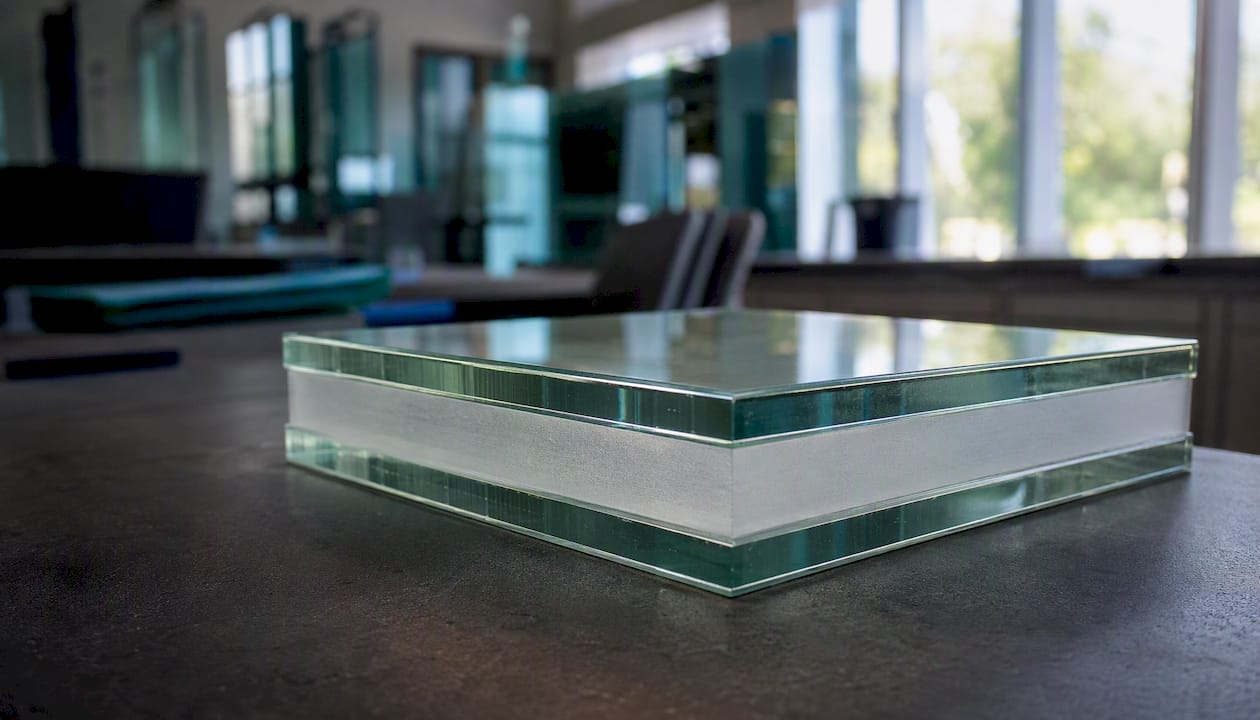
Laminated glass consists of two or more glass plies bonded together with one or more plastic interlayers, typically under heat and pressure. The interlayer is what separates laminated glass from every other glazing type: when the glass breaks, the interlayer holds the fragments in place, preventing the pane from collapsing into an open hole.
The glass plies themselves can be annealed (standard float glass), heat-strengthened, or fully tempered. Annealed plies break into large, irregular shards; tempered plies shatter into small cubes. In a laminated assembly, the interlayer controls what happens after either type breaks, which is why ply selection matters less than interlayer selection for security applications.
Interlayer materials and what they actually do
PVB (polyvinyl butyral) is the most common interlayer. It’s flexible, bonds well to glass, and provides solid post-break adhesion for most residential and light commercial security applications. Standard laminated safety glass uses 0.38 mm or 0.76 mm PVB; security-grade assemblies step up to multiple PVB layers or thicker interlayer stacks.
SGP (SentryGlas® ionoplast) is stiffer, roughly five times stronger in tear resistance than standard PVB, and maintains structural integrity better after breakage. It’s the interlayer of choice for high-security applications, hurricane-rated glazing, and structural glass where post-break stiffness matters. The trade-off is cost and fabrication complexity.
EVA (ethylene-vinyl acetate) appears in some specialty laminates, particularly decorative or UV-sensitive applications. It’s less common in pure security contexts.
Polycarbonate interlayers or polycarbonate plies appear in multi-layer ballistic assemblies, where the goal shifts from forced-entry delay to bullet resistance. These are heavier, thicker, and significantly more expensive.
Beyond security, interlayers also affect:
- UV blocking: PVB and SGP both filter a high percentage of UV radiation, protecting interiors and occupants
- Acoustic performance: Laminated assemblies with PVB dampen sound transmission noticeably compared with monolithic glass of the same thickness
- Optical clarity: High-quality PVB and SGP maintain excellent visual clarity; lower-grade interlayers can introduce slight haze over time
How laminated glass resists forced entry
The core mechanism is simple: when an attacker strikes laminated glass, the plies crack but stay bonded to the interlayer. The result is a web of fractured glass held in place, not a hole. To get through, the attacker must keep striking the same spot repeatedly, cut or pry the interlayer, or attack the frame and remove the entire glazed unit.
That’s a fundamentally different problem than breaking standard glass. A single blow through a single-pane window takes seconds. Working through a laminated assembly under a forced-entry test standard like ASTM F1233 or UL 972 can take minutes of sustained effort with specific tools, even for a trained tester.
What happens in common attack scenarios
Smash-and-grab: A single hard blow shatters the outer ply but leaves the interlayer intact. The glass crazes but doesn’t open. A second, third and fourth blow are needed to begin deforming the interlayer, and even then the attacker is pushing through a sticky, resistant membrane rather than an open gap. Security glazing keeps shards bound and creates delays that reduce the likelihood of successful looting, though determined attacks can still succeed if frames or locks fail.
Repeated hammer strikes: Each blow adds fracture lines but the interlayer continues to bridge the cracks. The attacker is working against increasing resistance as the broken glass distributes load across the interlayer. Entry time scales with interlayer thickness and ply count.
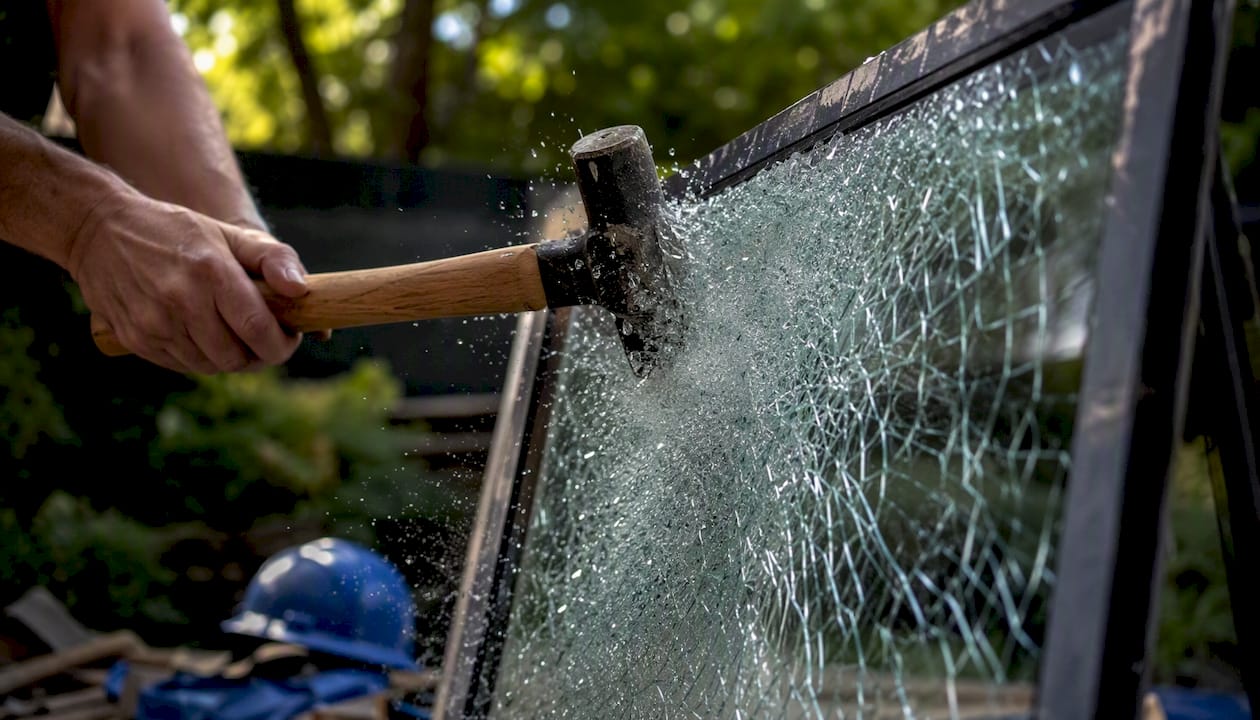
Pry attempts: Prying at the edge of a laminated pane is often more effective than striking the center, which is why frame anchorage matters as much as the glass itself. A well-specified laminated pane in a poorly anchored frame can be removed intact.
Real-world effects you can count on:
- No flying glass shards on impact, reducing injury risk to occupants and bystanders
- Meaningful time delay compared with single-pane or tempered glass
- Visual deterrent: a crazed but intact pane signals that the attack is taking longer than expected
- Reduced secondary looting opportunity because the opening doesn’t appear quickly
Pro Tip: When reviewing a forced-entry test report, look for the number of strikes and tool types used before passage occurred. That number is your realistic delay estimate, not the marketing headline.
Laminated vs. tempered glass: which one actually protects you?
Tempered glass is stronger under initial impact than annealed glass, roughly four to five times more resistant to breakage. But when it breaks, it shatters completely into small cubes, leaving an open hole. That’s useful for safety (no large shards), but it’s the opposite of what you want for security.
Laminated glass is often weaker under the first strike but dramatically better at everything that happens after. The comparison on security-relevant dimensions:
| Dimension | Laminated glass | Tempered glass |
|---|---|---|
| Post-break integrity | Holds together; no open hole | Shatters completely; immediate opening |
| Forced-entry delay | Significant; scales with assembly | Minimal; one break = passage |
| Spall / shard risk | Low; fragments stay bonded | Low (small cubes) but opening is immediate |
| Retrofit options | Film upgrades possible; full replacement preferred | No meaningful retrofit for security |
| Optical clarity | Excellent with quality interlayer | Excellent |
| Overhead / safety use | Acceptable with correct spec | Preferred for accidental impact safety |
The practical recommendation: choose laminated glass anywhere forced-entry delay is the goal. Tempered glass is appropriate for overhead glazing, shower enclosures, and applications where accidental human impact is the primary hazard and post-break security is not required. Consumer guidance consistently frames laminated glass as better for burglary resistance compared with single-pane and tempered glass because it holds together when fractured.
One nuance worth knowing: tempered glass used as a ply within a laminated assembly is a legitimate configuration. The tempered ply adds initial impact resistance; the interlayer handles post-break integrity. You get both properties, at higher cost and weight.
Common laminated assemblies and what they’re actually good for
The three variables that determine security performance are glass thickness per ply, number of plies, and interlayer type. Increasing any one of them improves performance; the combination matters more than any single factor.
Common nominal thicknesses for laminated door and window glass include 10.76 mm, 12.76 mm, and 17.52 mm, with security ratings ranging from EN 356 P1A through P5A depending on interlayer and ply choices.
| Assembly type | Typical construction | Primary use | Security impact |
|---|---|---|---|
| Entry-level | 10.76 mm (3+3 PVB) | Residential windows, interior partitions | Basic post-break integrity; deters opportunistic attack |
| Enhanced | 10.76 mm (5+5 PVB or 4+4 SGP) | Storefronts, entrance doors, sidelights | Meaningful forced-entry delay; EN 356 P2A–P4A range |
| Heavy-duty | 17.52 mm+ multi-ply with SGP | High-security commercial, teller lines, display cases | Extended delay; EN 356 P5A+ or ASTM F1233 compliant |
| Ballistic | Multi-ply glass + polycarbonate | Banks, government, high-risk retail | Bullet-resistant ratings; UL 752 levels |
Switching from PVB to SGP in an otherwise identical assembly adds stiffness and tear resistance without necessarily adding weight or thickness. For most commercial security upgrades, that swap is the most cost-effective performance gain available.
IGU (insulating glass unit) configurations add a second sealed pane for thermal performance, but the laminated lite is still the security layer. The air or gas gap in an IGU doesn’t contribute to forced-entry resistance.
Pro Tip: A heavy-duty laminated pane in a lightweight aluminum frame with inadequate anchorage is not a security upgrade. The frame and its attachment to the wall structure must be specified alongside the glass. Assess window hardware and frame integrity before committing to a glass specification.
What standards and test reports actually tell you
The most relevant standards for forced-entry and security glazing in the United States are:
- ASTM F1233: Tests glazing assemblies against a defined attack sequence using specific tools and strike counts. Results indicate whether the assembly resisted passage within the test protocol.
- UL 972: Burglar-resistant glazing standard; tests resistance to repeated blows from a weighted impactor. Products that pass are listed by UL.
- EN 356: European standard with classes P1A through P8B based on drop-ball and axe-attack tests. P1A is the entry level; P8B represents the highest manual-attack resistance. Widely referenced by manufacturers selling into the U.S. market.
- UL 752: Ballistic resistance standard for glazing, with levels 1 through 8 corresponding to specific ammunition and calibers.
- ASTM F1642 / GSA TS01-2003: Blast-resistance standards for glazing in high-threat environments.
Cardinal Glass Industries has passed multiple international test standards for forced entry and burglary resistance, offering options from basic to heavy-duty forced-entry glazing. That range illustrates how a single manufacturer can cover the full spectrum from opportunistic-deterrent to sustained-attack resistance.
When evaluating any product or quote, request these specific documents:
- Full lab test report (not a summary sheet or brochure)
- Test setup description and sample identification
- Date of test and lab name with accreditation number
- Confirmation that the tested assembly matches what you’re being quoted (same ply count, thickness, interlayer, and edge treatment)
Verify lab accreditation: The testing laboratory should hold ISO/IEC 17025 accreditation for the relevant test methods. A test report from a non-accredited lab carries no independent weight. In the U.S., check the lab’s scope of accreditation through the ILAC MRA network or directly with the accrediting body (A2LA, NVLAP, or Perry Johnson Laboratory Accreditation).
Where laminated security glass works best
The short answer: anywhere a broken pane creates an immediate entry point. That covers more of a typical building than most owners realize.
Residential applications where laminated glass for doors and windows adds the most value:
- Front doors with glass panels or sidelights, where a single broken pane reaches the interior lock
- Patio and sliding doors at ground level, particularly in properties without secondary barriers
- Ground-floor picture windows or large fixed panes visible from the street
- Garage entry doors with glazed panels
For residential use, laminated glass also offers noise reduction, UV blocking, and privacy or texture options that can be specified alongside security features, making the upgrade easier to justify on multiple grounds. Laminated security rain glass, for example, is offered for front doors as a durable option that holds together when broken while also reducing noise and filtering UV.
Commercial applications where the investment is most clearly justified:
- Storefronts and retail entrances, particularly jewelry, electronics, and pharmacy locations
- Bank teller lines and cash-handling areas
- Internal secure enclosures and server room glazing
- Display cases and museum vitrines with high-value contents
- Vestibules and access-controlled entry points
Retail storefronts and high-value display cases commonly combine laminated glass with stronger framing and locking hardware to convert glazing from a weak point to a meaningful delay layer. Commercial storefront glazing is one of the most common upgrade paths because the threat profile is clear and the cost of a successful smash and grab is immediate and quantifiable.
Use-case selection tips:
- Prioritize openings where a single broken pane gives direct access to a lock, latch, or high-value area
- Weight vulnerability by hours of exposure: a storefront closed overnight is more vulnerable than one staffed 24 hours
- Consider visibility: openings visible from the street or a parking lot are both higher-risk and better deterred by visible security glazing
- Factor in value density: a small display case with $50,000 in inventory justifies a heavier spec than a large window overlooking a storage room
What laminated glass won’t do
Laminated glass improves delay and reduces hazard, but it is not a standalone anti-intrusion system. A determined attacker with enough time, the right tools, and no alarm response will eventually get through any glazing assembly short of ballistic-rated multi-ply composites.
Specific limitations to plan around:
- Frame and perimeter failure: The glass can outlast the frame. A laminated pane in a corroded or poorly anchored frame can be removed by attacking the perimeter, not the glass itself.
- Cutting attacks: A glass cutter and suction cup won’t work on laminated glass the way it does on single-pane, but a reciprocating saw or angle grinder through the frame bypasses the glass entirely.
- Glazing bead removal: In some commercial systems, the glazing bead holding the pane can be removed from the exterior, allowing the entire unit to be pushed inward.
- Ballistic and blast thresholds: Standard laminated security glass is not bullet-resistant. Ballistic protection requires purpose-built multi-ply assemblies tested to UL 752 or equivalent.
- Optical trade-offs: Very thick or multi-ply assemblies can introduce slight color shift or reflection differences; specify optical-grade interlayers when appearance matters.
Complementary measures that close the gaps:
- Stronger frames with structural anchorage to the wall, not just the rough opening
- Laminated glass combined with a security film overlay for additional tear resistance
- Secondary barriers: grilles, security screens, or roll-down shutters for after-hours protection
- Alarm systems with glazing break sensors and fast response times
- Quality hardware: multi-point locking, reinforced strike plates, and upgraded door and window hardware
Pro Tip: Budget your upgrade starting with the weakest point, which is almost always the frame, not the glass. A $2,000 laminated pane in a $50 frame is a security theater exercise.
Retrofit options vs. full replacement: what’s worth it
Three paths exist for upgrading existing glazing to laminated security performance, and they differ significantly in cost, disruption, and actual protection.
Security film (retrofit film): Applied to the interior surface of existing glass. Film holds shards together after breakage and adds some forced-entry delay, but it does not replicate the performance of a true laminated assembly. The film can delaminate from the glass edge over time, and its adhesion to the glass surface is the limiting factor under sustained attack. It’s the lowest-cost option and the lowest-performance option.
Bonded laminated insert: A laminated panel bonded into the existing frame opening, replacing the original glass without replacing the frame. Better performance than film, but the frame must be inspected for structural adequacy and glazing pocket depth. Weight increases significantly with thicker assemblies.
Full replacement with laminated IGU or monolithic laminated pane: The highest-performance option. The entire glazed unit, and often the frame, is replaced with a system specified for the threat level. This is the only path to a certified, test-report-backed security rating.
Installation checklist before committing to any retrofit:
- Inspect the frame for rot, corrosion, or inadequate anchorage
- Measure the glazing pocket depth to confirm it can accept the new assembly thickness
- Check the structural load capacity of the frame and surrounding wall for the added weight
- Confirm hardware compatibility: heavier glass requires heavier hinges and stronger locking mechanisms
- Get lead time in writing: security-grade laminated glass is not a stock item at most suppliers
- Clarify warranty terms: who covers the glass, who covers the installation, and for how long
Cost varies widely by assembly type, opening size, and location. Security film runs significantly less per square foot than full laminated replacement, but the performance gap is real. For high-priority openings, full replacement with a tested assembly is the specification that actually delivers the delay you’re paying for. Checking vendor credibility through resources like the BBB listing for fabricators is a reasonable starting point when evaluating suppliers you haven’t worked with before.
The buyer’s checklist: what to ask before signing anything
Start with one line on every quote: “Please provide the assembly description, interlayer type and manufacturer, nominal thickness, test standard referenced, rating achieved, and the full lab report.” If the quote doesn’t answer all of those, it’s incomplete.
Questions to ask every supplier and installer:
- What test standard does this assembly meet, and can you provide the full lab report?
- Is the tested assembly identical to what I’m being quoted (same ply count, thickness, interlayer brand, edge treatment)?
- Is the testing lab ISO/IEC 17025 accredited?
- What warranty covers the glass, and what covers the installation?
- What is the lead time for this specific assembly?
- How is the edgework finished, and does it affect the security rating?
- Is this a monolithic laminated pane or an IGU, and does the IGU configuration affect the security rating?
Red flags that should stop a conversation:
- No lab report available, only a brochure or marketing sheet
- Vague references to “security glass” without a named standard or rating
- Warranty that covers the glass but not the installation or the frame interface
- No specification of framing or anchorage requirements alongside the glass spec
- Test report that references a different assembly than what’s being quoted
- Lab name you can’t verify through A2LA, NVLAP, or a similar accreditation body
On cost vs. performance: the upgrade that matters most is the one at your highest-risk opening. Spending more on a heavy-duty assembly at the front door and using enhanced-grade glass at secondary windows is a smarter allocation than uniform mid-grade glass everywhere. Window replacement as a long-term investment pays off most clearly when the specification matches the actual threat.
What Star Windows Solutions offers in Kansas City
Star Windows Solutions serves residential and commercial properties across the Kansas City area, handling everything from single-pane emergency replacements to full security glass upgrades and bulletproof glazing installations. The service range covers the full upgrade path described in this guide: assessment, specification, supply, and installation.
Specific services relevant to security glazing:
- Laminated and impact-resistant glass replacement for windows and doors
- Commercial storefront and entrance glazing with security-grade options
- Hardware and frame inspection and reinforcement alongside glass upgrades
- Emergency glass repair for broken or compromised panes
- Bulletproof and ballistic-rated glazing for high-risk applications
- Free estimates and financing options for qualifying projects
Before requesting an assessment, have the following ready:
- Approximate dimensions of the openings you want to upgrade
- Photos of the existing frames and hardware
- A description of the threat you’re addressing (smash-and-grab, forced entry, ballistic)
- Your priority level: which openings are most urgent
Pro Tip: If you’re unsure which openings to prioritize, ask for a site walkthrough. An experienced installer will identify frame weaknesses and glazing vulnerabilities you may not have noticed, and that assessment is worth more than any spec sheet.
The pragmatic case for laminated security glass
Most security glazing conversations get stuck on the glass itself, which is the wrong place to start. The glass is one layer of a system that includes the frame, the hardware, the anchorage, and the alarm response time. Laminated glass is the right choice for that layer, but only when the rest of the system is also addressed.
The conventional wisdom that “security glass is too expensive for residential use” misses the math. A smash-and-grab at a residential front door with a glass sidelight takes under 10 seconds through standard glazing. The same attack against a properly specified laminated assembly takes minutes. That gap is what alarm response times are built around. The glass doesn’t have to be impenetrable; it has to be slower than the response.
For commercial properties, the calculation is even clearer. A single successful smash-and-grab at a jewelry or electronics retailer can cost more than a full storefront glazing upgrade. The question isn’t whether laminated glass is worth it; it’s whether the specification matches the actual threat level at each opening.
Start with your highest-risk, highest-value openings. Get the test reports. Inspect the frames. Then make the upgrade in the right order, glass and frame together, not glass alone.
Glass security upgrades from Star Windows Solutions
Star Windows Solutions gives Kansas City property owners a direct path from security concern to installed, tested glazing, without the guesswork of sourcing specialty glass and finding a qualified installer separately.
The practical advantage: Star-ws handles the full scope, from frame inspection and hardware assessment to supply and installation of laminated, impact-resistant, or bulletproof glass matched to your threat level. For commercial properties, the storefront and entrance glazing service covers security-grade replacements with written quotes and clear timelines. Financing is available, and estimates are free.
To get started, request a site assessment. Bring your opening dimensions, photos of existing frames, and a clear description of what you’re trying to protect against. Star-ws will identify the weakest points, recommend the right assembly for each opening, and give you a written quote with lead times before any work begins.
Sources
- Laminated glass