
Yes, noise reduction windows work. Properly specified and installed acoustic glazing typically cuts perceived street noise by roughly half compared with standard single-pane glass. That said, no window is perfectly soundproof, and the biggest gains often come from fixing gaps and seals before you spend a dollar on new glass.
Here is the fastest path to a quieter room:
- Seal visible gaps around the frame with acoustic caulk.
- Replace worn or missing weatherstripping.
- Identify which rooms and noise sources drive the problem.
- Choose the right glazing upgrade for that specific situation.
- Hire a professional installer when frame condition or multiple windows are involved.
Two terms you will see on any serious product spec: STC (Sound Transmission Class) and OITC (Outdoor-Indoor Transmission Class). STC covers a broad frequency range and is common for interior partitions. OITC weights low-frequency traffic and aircraft noise more heavily, making it the more useful number for exterior windows. A standard single-pane window typically rates a mid-to-high 20s STC; a well-specified acoustic laminated double-pane unit can reach high 30s to low 40s STC numbers. Chronic noise exposure links to stress, cognitive impairment, and cardiovascular harm, so the investment is about more than comfort. Star Windows Solutions handles acoustic glass upgrades and full window replacement in the Kansas City area if you want a professional assessment.
Key Takeaways
Acoustic glazing works best when sealing, glass specification, and professional installation are treated as a single system rather than separate choices.
| Point | Details |
|---|---|
| Seal before you spend | Fixing gaps and weatherstripping often delivers a noticeable improvement for under $50. |
| Choose asymmetric or laminated glass | Acoustic laminated or asymmetric double panes consistently outperform standard symmetric double glazing for traffic noise. |
| Secondary glazing for severe noise | A 50–200 mm air gap in secondary glazing can reach Rw 40–50+, often the strongest single upgrade available. |
| The weakest link is the seal | High-rated glass installed in a leaky frame performs like a much lower-rated unit in practice. |
| Star-ws for Kansas City installs | Star Windows Solutions provides acoustic glass replacement, frame repair, and weatherstripping with written specs and warranties. |
Table of Contents
- What are noise reduction windows, really?
- How do noise-reducing windows actually cut sound?
- Which glazing options actually reduce noise?
- Single-, double-, and triple-pane windows: what the numbers look like
- Retrofit options: secondary glazing, storm windows, inserts, and full replacement
- What does noise reduction window work cost in the U.S.?
- How to reduce window noise on a budget
- When should you call a professional window installer?
- The 25 mm gap rule and the weakest link principle
- When acoustic upgrades are worth prioritizing
- Star-ws can handle the whole job in Kansas City
- Sources
What are noise reduction windows, really?
The phrase “noise reduction window” is a marketing description, not a technical standard. The industry term is acoustic glazing, and it refers to any window assembly engineered to reduce sound transmission beyond what ordinary glass achieves. No assembly eliminates noise entirely; the goal is meaningful attenuation, typically measured in decibels (dB) of reduction.
Common situations where acoustic glazing delivers a clear return:
- Bedrooms facing a busy arterial road or highway
- Home offices where traffic noise breaks concentration
- Properties under flight paths or near rail lines
- Ground-floor units in dense urban buildings
The two performance metrics that matter are STC and OITC. OITC is the preferred rating for transportation noise because it accounts for low-frequency rumble from trucks and trains, which STC tends to underweight. When comparing products, ask for both numbers and weight OITC more heavily if traffic or aircraft is your primary problem.
How do noise-reducing windows actually cut sound?
Sound travels through a window via three distinct paths: through the glass itself, through sympathetic resonance between identical panes vibrating at the same frequency, and through gaps and leaks around the frame. Effective acoustic design attacks all three.
Mass is the simplest lever. Thicker glass vibrates less freely, so it transmits less sound energy. A 6 mm pane outperforms a 4 mm pane at the same frequency, all else equal.
Damping goes further. An acoustic interlayer, typically polyvinyl butyral (PVB), bonded between two glass lites converts sound vibration into a tiny amount of heat rather than letting it pass through. This is what separates acoustic laminated glass from plain thick glass.
Air space and decoupling address resonance. When two panes are separated by a meaningful air gap, sound must cross two independent barriers. The gap itself acts as a buffer. Identical-thickness panes tuned to the same resonant frequency can actually amplify certain tones, which is why asymmetric pane combinations (say, 4 mm and 6 mm) outperform symmetric ones.
Airtight seals are where most installations fail. A gap the width of a pencil around a frame can negate the acoustic benefit of expensive glass. Investing in high-STC glass without addressing perimeter seals, siding, and wall-to-frame details wastes the acoustic investment. This is the “weakest link” principle: the assembly performs at the level of its worst component.
Pro Tip: Before pricing new glass, run your hand around the frame on a windy day. Any draft you feel is a noise leak. Fix those first — it costs almost nothing and often produces a noticeable improvement on its own.
Which glazing options actually reduce noise?
Laminated glass with an acoustic PVB interlayer
This is the workhorse of acoustic glazing. Two glass lites are bonded with a PVB or EVA interlayer that damps vibration across a wide frequency range. Standard laminated glass (used in car windshields) offers some benefit; acoustic-grade PVB interlayers are thicker and tuned for broader attenuation. For a bedroom facing a busy road, an acoustic laminated double-pane unit is usually the most cost-effective upgrade.
Asymmetric glazing
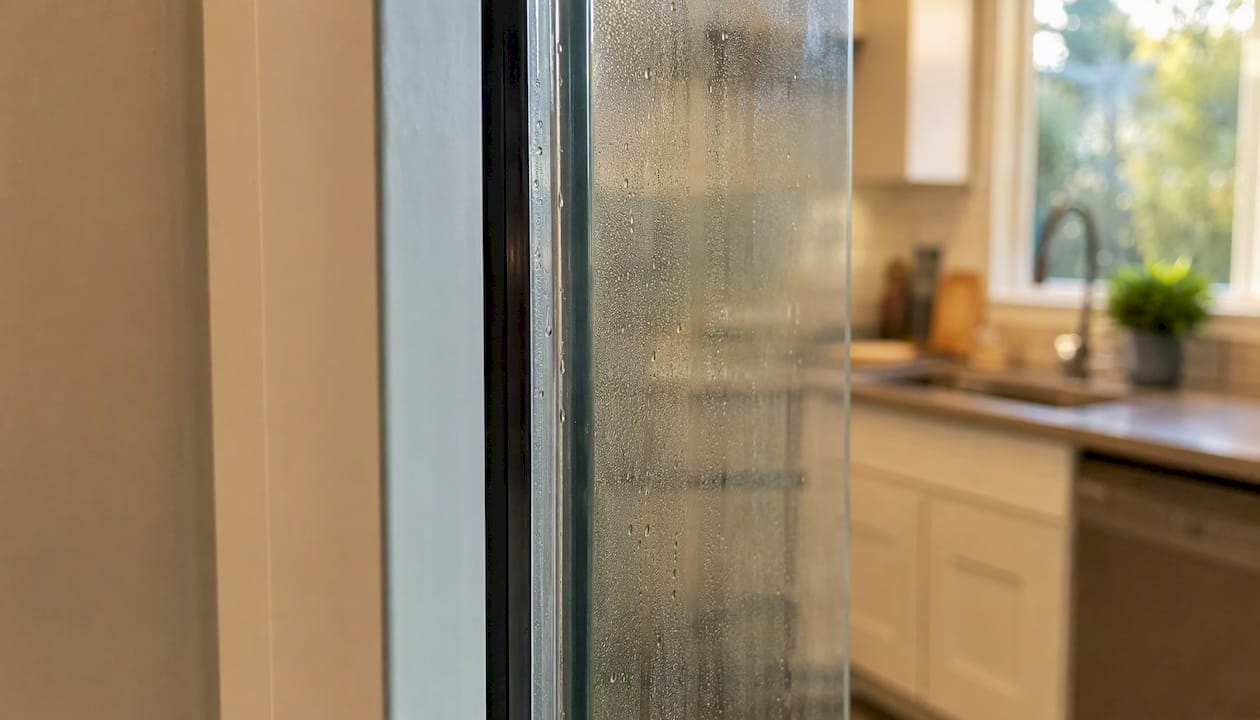
Using panes of different thicknesses, such as 4 mm outer and 6 mm inner, shifts the resonant frequencies of each lite so they do not reinforce each other. Asymmetric glazing consistently outperforms symmetric standard double glazing for traffic noise, often by several dB without adding significant weight or cost.
Triple glazing
Three panes with two air gaps add mass and an extra barrier. Triple glazing excels at thermal insulation and performs well acoustically, but it is not automatically better than acoustic laminated double glazing for noise. A well-specified asymmetric laminated double unit often matches or beats a standard triple-pane unit at lower cost and weight.
Vacuum insulating glass (VIG) and specialty acoustic units
VIG eliminates the gas gap entirely, replacing it with a near-vacuum. The result is a very thin, thermally excellent unit. Acoustic performance is good but not exceptional compared with a large-gap secondary glazing system. Purpose-built acoustic IGUs from specialist manufacturers can reach Rw 40+ in a standard frame, but they carry a significant price premium and longer lead times.
Single-, double-, and triple-pane windows: what the numbers look like
The table below shows typical weighted sound reduction index (Rw) and approximate STC ranges for common glazing configurations. These are representative ranges, not guarantees; actual performance depends on frame, seals, and installation quality.
| Glazing type | Typical Rw / STC range | Noise reduction feel |
|---|---|---|
| Single pane (3–4 mm) | Rw 25 | Minimal; traffic clearly audible |
| Standard symmetric double pane | Rw 30 | Modest; some attenuation |
| Asymmetric double pane (4/6 mm) | Rw 35 | Noticeable improvement |
| Acoustic laminated double pane | Rw 40 | Clear reduction; traffic recedes |
| Triple pane (standard) | Rw 35 | Good, but varies widely |
| Secondary glazing (50–200 mm gap) | Rw 40–50+ | Often the strongest single upgrade |
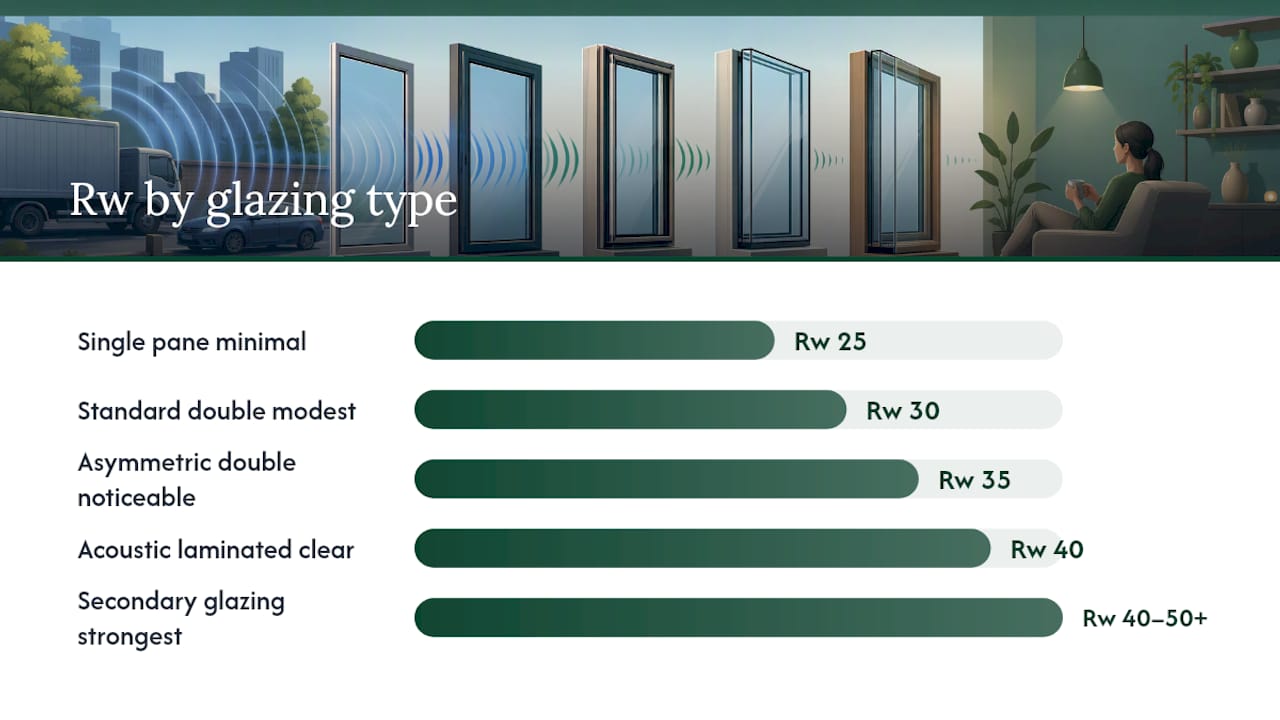
Standard symmetric double glazing is the most common upgrade path, yet it often disappoints for noise because identical panes resonate together at certain frequencies. Asymmetric or laminated configurations fix that problem without requiring a full frame replacement. Secondary glazing with a large air gap can reach Rw values in the mid-40s, which is why it sometimes delivers the largest single acoustic improvement of any retrofit option.
Key points when comparing options:
- Ask for OITC alongside STC for any exterior window product.
- A few decibels of improvement are just perceptible; a larger change can feel roughly half as loud to most listeners.
- Frame and seal quality can shift real-world performance by 5–8 dB versus lab ratings.
Retrofit options: secondary glazing, storm windows, inserts, and full replacement
Not every noise problem requires ripping out the existing window. Several retrofit paths offer strong performance at lower cost and disruption.
Secondary (internal) glazing
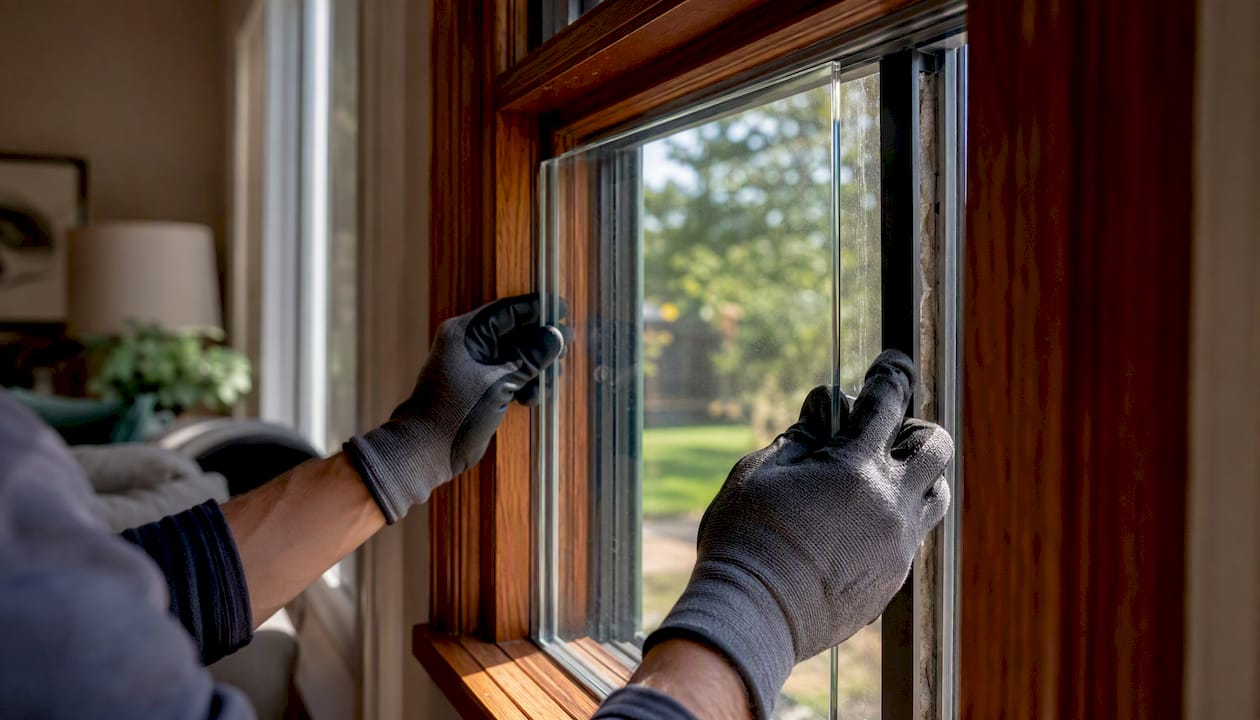
A second glazed panel is fitted inside the existing window reveal, creating a large air gap. The gap is the key: 50–200 mm of separation between the two panes allows the air mass to absorb sound energy far more effectively than a standard IGU’s 12–20 mm cavity. Secondary glazing is also the preferred solution for historic or listed buildings where the original window must be preserved.
Pros: High acoustic performance, reversible, no structural work, renter-friendly in some cases.
Cons: Reduces sill depth, can complicate ventilation, requires clean reveal for a good seal.
Exterior storm windows / decoupled double-window systems
An exterior storm sash is added outside the primary window, creating a decoupled system. Fenestration guidance recommends a minimum 25 mm air gap for high-noise sites; larger gaps perform better. This approach suits homes where the primary window is in good condition but acoustically inadequate.
Acoustic inserts and removable panels
Panels cut to fit inside the window opening, often using acrylic or laminated glass in a foam-gasketed frame, can be removed for ventilation and reinstalled easily. Performance varies widely by product and fit quality. They work best as a temporary or rental-friendly measure rather than a permanent solution.
Full window replacement
When frames are rotted, poorly fitted, or the existing window is single-pane with no upgrade path, full replacement is the right call. It allows specifying the exact glass makeup, frame material, and sealing system from scratch. Full replacement also opens the door to standardized units that carry manufacturer acoustic ratings and warranties.
Retrofit vs. replacement decision checklist:
- Is the existing frame structurally sound? If not, replace.
- Is the building historic or subject to HOA restrictions? Secondary glazing is usually the path.
- Is the noise problem severe (heavy traffic, rail, flight path)? Consider a decoupled system or secondary glazing.
- Is this a rental where reversibility matters? Acoustic inserts or secondary glazing.
What does noise reduction window work cost in the U.S.?
Costs vary significantly by window size, glass specification, frame condition, and local labor rates. The ranges below are typical for the U.S. market and should be treated as planning estimates, not quotes.
| Solution | Typical cost range | Lead / install time |
|---|---|---|
| Weatherstripping and caulk (DIY) | $20–$50 per window | 1–2 hours |
| Acoustic inserts (removable panels) | $150–$300 per window | 1–3 days (custom fabrication) |
| Secondary glazing (internal) | $400–$600 per window | 1–2 days per room |
| Acoustic laminated IGU retrofit | $300–$600 per window | 1–2 weeks (glass order) |
| Full window replacement (acoustic spec) | $600–$1,200 per window | 2–6 weeks |
How to reduce window noise on a budget
Most homes have obvious noise leaks that cost almost nothing to fix. Work through this list before spending money on glass.
- Find the leaks. Hold a stick of incense near the frame perimeter on a windy day. Smoke drift identifies gaps. Alternatively, have someone stand outside and speak at normal volume while you listen from inside with your eyes closed.
- Replace weatherstripping. Self-adhesive foam tape (V-strip or D-profile) costs $5–$15 per window at any hardware store. Replacing worn weatherstripping is one of the most commonly reported low-cost noise fixes and takes under 30 minutes per window.
- Apply acoustic caulk. Standard paintable acoustic caulk (DAP DynaFlex or similar) seals the joint between the frame and the wall. Remove old cracked caulk first.
- Build or buy a window plug. A panel of mass-loaded vinyl (MLV) or rigid foam faced with fabric, cut to fit the opening and seated against the frame, blocks a surprising amount of noise. Total materials cost is typically $20–$60.
- Hang dense curtains. Heavyweight velvet or thermal-backed curtains add mass and absorb reflected sound. They do not block direct transmission well, but they reduce the reverberant noise level in the room noticeably.
Materials you will need: V-strip or D-profile weatherseal tape, acoustic caulk, a caulk gun, and optionally mass-loaded vinyl or rigid foam board. All are available from Home Depot, Lowe’s, or online retailers.
Pro Tip: Download a free dB meter app (NIOSH SLM or Decibel X) and take a 30-second reading before and after each fix with the same noise source playing outside. Even a 3–5 dB drop is real progress and tells you whether to keep going or upgrade the glass.
When should you call a professional window installer?
DIY fixes cover a lot of ground, but several situations call for a contractor.
Hire a pro when:
- Baseline interior noise regularly exceeds 55 dB (roughly the level of a normal conversation) even with windows closed.
- The frame shows rot, gaps at the corners, or visible daylight around the sash.
- You are replacing three or more windows and want consistent acoustic performance across the room or floor.
- The building is historic, subject to HOA rules, or requires a permit for window work.
Questions to ask any contractor before signing:
- Can you provide the OITC and STC test data for the specific glass unit you are proposing?
- What is the exact glass makeup (pane thicknesses, interlayer type, gas fill, spacer width)?
- What dB or STC/OITC improvement should I expect in my specific situation?
- How will the perimeter be sealed, and what warranty covers both the glass unit and the installation?
- What is the written timeline from order to completion?
A contractor who cannot tell you the exact glass makeup is guessing.
The 25 mm gap rule and the weakest link principle
For homes with severe noise exposure, a single upgraded IGU is rarely enough. Fenestration experts recommend a decoupled double-window system with a minimum 25 mm (1 inch) air gap between the primary and secondary window. The gap acts as an acoustic buffer; larger gaps (50–200 mm) perform even better.
The weakest link principle is equally important. A window rated Rw 42 installed in a frame with gaps, set into a wall with uninsulated cavities, will perform like a Rw 30 window in practice. Every component in the sound path, including the frame, the perimeter caulk, the wall assembly, and even the adjacent wall’s insulation, must be addressed together.
Implementation checklist for high-performance acoustic upgrades:
- Commission an acoustic survey or at minimum take calibrated dB readings at multiple points in the room.
- Inspect and repair frame condition before ordering glass.
- Air-seal the full perimeter: frame-to-wall joint, sill, and head detail.
- Specify the glass unit with OITC and Rw data from the manufacturer.
- Install with continuous perimeter gaskets and no bridging between the primary and secondary frames.
- Re-test after installation to confirm the improvement matches the specification.
Most acoustic failures happen at installation, not in the glass factory. Even the best acoustic unit underperforms if glazing beads, perimeter gaskets, or sill details are poorly executed.
When acoustic upgrades are worth prioritizing
The conventional wisdom is to upgrade to double glazing and call it done. That is the right call for mild noise situations. For anything more serious, the order of operations matters more than the product choice.
Seal first, always. A $15 weatherstripping job on a drafty single-pane window often delivers a more noticeable result than swapping to a standard double-pane unit in a leaky frame. The physics are unambiguous: a gap transmits sound almost unimpeded, while even modest glass adds meaningful resistance.
Target the noisiest rooms, not every window in the house. Spending $4,000 on eight windows when three bedroom windows face the road is a poor return. Identify the two or three windows that matter most and spend the budget there on the best glass you can specify.
Secondary glazing deserves more credit than it gets. Most homeowners default to full replacement because it feels more permanent. But for a bedroom on a flight path or a home office facing a highway, internal secondary glazing with a 100 mm gap will often outperform a new triple-pane unit at lower cost and with no structural disruption. The large air gap is doing work that no IGU cavity can replicate.
ROI considerations worth keeping in mind:
- Sleep quality and cognitive performance improve measurably when nighttime noise drops below 40 dB indoors.
- Acoustic upgrades add resale value in urban markets where noise is a known buyer concern.
- Rental properties benefit most from reversible solutions (inserts, secondary glazing) that do not require landlord approval for removal.
Star-ws can handle the whole job in Kansas City
Quieter rooms require more than good glass. They require airtight installation, sound frame condition, and sealed perimeter details. Star Windows Solutions covers every part of that chain for homeowners and property managers in the Kansas City area: weatherstripping and caulking, IGU and acoustic glass replacement, secondary glazing installs, and frame rot repair before new glass goes in.

Every job comes with a written glass specification, manufacturer warranty, and proper perimeter sealing so the unit performs at its rated value, not below it. Free estimates are available with no obligation. If noise is affecting your sleep or your work, the fastest next step is a site visit to identify exactly where the sound is entering and what the most cost-effective fix looks like for your specific windows.
Request a free estimate from Star Windows Solutions and get a clear answer for your Kansas City home.
Sources
- Designing for quiet: How fenestration impacts building acoustics – Construction Specifier
- Best Glass for Noise Reduction Windows: UK 2026 Guide – Vitrums
- Soundproof Windows: Reduce Street Noise in Your Home – Centennial Glass
- Noise pollution isn’t just annoying — it’s bad for your health – BrainFacts
- How can I reduce noise coming in a window for under $100? – DIY Stack Exchange