
For reliable hail protection, choose impact-rated laminated insulated glass in a reinforced fiberglass or steel-reinforced vinyl frame. That combination holds together on impact, keeps the building envelope sealed, and meets the test standards insurers and building codes actually recognize. No window is truly “hail-proof,” but impact-resistant glass built to ASTM E1996/E1886 or TAS 201/202/203 is the closest thing available.
Your three practical options, in order of protection:
- Full replacement with impact-rated laminated IGUs in reinforced frames — permanent, code-compliant, insurable
- Retrofit laminated storm windows over existing units — lower upfront cost, meaningful upgrade
- Temporary measures (polycarbonate panels, shutters, plywood) — for immediate storms only, not a long-term answer
Before hiring anyone, ask for lab reports showing ASTM E1996/E1886 or TAS test results for the specific model they plan to install.
Key Takeaways
Laminated insulated glass in a reinforced frame, verified by ASTM E1996/E1886 or TAS 201/202/203 lab reports, is the most effective permanent protection against hail damage for U.S. homeowners.
| Point | Details |
|---|---|
| Specify laminated IGUs | Laminated interlayer holds shards together; paired with an IGU for thermal performance. |
| Demand lab reports | Ask for ASTM E1996/E1886 or TAS 201/202/203 test reports for the exact model being installed. |
| Impact-rated costs 30–60% more | The premium over standard double-pane is offset by longer lifespan and potential insurance discounts. |
| IGU seal failure requires replacement | Fogging between panes after a storm means the unit must be replaced, not repaired. |
| Star-ws serves Kansas City | Star Windows Solutions provides impact-rated installations, emergency repairs, and insurance documentation locally. |
Table of Contents
- How does hail actually damage your windows?
- What construction features make a window hail resistant?
- Which test standards should you demand from installers?
- Which frame materials hold up best in hail-prone climates?
- What are your retrofit and temporary protection options?
- What do hail resistant windows cost, and what does insurance cover?
- How do you vet and hire a qualified installer?
- What Star-ws offers for hail-resistant upgrades in Kansas City
- What I’d tell a homeowner comparing offers right now
- Star-ws handles hail-resistant window work in Kansas City
- Sources
How does hail actually damage your windows?
Hail damage is a physics problem. A hailstone’s destructive energy scales with both its size and speed. A 1-inch stone traveling at 40 mph carries enough kinetic energy to crack standard single-pane glass. At 1.5–2 inches in diameter, which hailstones in many U.S. hail-prone states regularly reach, that energy is enough to shatter standard insulated glass units (IGUs) outright or fracture the outer lite while leaving the inner one intact but compromised.
The failure modes that matter most aren’t always the dramatic ones. A cracked outer lite is obvious. What homeowners miss is the subtler damage: a hard impact can break the IGU’s perimeter seal without visibly cracking either pane. Once that seal fails, moisture infiltrates the gap, fogging appears within days or weeks, and the insulating gas (argon or krypton) escapes. Even without visible cracking, a failed IGU seal requires replacement — repair is not an option for a breached sealed unit.
After a storm, look for these specific signs:
- Cracked or starred glass on the outer lite, even hairline fractures
- Fogging or condensation between panes — seal failure, not surface moisture
- Dented or bent frame corners where the frame absorbed impact energy
- Gaps in weatherstripping or caulk along the frame perimeter
- Water staining on the interior sill indicating a pressure breach
Frame fracture is the least visible and most expensive failure. A frame that cracks at a corner loses its structural connection to the rough opening, and no amount of caulk fixes that.
What construction features make a window hail resistant?
The single most important feature is a laminated interlayer. Standard tempered glass shatters into small cubes on hard impact — it’s safer than annealed glass for human contact, but it offers no resistance to penetration. Laminated glass bonds two or more glass lites around a polymer interlayer, typically polyvinyl butyral (PVB) or the stiffer SentryGlas ionoplast. When struck, the glass may crack, but the interlayer holds the shards in place and maintains the window’s barrier function. Pella’s impact testing confirms this: their laminated units are subjected to a 2×4 missile fired at the glass and then cycled under thousands of pressure cycles to verify the unit stays intact post-impact.
A laminated IGU (insulated glazing unit) adds a second sealed air or gas space for thermal performance. That’s the configuration worth specifying for most U.S. climates: impact protection on the outer lite, insulation value from the sealed cavity.
| Glazing type | Protection level | Retrofit suitability | Energy/noise | Maintenance/lifespan |
|---|---|---|---|---|
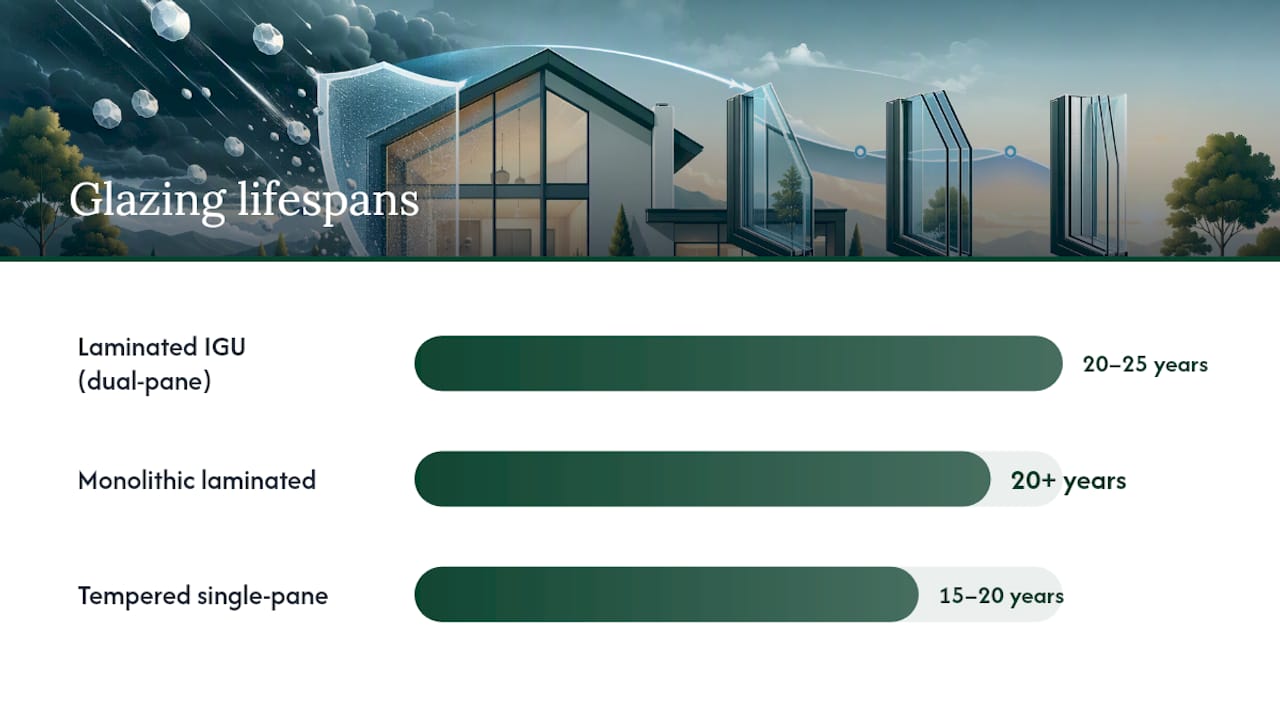
| Laminated IGU (dual-pane) | Resists small and large hail, debris | Full replacement only | High — argon fill, low-E coating options | 20–25 years; seal inspection every 5 years |
| Monolithic laminated (single) | Resists small to moderate hail | Possible in some frames | Lower thermal value; good noise reduction | 20+ years; no IGU seal to fail |
| Tempered single-pane | Resists minor impacts only | Yes, direct swap | Poor thermal; moderate noise | 15–20 years; shatters on hard strike |
| Polycarbonate panel | Resists large hail and debris | Yes, surface-mount | Poor thermal; good noise | —; yellows with UV exposure |
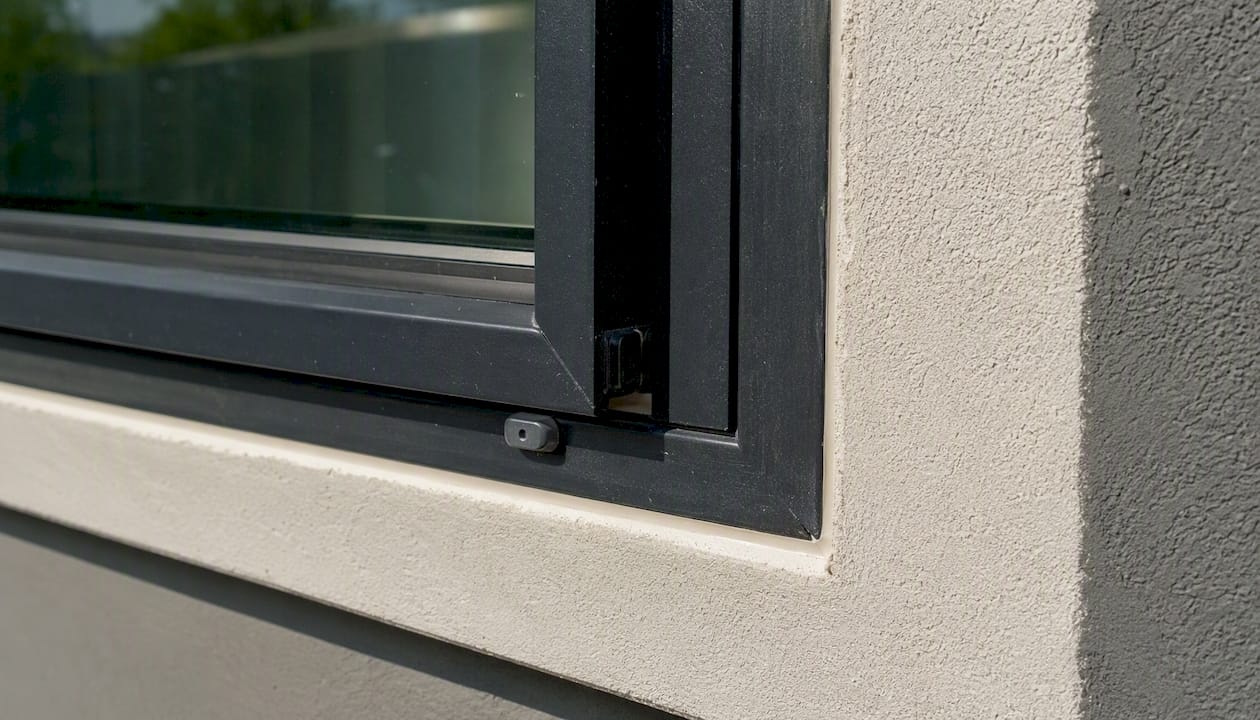
Frame strength matters as much as the glass. A laminated lite in a flimsy vinyl frame can still fail if the frame flexes enough to break the glazing bead seal. Reinforced fiberglass frames resist both impact and thermal expansion. Steel-reinforced vinyl offers a middle ground: the steel insert prevents racking while the vinyl exterior handles weathering. Aluminum frames are stiff but thermally conductive unless the profile includes a thermal break. Wood and composite frames absorb shock well but require more maintenance in hail-prone climates where repeated impacts can split painted surfaces.
Pro Tip: Specify a laminated IGU when you need both impact protection and thermal performance — the two-in-one construction is worth the premium in most U.S. climates. A monolithic laminated pane is the right call only when retrofitting into an existing frame that can’t accommodate the added thickness of a full IGU.
Which test standards should you demand from installers?
Knowing the standard names is what separates a homeowner who gets the right product from one who gets a sales pitch. The two most important U.S. test protocols are:
ASTM E1886/E1996 — the dominant standard for impact-resistant fenestration in the continental U.S. E1886 is the actual test method (how the test is run); E1996 is the specification (what the product must survive). Together they define missile levels: a Missile Level D test fires a 9-pound 2×4 stud at the unit. Surviving that test, plus 9,000 positive and negative pressure cycles, is what earns an “impact-rated” designation.
TAS 201/202/203 — Florida’s testing application standards, required for products sold in Florida’s High-Velocity Hurricane Zone. TAS 201 covers impact, TAS 202 covers cycling, and TAS 203 covers uniform static air pressure. Products with TAS approval are generally the most rigorously tested available for residential use.
PG (Performance Grade) ratings measure air infiltration, water penetration resistance, and structural load capacity. Andersen confirms that true impact resistance requires both missile impact testing AND PG testing — a window can pass a missile test but still fail at air and water performance under sustained wind pressure. Ask for both.
For the highest occupant protection in extreme-weather environments, ICC 500 and FEMA 361 are the most stringent standards, used for storm shelters and safe rooms. Most residential applications don’t require that tier, but critical facilities or safe room installations should specify it.
Ask every installer these exact questions before signing anything:
“Do you have lab reports for ASTM E1996/E1886 or TAS 201/202/203 for this specific model?”
“What is the PG rating for air, water, and structural performance?”
“Can you show me the NFRC label for energy performance?”
“Is this product listed with an ICC-accredited testing lab?”
Consumer Reports’ lab testing reinforces why this matters: impact-rated storm windows are built specifically to survive flying debris and extreme winds, and lab-tested performance is the most reliable predictor of field results. Marketing copy is not a substitute.
Which frame materials hold up best in hail-prone climates?
Frame choice affects both how the window survives a direct hit and how long it maintains its seal between storms.
Fiberglass is the strongest performer in hail-prone zones. It doesn’t expand or contract significantly with temperature swings, which keeps the glazing bead tight and the IGU seal intact over years of thermal cycling. The tradeoff is cost: fiberglass frames typically run higher than vinyl. Contractor experience in high-exposure climates points to fiberglass and composite frames as the preferred choice for repeated hail exposure.
Steel-reinforced vinyl is the practical middle ground for most homeowners. The steel insert prevents the frame from racking under lateral impact, and welded corners (not mechanically fastened) are critical — a welded corner won’t open up under repeated stress the way a screwed joint can.
Thermally broken aluminum suits commercial applications and modern residential designs. The thermal break prevents condensation on interior surfaces, but aluminum’s rigidity means it transfers impact energy directly to the frame anchors. Inspect anchor points after any significant hail event.
Wood and composite frames absorb shock reasonably well, but painted wood surfaces chip and split under repeated hail, creating entry points for moisture. Composite (wood-fiber/polymer) performs better and requires less maintenance, but neither matches fiberglass for long-term durability in storm-prone areas.
A few installation details that separate a quality job from a problem one:
- Glazing bead design: the bead should be mechanically retained, not just friction-fit, so it can’t be dislodged by impact vibration
- Welded frame corners: look for a continuous weld, not corner keys
- Drainage details: weep holes in the sill must be clear; blocked drainage causes water to pool against the IGU seal
Pro Tip: Ask your installer whether the frame corners are welded or mechanically joined before you approve the product. On a vinyl frame, welded corners add maybe $20–30 per window at the factory and can add years to the frame’s service life in a hail-prone climate.
What are your retrofit and temporary protection options?
Not every situation calls for a full replacement. Here’s how the options stack up, from most to least effective:
- Impact-rated full replacement — the only permanent solution; addresses glass, frame, and seal simultaneously
- Laminated storm windows (interior or exterior retrofit) — add a laminated lite over existing windows; meaningful protection against moderate hail without full replacement
- Polycarbonate panels — surface-mounted over the window opening; stops large hail and debris but adds no thermal value and yellows over time
- Roll-up or accordion storm shutters — fast to deploy, good debris protection, but require permanent hardware installation
- Emergency plywood — last resort before a storm; stops penetration but can trap moisture against the frame if left more than 48 hours
For plywood or polycarbonate emergency installation:
- Cut panels to overlap the window frame by at least 2 inches on all sides
- Pre-drill fastener holes to prevent splitting
- Use 3-inch structural screws into the framing, not just the cladding
- Space fasteners no more than 12 inches apart around the perimeter
- Remove within 48 hours after the storm to prevent moisture damage to frames and siding
Retrofit storm windows perform well against moderate hail and flying debris. Consumer Reports confirms that impact-rated storm windows are specifically built to survive flying debris — but they won’t address an existing IGU seal that’s already compromised, and they add a second air space that can trap condensation if not properly vented.
Pro Tip: For a quick pre-storm response, polycarbonate panels are faster to install than plywood and won’t splinter. Avoid taping plastic sheeting directly to glass — the adhesive can etch the surface and the sheeting provides almost no impact resistance.
What do hail resistant windows cost, and what does insurance cover?
Impact-rated windows cost more upfront. The premium over standard double-pane units runs roughly 30–60% higher, depending on size, frame material, and glazing configuration. For a typical residential window, installed costs generally fall in the $400–$1,000 range per window for standard sizes with laminated IGU glazing; larger, shaped, or decorative-grid units push toward the higher end. Get local quotes — Kansas City pricing differs from coastal markets where impact glazing is code-required and volume is higher.
Lifespan for a quality laminated IGU in a fiberglass or reinforced vinyl frame runs 20–25 years under normal conditions. Hail-prone climates shorten that if the frame takes repeated direct hits. When to replace rather than repair:
- Any IGU seal failure (fogging between panes) — repair is not possible, replacement is required
- Frame fracture at corners or anchor points
- Two or more impact events that cracked the outer lite — cumulative micro-fractures weaken the interlayer bond
Insurance considerations are worth a direct conversation with your carrier before you buy. Some insurers offer premium discounts for impact-rated glazing, particularly in high-risk states. The discount varies by carrier and policy, so ask specifically about your hail-risk zone. For a post-storm claim, your installer should supply:
- Lab test reports (ASTM or TAS) for the replacement product
- Itemized invoice with model numbers and serial numbers
- Pre- and post-installation photos
- NFRC label documentation for energy performance
Qualifying energy-efficient window upgrades may also be eligible for the IRS Energy Efficient Home Improvement Credit — retain your NFRC documentation and confirm eligibility with a tax professional, since the credit applies to specific performance thresholds, not all impact-rated products automatically.
Beyond insurance, the ROI case for window replacement includes reduced heating and cooling costs from better-insulated glazing, lower risk of interior water damage after storms, and avoided emergency repair costs after a major hail event.
How do you vet and hire a qualified installer?
The window is only as good as the installation. A laminated IGU installed with incorrect shimming, inadequate fastening, or missing flashing will fail at the frame long before the glass gives out.
Hiring checklist:
- Request lab test reports (ASTM E1996/E1886 or TAS 201/202/203) for the specific product model they plan to install
- Verify contractor licensing and liability insurance in your state
- Ask for three local references from hail-related installs specifically
- Compare written warranties — both the manufacturer’s product warranty and the installer’s labor warranty
- Confirm the installation method: how they flash the rough opening, what sealant they use, and how they handle drainage
Questions worth asking directly:
- “What PG rating does this product carry for air, water, and structural performance?”
- “Will you provide NFRC labels for my insurance and tax documentation?”
- “How do you handle frame shimming and flashing at the rough opening?”
- “What does your labor warranty cover, and for how long?”
Red flags to walk away from:
- Unwillingness to produce lab reports (“trust us, it’s impact-rated” is not documentation)
- No local references for hail-specific installs
- Warranty terms that exclude storm damage or require manufacturer arbitration
- A bid significantly below other local quotes without a clear explanation
Common installation mistakes — improper shimming, skipped flashing, wrong sealant — account for a large share of early window failures. A qualified installer will walk you through their process without being asked.
What Star-ws offers for hail-resistant upgrades in Kansas City
Star Windows Solutions serves residential and commercial properties across the Kansas City area with a full range of impact-rated glass and window services. For homeowners and property managers dealing with hail damage or planning upgrades before storm season, the relevant services include:
- Impact-rated glass installation for residential windows and doors
- Emergency glass replacement after storm events, with fast turnaround
- Insurance documentation support — itemized invoices, product documentation, and photo records for claims
- Commercial window replacement for multi-unit and commercial properties
- Glass replacement services with documented workflows for insurance and warranty purposes
A local installer matters for more than convenience. A Kansas City-based team knows the regional hail risk profile, can conduct a proper site survey to confirm frame condition before specifying glass, and can respond quickly for emergency repairs after a storm. Fitment tolerances for replacement glazing require on-site measurement — a remote order-and-ship approach routinely produces units that don’t seat correctly.
Property managers coordinating repairs across multiple units benefit from working with a single local provider who can schedule repairs efficiently and supply consolidated documentation for insurance claims.
What I’d tell a homeowner comparing offers right now
The gap between a good impact window and a mediocre one isn’t visible from the street. Both look like windows. The difference shows up in the lab report the installer either can or can’t produce, in the frame corner that either holds or opens up after three hail seasons, and in the warranty that either covers storm damage or quietly excludes it.
Prioritize laminated insulated units in reinforced frames for any permanent installation. If the budget forces a phased approach, retrofit laminated storm windows over your most exposed elevations first — south and west faces take the most hail in the Kansas City region — and plan full replacement within two to three years. The lifecycle cost of a quality installation almost always beats the cumulative cost of repeated repairs and insurance deductibles on standard glass.
Star-ws handles hail-resistant window work in Kansas City
Hail season in the Kansas City area runs hard from spring through early fall, and the window between a storm warning and actual impact is short. Star Windows Solutions offers free estimates for both residential and commercial hail-resistant window upgrades, with financing options available for larger projects.
A free estimate from Star-ws includes an on-site survey of your existing frames, a product recommendation with test documentation, and a clear timeline. For post-storm emergency replacements, the team provides the itemized invoices and product records your insurer will ask for. Whether you need a single residential window replaced or a commercial glass replacement across multiple units, Star-ws delivers documented, warranted work in the Kansas City area. Request your free estimate at Star-ws.
Sources
The standards and testing pages below let you verify product claims and read lab methodology directly.
- Impact Resistant Windows and Doors | Pella
- Impact-resistant windows & doors | Andersen Windows
- 3 Best Storm Windows of 2026, Lab-Tested and Reviewed
- Best Windows for Hail‑Prone States | 123 Exteriors
- Irs
When reading a lab report, look for the specific missile level tested (Level D for a 2×4 stud), the number of pressure cycles completed, and the PG rating for air, water, and structural performance. An NFRC label confirms energy performance independently of impact claims.