
Most replacement window warranties cover manufacturing defects in the glass, frame, and hardware, but they vary widely on how long that coverage lasts and whether labor is included. A “lifetime” warranty rarely means what it sounds like. If a window is failing right now, here’s what matters immediately.
- Coverage basics: Glass seal failures, frame defects, and hardware malfunctions are typically covered; labor coverage often lasts a limited number of years even under a “lifetime” glass warranty.
- Next steps today: Locate your purchase paperwork and the product ID sticker on the frame, photograph the damage, then contact your installer before the manufacturer if the problem looks installation-related.
Reality check: the word “lifetime” on a warranty document almost never means forever. According to the FTC’s consumer warranty guidance, warranty terms are legally binding as written, so the fine print, not the marketing headline, determines what you’re owed.
Key Takeaways
Replacement window warranties protect against manufacturing defects, but labor coverage, proration schedules, and documentation habits determine whether a claim actually gets paid.
| Point | Details |
|---|---|
| Verify what “lifetime” means | Ask for the exact proration schedule; “lifetime” often refers to ownership length, not permanent full coverage. |
| Separate defect from installation issues | Contact the installer first for workmanship problems and the manufacturer only for product defects. |
| Keep documentation from day one | Save receipts, product IDs, and dated photos, since missing paperwork is a leading cause of denied claims. |
| Prioritize labor and transferability | Weigh these over advertised years when comparing warranty offers before purchase. |
| Star-ws documentation supports claims | Star-ws hands owners product IDs, receipts, and checklists at installation to speed future warranty support. |
Table of Contents
- Types of Replacement Window Warranties Explained
- What Do Window Warranties Cover and Exclude?
- Which Maintenance Rules Can Void Your Warranty?
- How Does Proration Work Over the Life of a Window?
- Can You Transfer a Window Warranty to a New Owner?
- How Do You File a Window Warranty Claim?
- What Should You Ask Before Buying Window Warranties?
- How Star-ws Protects Your Warranty Coverage
- The Real Gap in Most Warranty Advice
- Get Warranty-Backed Window Replacement From Star-ws
- Sources
Types of Replacement Window Warranties Explained
Warranty labels get thrown around loosely by sales reps, and that’s where homeowners get burned. A limited lifetime warranty usually covers specific components, often the glass seal, for as long as the original buyer owns the home, while excluding labor, hardware, or cosmetic issues after a set number of years. A full lifetime warranty is broader and rarer, sometimes covering labor and parts indefinitely for the original owner, with no proration.
Prorated warranties are the ones that surprise people. Say a manufacturer covers a window part at 100% for the first 5 years, then reduces its contribution by 10% annually after that.
- Limited lifetime: component-specific coverage tied to original ownership, often with labor cutoffs.
- Full lifetime: broader coverage, sometimes including labor, with no ownership caveats in the strongest versions.
- Prorated: your cost share increases as the window ages, even under a “lifetime” label.
- Extended warranties: optional paid add-ons that typically extend labor coverage, worth it mainly if you’re not confident in the installer’s own workmanship guarantee.
What Do Window Warranties Cover and Exclude?
Coverage breaks down by component, and knowing the breakdown helps you spot a weak warranty before you sign a contract. Insulated glass units are the most commonly protected part, specifically against seal failure that causes fogging or condensation between panes. Frames, sashes, and hardware like locks, cranks, and balances usually get their own coverage terms, often shorter than the glass warranty.
Labor is the wild card. This Old House’s warranty guidance notes that coverage varies significantly between manufacturers, and it rarely includes damage from improper installation or homeowner neglect.
Commonly covered:
- Glass seal failure causing fog or moisture between panes
- Frame or sash material defects
- Hardware malfunction under normal use
- Limited labor, usually for a shorter term than the parts themselves
Commonly excluded:
- Accidental breakage (a baseball through the glass, storm impact)
- Damage from severe weather events
- Improper installation by a third party
- Cosmetic fading, discoloration, or minor scratches
- Modifications made after installation, including aftermarket tinting or hardware swaps
Material matters too. Vinyl frames often carry longer warranties than wood, since wood is more vulnerable to rot and moisture damage that manufacturers classify as maintenance-related rather than defect-related. If you’re dealing with an older wood frame already showing decay, understanding frame rot repair options helps you separate a warranty issue from a maintenance one before you file a claim.
Which Maintenance Rules Can Void Your Warranty?
Warranty documents almost always include a maintenance clause, and skipping it is one of the most common reasons claims get denied. Manufacturers expect you to clean tracks, lubricate hardware, and re-caulk exterior seams periodically. Failing to do so can void coverage even when the underlying defect is real, because the manufacturer can argue neglect caused or worsened the problem.
- Clean glass and frames with manufacturer-approved products, not harsh solvents or abrasive tools.
- Lubricate hinges, locks, and balances at least once a year.
- Re-caulk exterior joints when you see cracking or gaps, since water intrusion is a top reason claims get contested.
- Keep a dated log with photos each time you perform maintenance.
Workmanship and manufacturer warranties cover different failures entirely. If a window leaks because it was installed out of square, that’s an installer problem, not a manufacturer defect, and a good installer’s workmanship guarantee should fix it without ever touching the manufacturer’s claim process.
Pro Tip: Take timestamped photos at installation and every time you perform maintenance. A simple dated folder on your phone becomes powerful evidence if a manufacturer later argues the damage was preexisting rather than a covered defect.

How Does Proration Work Over the Life of a Window?
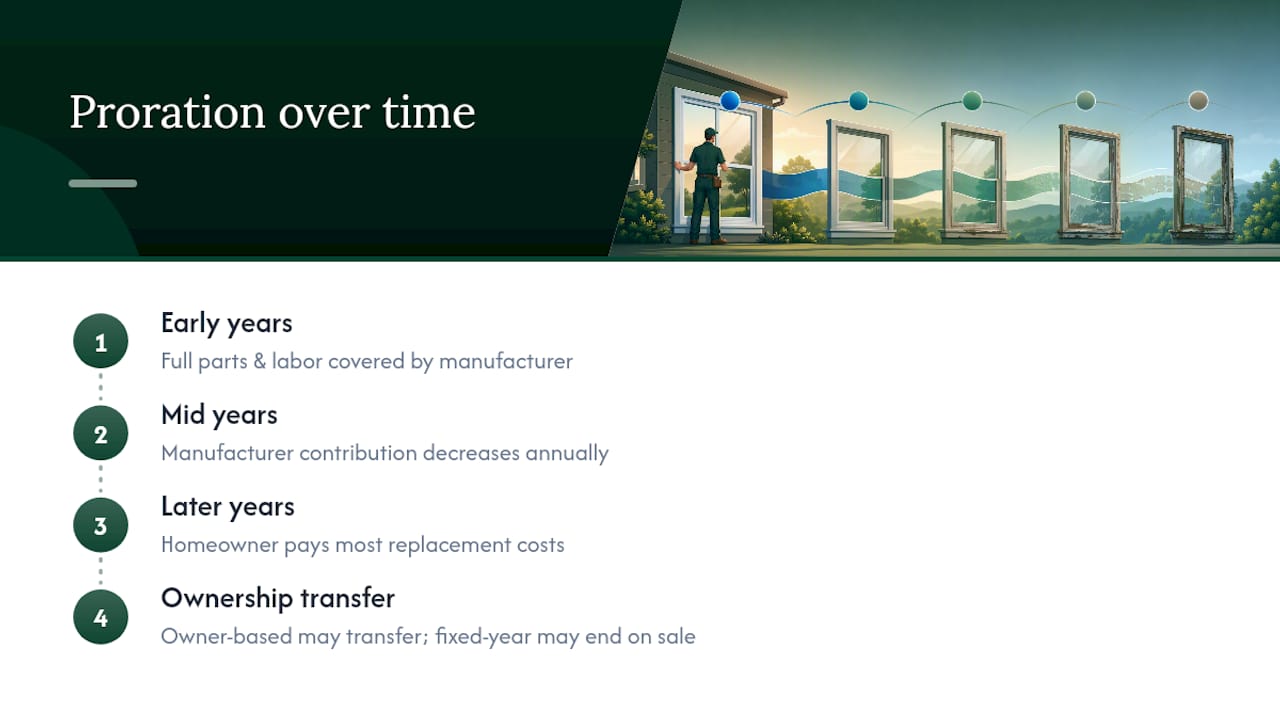
“Lifetime” coverage is often structured so your financial responsibility grows every year you own the windows. A typical prorated warranty schedule includes full coverage initially, with manufacturer contribution decreasing annually over time, ultimately leaving most replacement costs to the homeowner
Warranty coverage levels often start with full parts and labor coverage in the early years, then manufacturer coverage decreases steadily while homeowner responsibility grows as the windows age.
Owner-based lifetime coverage differs from fixed-year lifetime promises, too. Some warranties end the moment you sell the home; others transfer with reduced terms. The FTC notes that “lifetime” has no single legal definition, so read the exact schedule in your paperwork rather than trusting the word on its own.
Can You Transfer a Window Warranty to a New Owner?
Warranty transfer rules matter whether you’re selling your home or buying one with existing replacement windows. Most manufacturers allow a one-time transfer to a subsequent owner, but only within a limited window, often 30 to 90 days after the sale closes, and usually with a reduced remedy or shorter remaining term.
- Notify the manufacturer of the ownership change within their stated deadline.
- Submit the original product ID, purchase receipt, and proof of sale.
- Confirm in writing what coverage carries over, since many warranties drop labor coverage for second owners even when parts coverage continues.
- If you’re buying a home, request the warranty documents and product IDs at closing, not after.
How Do You File a Window Warranty Claim?
Start by identifying whether the issue is a product defect or an installation problem, because that determines who you call first.
- Document everything immediately. Photograph the defect, locate the product ID sticker on the frame, and pull your original purchase order or invoice.
- Contact the installer first if workmanship is the likely cause. A properly installed window shouldn’t leak, stick, or bow; if it does, the installer’s own guarantee should apply before any manufacturer claim.
- Contact the manufacturer directly for product defects, such as glass seal failure or hardware that fails under normal use. Expect an initial response within a few business days and an inspection scheduled within a few weeks.
- Know your likely remedy. Manufacturers typically offer repair, replacement, or in rare cases a partial refund; replacement parts may not perfectly match original color or texture if the product line has changed.
Pro Tip: Keeping your original receipt and product ID label on file from day one is the single biggest factor in whether a claim gets approved quickly or gets stuck in a paperwork dispute.
What Should You Ask Before Buying Window Warranties?
The warranty length printed on a brochure tells you far less than the answers to a handful of direct questions.
- “Is labor covered, and for how long?” Glass coverage means little if you’re paying $300 in labor to swap it.
- “Is this warranty prorated, and can I see the exact schedule?”
- “Who handles claims, and is there a local service network, or will I be shipping parts and waiting on a call center?”
- “Is the warranty transferable, and what changes for a second owner?”
Watch for red flags: vague “lifetime” language with no defined schedule, no local installer network backing the manufacturer’s promise, a claims process buried in legal jargon, or paperwork that doesn’t match what the sales rep told you verbally. A clearly written warranty page that spells out terms in plain language, the kind you’ll find from reputable manufacturers across home-improvement categories, is a good benchmark for comparison. Weigh labor coverage and transferability heavier than the number of years advertised.
How Star-ws Protects Your Warranty Coverage
Warranty coverage is only as good as the paperwork behind it, and that’s where most homeowners lose ground without realizing it. Star-ws documents every installation with a pre and post-install checklist, then hands owners their product IDs, receipts, and warranty registration details directly, so nothing gets lost between the purchase and the day you might need it.
- Pre-install and post-install checklists create a documented record of window condition and installation quality.
- Product IDs and receipts are handed to homeowners at project completion, not buried in an email you’ll forget.
- On-site assessments help homeowners tell the difference between a manufacturer defect and an installation issue before a claim gets filed.
- Claim paperwork support speeds up manufacturer response times because the documentation is already organized.
Homeowners who keep dated photos and receipts from day one consistently see faster, cleaner claim approvals than those who wait until something fails to start gathering proof.
Reviewing how professional installation supports long-term investment value shows why the documentation habit matters as much as the windows themselves.
The Real Gap in Most Warranty Advice
Most warranty guides treat “lifetime” as a selling point instead of a term you need to interrogate. That’s backwards. The research is consistent: the FTC has no standard definition for “lifetime,” manufacturers apply the word inconsistently, and proration schedules quietly shift the financial burden to homeowners years after the sale is closed. The conventional advice, compare warranty length, misses the point entirely. Length means almost nothing if labor isn’t covered or the schedule prorates hard after year five.
What actually protects you is boring: documentation, maintenance logs, and knowing whether your problem is a manufacturer defect or an installation failure before you call anyone. Homeowners who treat the warranty document like a contract, not a marketing brochure, get better outcomes when something actually goes wrong. Read the remedies section before you buy, not after you need it. Ask about labor and transferability before you ask about years. That’s where the real value lives, and it’s the part sales conversations skip almost every time.
— Artem
Get Warranty-Backed Window Replacement From Star-ws
Star-ws is the practical alternative to guessing your way through a warranty claim months after installation. Every project comes with documented product IDs, receipts, and installation checklists handed directly to you, so when a manufacturer asks for proof, you already have it organized instead of digging through old emails. That documentation habit, paired with a workmanship guarantee that catches installation issues before they ever become a denied manufacturer claim, is the difference between a warranty that protects you and one that just sits in a drawer.
If you’re weighing a replacement now, start with a free estimate on commercial window replacement or ask about glass replacement options if a current seal failure is your immediate problem. Either way, you leave with paperwork in hand, not a promise to track down later.