
A warm edge spacer is a low-conductivity bar that separates the panes in an insulated glass unit, replacing the metal channel that once ran around every window’s perimeter. Swap aluminum for one and the whole-window U-factor typically improves, edge-of-glass temperatures rise, and condensation risk at the sightline drops. Manufacturers report conductivity several hundred times lower than aluminum in comparable cross-sections, and classification for the category runs through Annex E of DIN EN ISO 10077-1 and Annex B of DIN EN ISO 12631, with manufacturer alignment coordinated through the Warm Edge Working Group.
Choose warm edge whenever a project needs to hit a strict whole-window U-value, faces cold-climate condensation complaints, or already uses triple glazing and low-E coatings that make the spacer the weakest remaining thermal link.
- Reduces thermal bridging at the glass edge
- Raises interior edge temperature, cutting condensation
- Improves whole-window U-factor without changing the glass package
- Backed by DIN EN ISO annexes and Warm Edge Working Group consensus
Key Takeaways
Warm edge spacers lower thermal conductivity at the glass edge, which raises interior edge temperature, reduces condensation risk, and improves whole-window U-factor by roughly 8 to 12 percent in typical low-E, argon-filled configurations.
| Point | Details |
|---|---|
| Core mechanism | Low-conductivity materials replace aluminum’s direct thermal bridge at the glass edge. |
| Measurable gain | Expect roughly an 8-12% whole-window U-factor improvement in common double-glazed setups. |
| Material choice matters | Rigid hybrids suit existing bending lines; foam and TPS suit curtain walls and complex shapes. |
| Standards to request | Ask for data referencing DIN EN ISO 10077-1 Annex E or DIN EN ISO 12631 Annex B. |
| Star-ws role | Star-ws specs and installs warm-edge-enabled IGUs for Kansas City area homes and commercial properties. |
Table of Contents
- How Do Warm Edge Spacers Reduce Heat Loss?
- What Spacer Materials and Types Are Available?
- How Much Do Warm Edge Spacers Improve U-Factor?
- What Standards Govern Warm Edge Spacer Performance?
- How Do You Choose the Right Spacer for Your Project?
- Which Manufacturers Make Warm Edge Spacers?
- When Do Warm Edge Spacers Become Essential?
- What We Recommend in the Field
- Where to Verify Spacer Data and Standards
- Get Warm Edge Performance Installed Right
- Frequently Asked Questions
- Sources
How Do Warm Edge Spacers Reduce Heat Loss?
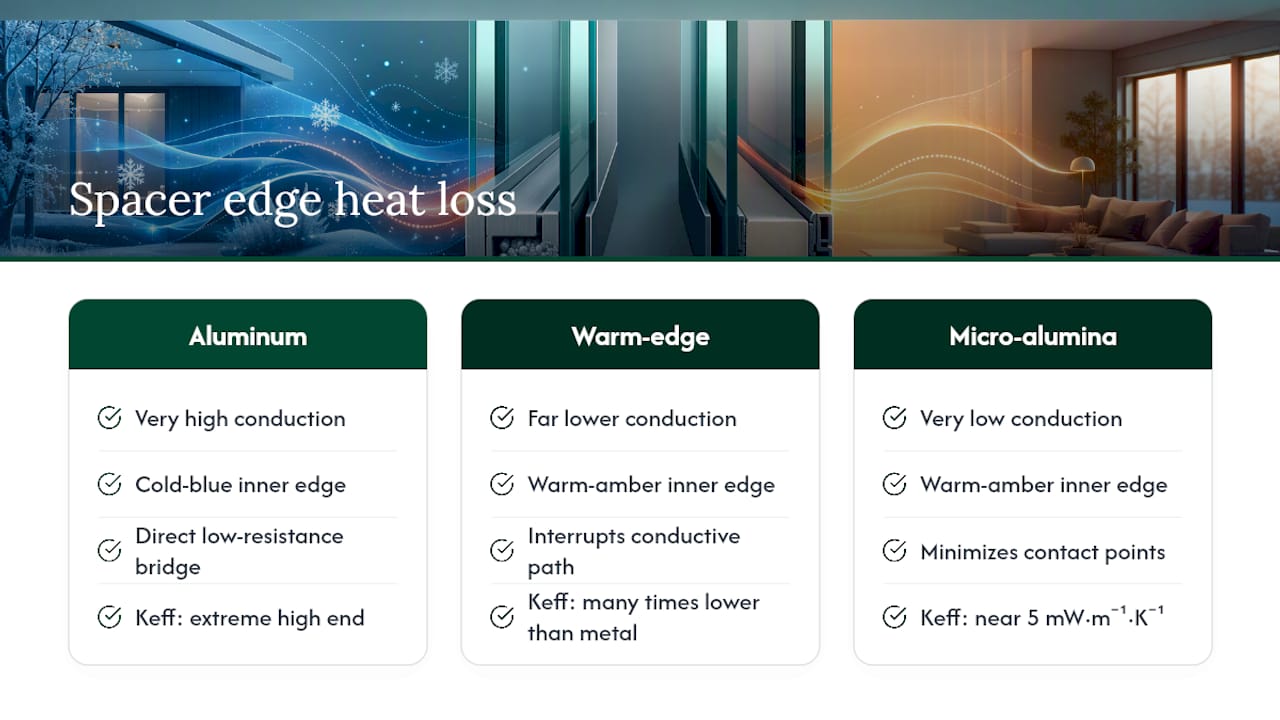
Heat moves through a window spacer the same way it moves through any solid: via conduction along the material’s own molecular path. Aluminum is an excellent conductor, which is exactly the problem. It creates a direct, low-resistance bridge between the warm interior pane and the cold exterior pane, pulling heat out through the edge far faster than through the center of the glass. Warm edge materials interrupt that path with polymers, foams, or hybrid structures that conduct far less efficiently, so less heat escapes and the interior edge of the glass stays measurably warmer.
Manufacturer data illustrate the scale of the gap. Aluminum sits at the extreme high end of thermal conductivity, while structural foam and thermoplastic spacer systems fall into a completely different class, often cited at conductivities many times lower than metal spacer bars. At the far edge of what spacer architecture can achieve, microfabricated alumina spacer research measured effective thermal conductivity near 5 mW·m⁻¹·K⁻¹, achieved by minimizing contact points between surfaces rather than relying on a solid conductive channel.
A cross-section diagram with a false-color temperature gradient, cold blue at an aluminum edge, warm amber at a polymer edge, makes this instantly legible to a client or code official.
Pro Tip: When comparing manufacturer Keff (effective thermal conductivity) values, confirm the test used the same glass makeup and gap width. Keff numbers are not always apples to apples across brands.
What Spacer Materials and Types Are Available?
Spacer selection comes down to matching material behavior to your production line and performance target, not picking whichever bar is cheapest per linear foot. Each family below trades thermal performance against processability differently.
- Thermoplastic spacers (TPS): applied as a warm extrusion directly to the glass, offering some of the lowest conductivity figures but requiring dedicated application equipment rather than a standard bending line.
- Structural foam spacers: flexible, cold-bendable, and well suited to curved or irregular sightlines; commonly ship pre-desiccated with an integrated molecular sieve.
- Stainless steel hybrid spacers: rigid composite profiles that often run on existing aluminum bending equipment with minor tooling changes, a practical bridge for fabricators not ready to retool.
- Plastic-metal hybrid spacers: combine a low-conductivity polymer body with a thin metal vapor barrier, balancing strength and thermal performance.
Rigid hybrids suit high-volume residential retrofit lines already set up for metal bending. Flexible foam and TPS earn their keep on curtain walls, custom shapes, and commercial storefront projects where the spacer has to follow a complex frame geometry. Uniglass’s overview of aluminum, warm edge, and TPS spacer technology breaks down these tradeoffs in more depth. Aluminum still has a legitimate role in storefront framing where structural rigidity outweighs edge-of-glass thermal concerns.
How Much Do Warm Edge Spacers Improve U-Factor?
Numbers make this decision concrete. Kawneer’s thermal charts show that switching from aluminum to a warm-edge spacer can improve whole-product U-factor by roughly 8 to 12 percent in typical double-glazed, low-E, argon-filled configurations, with no change to the frame or glass package. That is a meaningful swing when a project sits right on the edge of a code threshold.
| Configuration | Spacer type | Approximate impact |
|---|---|---|
| Double-glazed, low-E, argon | Aluminum | Baseline U-factor |
| Double-glazed, low-E, argon | Warm edge | 8-12% U-factor improvement |
| High-performance triple glazing | Aluminum | Can prevent meeting target U-value |
| High-performance triple glazing | Warm edge | Often required to hit target |
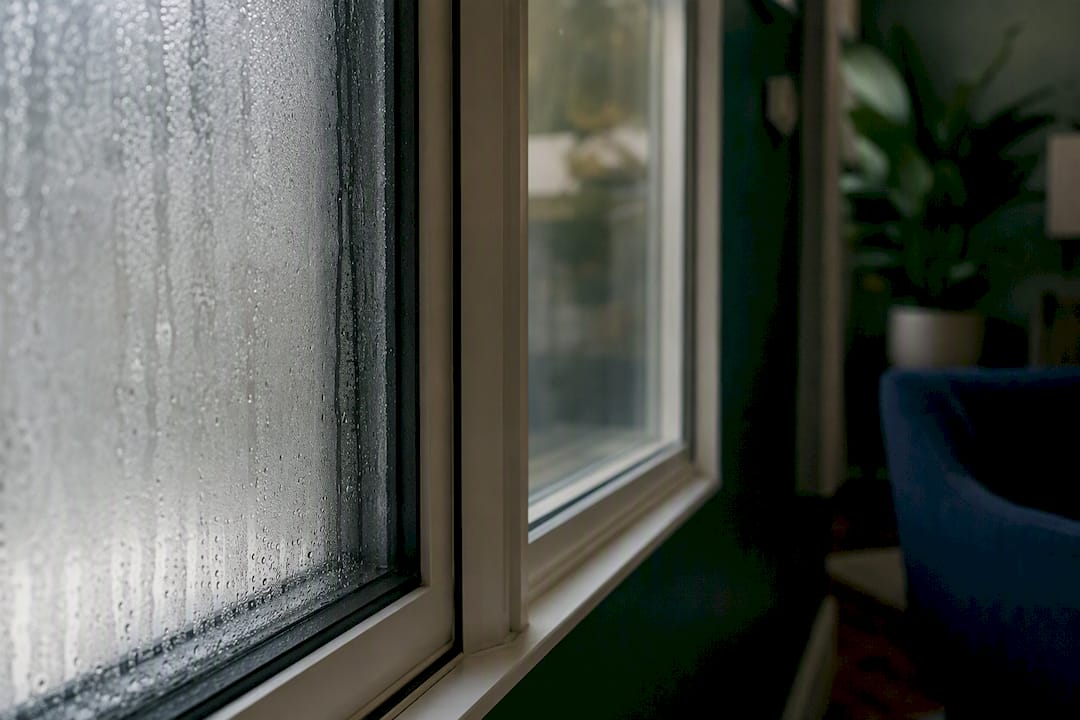
The edge-temperature effect matters just as much as the U-factor number. Warmer interior glass edges keep the surface above the dew point more often, which is why fabricators report better gas retention and condensation resistance with warm-edge systems compared to aluminum equivalents.
Pro Tip: The better your center-of-glass performance gets (triple panes, better low-E coatings), the more the spacer dominates total heat loss. Upgrading glass while keeping an aluminum spacer leaves real performance on the table.
What Standards Govern Warm Edge Spacer Performance?
Specifiers need a common reference point when comparing manufacturer claims, and that reference point is a short list of recognized standards rather than marketing copy.
- DIN EN ISO 10077-1, Annex E covers thermal calculation methods for windows, including spacer classification.
- DIN EN ISO 12631, Annex B extends similar thermal calculation guidance to curtain wall assemblies.
- The Warm Edge Working Group brings manufacturers together to align evaluation methods and terminology across the category, referenced in the broader warm edge classification framework.
- ISO itself sets the international governance context that these national and European standards sit within, per ISO’s own standards documentation.
When you request data from a supplier, ask specifically for Keff/psi values, full thermal charts, and whole-window performance data tied to a named test standard, not a generic “energy efficient” claim with no annex reference behind it.
How Do You Choose the Right Spacer for Your Project?
Start with your target whole-window U-value and work backward, since that number, more than any single material preference, determines whether warm edge is optional or effectively mandatory.
- Confirm the climate zone and condensation risk at the installation site.
- Check production compatibility: does your line bend rigid profiles, or does it need TPS application equipment?
- Verify secondary sealant compatibility, since spacer and sealant chemistry interact and mismatches can cause chemical fogging inside the unit’s seal.
- Weigh material cost per linear foot against lifecycle benefit, including warranty and seal-failure risk.
Ask suppliers directly for Keff/psi figures, cold-bend radius limits, whether the product ships pre-desiccated or needs separate desiccant, and a written compatibility statement for structural silicones. Treat a supplier who offers marketing language but no datasheet, no test numbers, and no sealant compatibility statement as a red flag. That gap tends to show up later as seal failure, not as a line item on the quote.
Which Manufacturers Make Warm Edge Spacers?
A handful of manufacturers anchor the category, and their datasheets are worth comparing side by side before you specify.
- EnerEDGE®-S (Tremco / Tremco IG products) is positioned as a rigid hybrid system aimed at fabricators wanting warm-edge performance without a full retool.
- Technoform offers thermally optimized warm edge spacer lines with cold-bendable options for curved and custom geometries.
- Swisspacer is known for a broad rigid composite range with published thermal charts across multiple glass configurations.
- Fenzi Group supplies traditional, warm-edge, and hybrid spacer bars with integrated sealing technology across its catalog.
When you pull datasheets from any of these, check Keff/psi values, cold-bend radius specs, and whether desiccant is integrated. Line up test conditions, glass thickness, gas fill, and low-E coating, before comparing thermal charts across brands, or the numbers will not mean the same thing.
When Do Warm Edge Spacers Become Essential?
High-performance targets are where warm edge stops being a nice upgrade and starts being close to unavoidable. Passivhaus-level whole-window U-values are difficult to reach with aluminum spacers even when the glass package is triple-pane, because the metal edge undoes gains made everywhere else in the assembly.
Experts in the field note that evolving energy codes are pushing adoption further: high-performance specifications can effectively require warm-edge spacers, since aluminum spacers alone may block a project from meeting whole-window U-value targets even with triple glazing in place.
That framing matters for budgeting conversations. The spacer line item looks small next to a glass upgrade, but it can be the cheaper path to the same code compliance.
What We Recommend in the Field
We generally push warm edge on any project chasing a strict U-value target or fighting condensation complaints, and stick with aluminum only on storefront framing where structural load matters more than edge temperature. The tradeoff is real: warm edge costs more per foot, but fewer seal failures pay that back over the unit’s life. Always cross-check the manufacturer datasheet against your specific glass and sealant before locking in a spec.
Where to Verify Spacer Data and Standards
- The Warm edge reference entry covers classification history and standards annexes.
- Fenzi Group’s spacer catalog shows product ranges and sealing options.
- Viracon’s spacer component page details sealant compatibility considerations.
Get Warm Edge Performance Installed Right
Reading a datasheet is one thing. Getting the spacer, sealant, and frame installed so the numbers actually hold up in your Kansas City home or building is another. Star-ws specs and installs insulated glass units built with warm-edge spacer technology, so you get the condensation resistance and U-factor gains this article covers without having to vet manufacturer charts yourself.
If you’re dealing with foggy seals, cold glass edges in winter, or a commercial storefront that needs to meet a tighter energy code, Star-ws handles everything from glass replacement to full commercial window replacement with warm-edge-enabled units. One of our partners at One Day Doors & Closets makes a similar case for interior doors as part of a whole-building efficiency approach, and the same logic applies here: the envelope only performs as well as its weakest component. Request a free estimate and we’ll tell you plainly whether your project needs warm edge or whether your existing spacer is fine.
Frequently Asked Questions
Are warm edge spacers worth the extra cost?
In most cold-climate or high-performance projects, yes. The material costs more per linear foot than aluminum, but reduced seal failures and condensation complaints tend to offset that over the unit’s life.
Can warm edge spacers be retrofitted into existing windows?
Not into an existing sealed unit. Warm edge spacers are built into the insulated glass unit at fabrication, so retrofitting means replacing the IGU itself, not just adding a component to an old window.
Do warm edge spacers work with triple glazing?
Yes, and they matter more there than with double glazing. As center-of-glass performance improves with triple panes and better coatings, the spacer becomes a larger share of total heat loss, so warm edge delivers a bigger relative gain.
What is the difference between warm edge and TPS spacers?
TPS is one specific warm-edge technology, applied as an extruded thermoplastic seal directly to the glass. Warm edge is the broader category that also includes foam, stainless hybrid, and rigid composite spacers.
Sources
- Warm Edge vs Aluminum Spacer Bar: A Data-Driven Comparison for IG Manufacturers
- Microfabricated alumina-based spacers for micron gaps (Nature/Scientific Reports paper)