
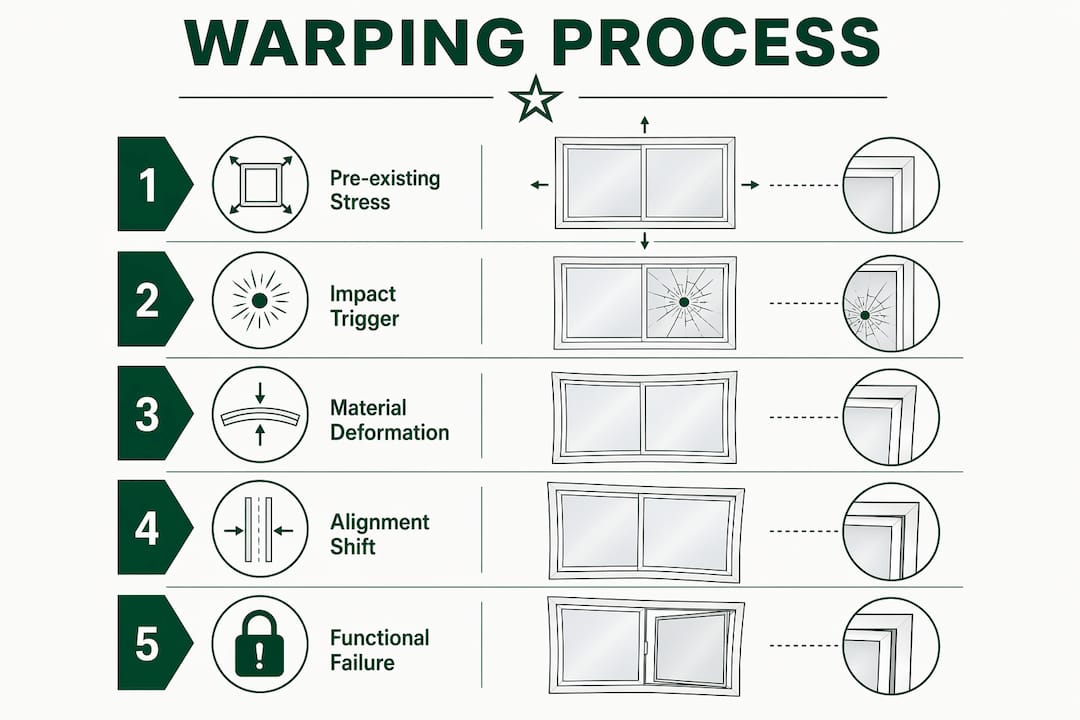
A physical impact rarely creates warping from nothing. What it usually does is push a frame that was already stressed by moisture, heat cycles, or a flawed installation past the point of no return. That distinction matters for every decision you make next.
If you’ve just had an impact, do these first:
- Check that the window can still close and lock securely. If it can’t, treat it as a security issue, not just a maintenance item.
- Photograph the frame from all four sides before touching anything. Insurers and contractors both need that documentation.
- Press a folded towel or foam backer rod into any visible gap to block drafts and water until a pro can assess the damage.
- Run your hand along the sash perimeter. A gap you can feel but couldn’t feel before the impact is a reliable sign the frame geometry has shifted.
Pro Tip: Don’t open and close a damaged sash repeatedly to “test” it. Repeated cycling can worsen a hairline deformation into a full structural shift.
If the frame won’t close, lock, or seal, call a professional for an inspection. Minor misalignment with no gap or water intrusion can often wait a few days; anything involving water getting inside the wall cavity cannot.
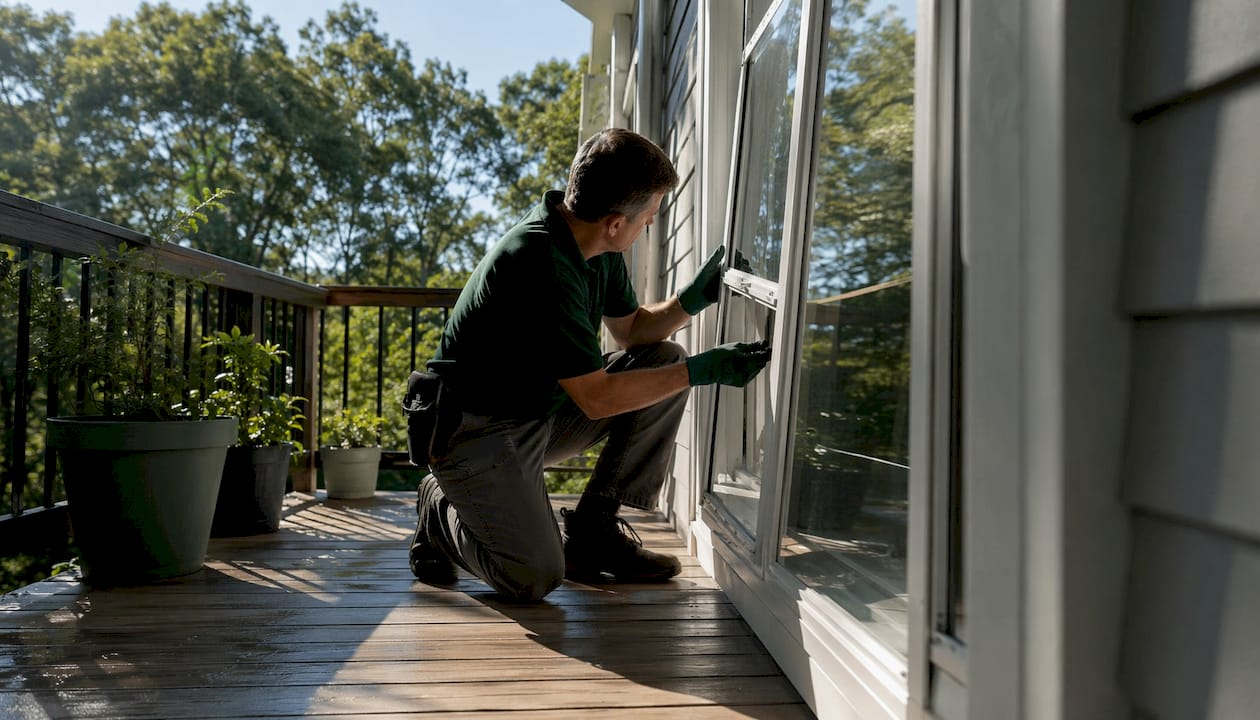
Table of Contents
- Why do window frames warp after impact?
- How an impact acts as a catalyst for hidden frame stress
- Which frame materials are most vulnerable to warping?
- How can you tell if your window frame is actually warped?
- When should you repair a warped frame versus replace the whole window?
- What does a warped frame actually cost you in energy, water, and security?
- How can you prevent warping and reduce impact vulnerability?
- When should you call a professional for a window inspection?
- What do inspection, repair, and replacement typically cost?
- Key Takeaways
- A local specialist’s perspective on post-impact frame damage
- Star Windows Solutions handles post-impact window work in Kansas City
- Useful sources and further reading
Why do window frames warp after impact?
The short answer: impacts expose weaknesses that were already there. A frame in perfect condition, properly installed with correct expansion gaps and intact sealant, can absorb a moderate blow without permanent deformation. But most frames in service for more than a few years carry at least one hidden vulnerability, and an impact is often what finally makes it visible.
There are four overlapping categories of causes:
Direct mechanical deformation is the obvious one. A hard enough hit from hail, a falling branch, or a struck sash can physically bend or dent the frame profile, knock it out of square, or shear an anchor point. Aluminum frames dent; vinyl frames crack or buckle; wood frames split along the grain.
Environmental weakening sets the stage long before any impact. Moisture absorbed into wood fibers causes swelling and eventual rot. UV radiation degrades vinyl and painted wood surfaces, creating micro-cracks that reduce the frame’s ability to flex and recover. Repeated thermal expansion and contraction over years of seasonal cycling slowly fatigue the material at corners and anchor points.
Installation problems are the most underappreciated cause. Windows installed without proper expansion gaps, or with foam backing compressed too tightly, have no room to move when temperatures change. The frame builds up internal stress with every hot summer and cold winter. An impact then releases that stored stress all at once. Improper anchoring, missing or incorrectly lapped flashing, and inadequate fastener spacing all compound the problem. Proper window frame anchoring is one of the most important factors in long-term frame stability.
Material quality and age multiply every other risk. Older frames have accumulated more fatigue cycles. Lower-grade vinyl or wood that was never properly primed or sealed is more brittle and more porous than quality material installed correctly.
Pro Tip: If your frames are old and you’ve never had the sealant or weatherstripping replaced, assume some environmental fatigue is already present before any impact assessment.
How an impact acts as a catalyst for hidden frame stress
Think of a frame under hidden stress like a bent paperclip that’s been flexed back and forth. It looks fine until one more flex snaps it. An impact is that last flex.
Industry observations consistently show that impacts usually act as a catalyst rather than a standalone cause. Professionals doing post-impact inspections routinely find evidence of thermal fatigue or moisture damage that predated the event by months or years. The impact didn’t cause the problem. It revealed it.
Common pre-existing stresses that an impact can trigger into visible warping:
- Accumulated moisture in wood or MDF components that has softened the frame’s structural core
- Thermal cycling stress concentrated at corners where the frame profile is mitered or welded
- Installation tension from missing expansion gaps, which means the frame was already under compression
- Corroded or loose anchors that had been holding the frame in position by friction alone
A real-world example: a hailstorm hits an older double-hung vinyl window on the south side of a house. The hail dents the exterior casing and the homeowner notices the sash now sticks and won’t latch. The frame looks straight to the eye, but a level check shows a slight bow along the bottom rail. The hail didn’t bow the rail. Years of south-facing solar heat had already shifted the frame out of square, and the impact was enough to make the sash bind.
Pro Tip: During a post-impact inspection, look for paint cracking or sealant separation at the corners of the frame. Those are signs of pre-existing thermal stress that the impact finished off, not fresh damage.
Which frame materials are most vulnerable to warping?
Material choice is the single biggest predictor of how a frame behaves after impact, and each material has a distinct failure mode.
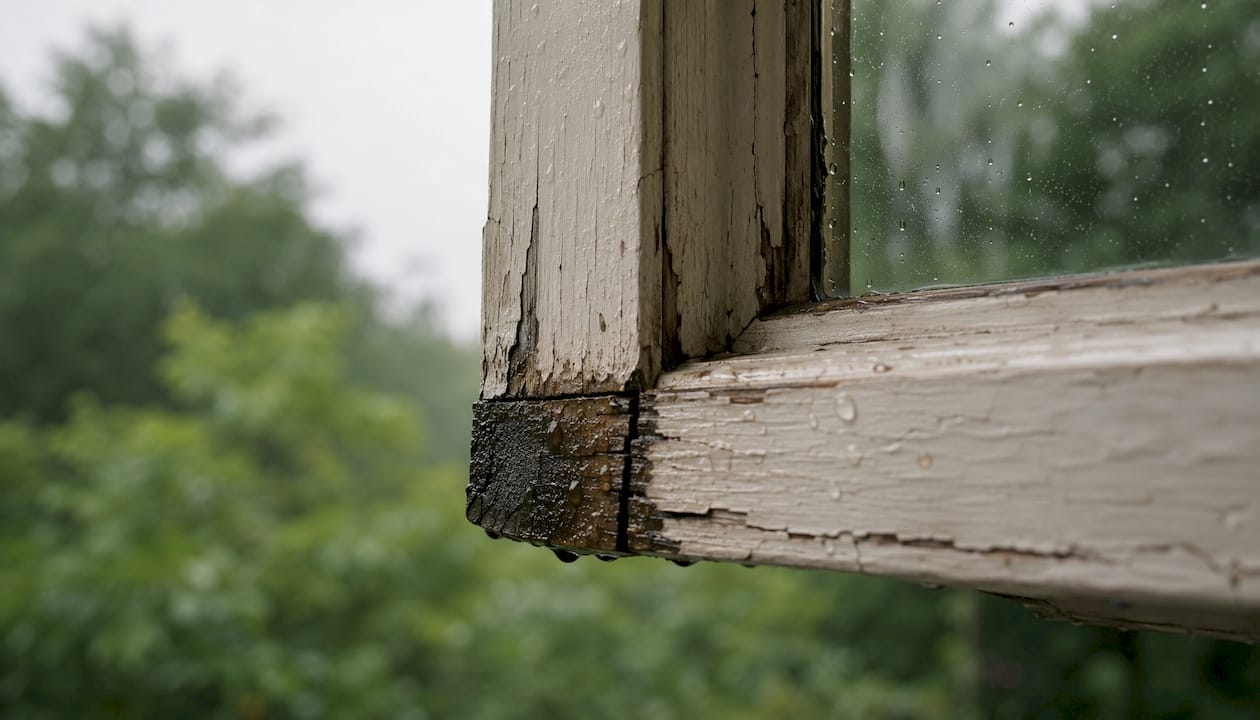
Wood absorbs moisture readily, especially at end-grain cuts and any spot where paint or sealant has failed. Swollen wood fibers push the frame out of square gradually, and a wet frame is far more likely to deform permanently under impact than a dry one. Wood is also the most repairable material: a skilled carpenter can plane, reshim, or sister a damaged section. The catch is that wood rot, once established, spreads, so the window around an impact site needs a moisture probe, not just a visual check.
Vinyl (PVC) expands and contracts more per degree of temperature change than metal or fiberglass, which makes its seasonal movement more pronounced. Low-quality PVC can soften at high surface temperatures, increasing the risk of permanent bending under thermal or impact stress. Dark-colored vinyl on a south-facing wall is the highest-risk combination. Vinyl expands more per degree than metal or fiberglass, so any installation that didn’t account for that movement is already stressed before impact. Vinyl frames that have buckled or cracked are generally not field-repairable and need replacement.
Aluminum is dimensionally stable and doesn’t absorb moisture, but it dents easily and conducts heat so efficiently that it can develop localized stress at anchor points when one side heats faster than the other. A hard impact can shear an anchor or shift the frame in its rough opening. The frame profile itself rarely warps, but the whole unit can shift out of plumb if the anchoring fails.
Fiberglass and composite frames are the most stable option. They expand and contract at roughly the same rate as glass, which reduces seal stress, and they don’t absorb moisture. After an impact, fiberglass frames are more likely to crack at a specific point than to warp gradually. That makes damage easier to locate but sometimes harder to repair without a full-section replacement.
A few factors that change the risk for any material:
- Dark colors absorb more solar heat, raising surface temperatures and accelerating thermal cycling stress
- South- and west-facing exposures get the most direct sun and the widest daily temperature swings
- Large panes put more leverage on the frame corners, amplifying any deformation
How can you tell if your window frame is actually warped?
Before you call anyone, run through these checks yourself. They take about ten minutes and will tell you whether you’re dealing with a frame geometry problem or a hardware problem.
Visual checks:
- Stand back and look at the frame from outside. A bowed or twisted frame is often visible as a gap between the sash and the frame that’s wider on one side than the other.
- Check the corners. Cracked paint, separated caulk, or a visible gap at a mitered corner all point to frame movement.
- Look at the weatherstripping. Compressed flat on one side and barely touching on the other means the sash is sitting crooked in the frame.
- Check for daylight. In a darkened room, hold a flashlight along the frame perimeter from outside while someone inside looks for light bleed. Any visible light is a gap.
Measurement checks:
- Use a 4-foot level on each of the four frame sides. A reading more than 1/8 inch off level or plumb on a standard residential window is worth flagging.
- Measure the diagonals corner to corner with a tape measure. Even small deviations — a fraction of an inch difference between the two diagonal measurements — indicate the frame is out of square and will worsen if left alone.
- Run a straightedge along the sill. Any rocking or gap under the straightedge confirms a bowed sill.
Hardware checks (do these before assuming the frame is the problem):
- Test the balance springs or tilt latches on a double-hung. A failed balance can make a sash drop and bind without any frame deformation at all.
- Check hinge screws on casements. Loose screws let the sash sag and mimic warping symptoms exactly.
- Try adjusting the strike plate. Sometimes what looks like a warped frame is a strike plate that’s shifted 1/16 inch out of alignment.
If the hardware checks out and the measurements show misalignment, the frame geometry has shifted. That’s a different repair path than a hardware fix.
When should you repair a warped frame versus replace the whole window?
The decision comes down to four factors: how much the frame has moved, whether water has gotten into the wall, how old the window is, and what the repair will cost relative to replacement.
Repair is usually the right call when:
- The deformation is less than 1/4 inch across the frame width
- No water has entered the wall cavity (no staining, soft drywall, or mold smell)
- The frame material is wood and the damage is localized
- The window is less than 10 years old and otherwise in good condition
Replacement makes more sense when:
- The frame is visibly bowed, twisted, or cracked beyond a single point
- Water intrusion has reached the rough framing or caused rot
- The window is more than 20 years old and the seals are already failing
- The cost of repair approaches 50% or more of a new window’s installed price
- The frame has shifted enough to void any impact-resistance rating it carried
Repair methods by material:
- Wood: Plane or sand high spots, reshim the frame in the rough opening, replace rotted sections with epoxy filler or sister boards, and repaint with a moisture-barrier primer. For more extensive rot, frame rot repair and replacement is the more durable path.
- Vinyl: Re-anchor the frame in the rough opening if it has shifted. Cracked or buckled profiles generally can’t be patched reliably and need a full-unit replacement.
- Aluminum: Re-anchor shifted frames, replace dented extrusions if the profile is compromised, and check that all thermal break components are still intact.
- Fiberglass: Localized cracks can sometimes be filled with structural epoxy, but a frame that has shifted in its opening needs re-anchoring or replacement.
Short-term mitigation before a pro arrives:
- Press foam backer rod into visible gaps and cover with painter’s tape or glazing tape to block air and water
- Apply a temporary bead of silicone or butyl sealant over any cracked exterior caulk joint
- If the sash won’t stay closed, use a wedge shim at the bottom rail to hold it in position
- For broken glass alongside a warped frame, securing the opening immediately with plywood or polycarbonate sheet prevents water damage while you wait for service
What does a warped frame actually cost you in energy, water, and security?
A warped frame isn’t just an aesthetic problem. The practical consequences compound quickly if you leave it unaddressed.
Energy loss is the most immediate cost. Gaps along a misaligned frame allow conditioned air to escape and outside air to enter. The American Architectural Manufacturers Association (AAMA) notes that improper installation and degraded seals are primary contributors to water and air penetration, even in products that otherwise meet structural ratings. A frame that has shifted even 1/8 inch can break the compression seal between the sash and the frame, turning a well-insulated window into a significant source of air leakage.
Water intrusion is the more serious long-term risk. Water that gets past a warped frame doesn’t stop at the interior trim. It wicks into the rough framing, insulation, and drywall. Once that process starts, you’re looking at potential mold, wood rot in the structural framing, and repairs that go well beyond the window itself. Interior moisture damage to frames is one of the most common consequences of leaving a post-impact gap unaddressed.
Security and impact ratings are the third consequence, and the one most homeowners overlook. Impact-resistant window systems are engineered as complete units. If the frame shifts, the whole assembly’s wind-load and impact performance may be compromised, regardless of how intact the glass looks. A shifted frame can also prevent a lock from engaging fully, leaving the window as an easy entry point.
Key consequences at a glance:
- Broken compression seals increase air leakage and raise heating and cooling costs
- Water infiltration can reach wall framing and insulation within weeks of a storm
- A frame that has shifted out of square may prevent locks from engaging at full throw
- Impact-rated assemblies may lose their certified performance if the frame geometry changes
How can you prevent warping and reduce impact vulnerability?
Prevention is mostly maintenance. A frame that’s well-sealed, properly coated, and free of accumulated moisture stress is far more likely to survive an impact without permanent deformation.
Routine maintenance tasks (spring and fall):
- Inspect all weatherstripping and gaskets. Replace any section that’s compressed flat, cracked, or pulling away from the frame.
- Check exterior caulk joints at the frame perimeter and at the sill. Reapply where caulk has cracked or separated.
- Inspect flashing above and beside each window. Lapped flashing that has lifted or separated is a water entry point waiting for the next storm.
- Clean weep holes in the sill track. Blocked weep holes trap water against the frame and accelerate moisture damage.
- Recoat bare or faded wood frames with a quality exterior primer and paint. UV radiation and moisture create micro-cracks that leave frames vulnerable to deformation when impacted, so keeping the protective finish intact is a direct defense against impact damage. A seasonal window cleaning and inspection routine makes it easier to catch early signs of seal failure or coating breakdown before they become structural problems.
Installation best practices to demand from any contractor:
- Correct expansion gaps at the head and jambs for the specific material being installed
- Foam backing at the correct compression ratio, not over-compressed
- Fasteners at the manufacturer’s specified spacing and penetration depth
- Correctly lapped and sealed flashing at the head and sill
- Weep holes clear and oriented to drain away from the wall cavity
Material selection for high-risk exposures:
- South- or west-facing windows in Kansas City’s climate see wide temperature swings. Fiberglass or high-quality composite frames handle that better than standard vinyl.
- For coastal or high-humidity environments, avoid untreated wood or low-grade vinyl without UV stabilizers.
- Dark frame colors on sun-exposed elevations increase surface temperatures significantly. Lighter colors or factory-applied UV coatings reduce thermal cycling stress.
When should you call a professional for a window inspection?
Some post-impact situations are clear DIY territory. Others need a professional the same day.
Call a pro immediately if:
- The frame has visibly shifted in the rough opening (you can see daylight at the perimeter or the trim has pulled away from the wall)
- Water is getting into the wall cavity, not just onto the sill
- The lock won’t engage at all, leaving the window as an unsecured opening
- You can see or smell mold near the frame
- The window carries an impact-resistance rating and you need to know if it’s still valid
What a professional inspection covers:
- Level and diagonal measurements on all four frame sides, with documented tolerances
- Anchor and fastener check: are the frame anchors intact, and are they at the correct spacing?
- Flashing inspection: is the head flashing lapped correctly and sealed?
- Hardware evaluation: do locks, hinges, and balances operate at full function?
- Moisture probe of the surrounding framing and sill
- Photographic report documenting pre-repair condition for insurance purposes
Questions to ask before you hire:
- What does the inspection cover, and is there a written report?
- Are you licensed and insured for window work in Missouri?
- What’s the warranty on parts and labor for any repair or replacement?
- Have you worked with my frame material and window type before?
What to prepare before the visit:
- Pull out any photos you took immediately after the impact
- Note when the impact occurred and what caused it (hail, branch, accidental strike)
- Write down any symptoms you’ve noticed: sticking, drafts, condensation, water stains
- Locate any original installation paperwork or warranty documents if you have them
What do inspection, repair, and replacement typically cost?
Cost ranges vary by material, damage extent, window size, and local labor rates. These figures reflect typical U.S. residential market conditions in 2026 and should be treated as planning estimates, not quotes.
Inspection: Many window contractors in the Kansas City area offer free estimates for repair or replacement work. A standalone written inspection report from an independent inspector typically runs $75–$150 for a single window, though that fee is often credited toward any repair work that follows.
Common repairs:
- Weatherstripping replacement: $50–$150 per window, depending on window type
- Hardware replacement (locks, hinges, balances): $100–$300 per window; hardware replacement is often the right first step when symptoms look like warping but the frame geometry checks out
- Resealing and recaulking: $75–$200 per window
- Wood frame repair (planing, epoxy fill, reshimming): $200–$600 depending on extent of damage
- Partial frame section replacement: $300–$800
Full window replacement:
- Standard double-hung vinyl replacement: $400–$900 installed
- Wood or fiberglass unit: $700–$1,800 installed
- Custom sizes, impact-rated glazing, or specialty shapes add cost and lead time
Factors that shift costs:
- Permit requirements (some Kansas City municipalities require permits for full replacements)
- Second-floor or difficult-access locations
- Discovery of rot or structural damage in the rough framing during removal
- Lead times for custom or impact-rated units, which can run 4–8 weeks
Insurance and storm claims: If the damage was caused by hail, wind, or a falling object, your homeowner’s insurance policy may cover repair or replacement costs minus your deductible. Document everything before any repair work begins. Most insurers require a contractor’s written estimate and photos of the pre-repair condition. Filing a claim can extend the timeline by 2–4 weeks while an adjuster reviews the damage.
Key Takeaways
An impact rarely warps a window frame on its own. It exposes pre-existing thermal, moisture, or installation weaknesses that were already compromising the frame’s stability.
| Point | Details |
|---|---|
| Impact as catalyst | Impacts usually reveal pre-existing stress from moisture, heat cycles, or installation errors rather than causing warping from scratch. |
| Measure before deciding | Check diagonals and all four frame sides with a level; even a fraction of an inch off square predicts worsening air and water infiltration. |
| Hardware first | Rule out failed balances, loose hinges, or a shifted strike plate before concluding the frame itself has warped. |
| Repair vs. replace threshold | Repair when deformation is minor and no water has reached the wall cavity; replace when the frame has shifted significantly, rot is present, or repair costs approach replacement cost. |
| Star-ws for local inspections | Star Windows Solutions provides post-impact inspections, frame repair, hardware replacement, and full window replacement for Kansas City homeowners and property managers. |
A local specialist’s perspective on post-impact frame damage
The thing most homeowners get wrong after a storm or accidental impact is treating the visible damage as the whole story. A dented casing or a sticking sash gets all the attention, but the real question is what was already happening inside that frame before anything hit it. In Kansas City, we deal with some of the widest seasonal temperature swings in the country. A frame installed in July at 95°F and inspected after a January ice storm has already been through dozens of significant thermal cycles. By the time hail or a branch adds mechanical stress, the frame may have been accumulating fatigue for years.
What I see repeatedly in post-impact inspections is that the frames that fail badly are almost always the ones with a second problem: missing expansion room, a caulk joint that dried out two winters ago, or a sill that’s been holding water because the weep holes were painted over. The impact is the last straw, not the first cause. That’s why a thorough inspection after any impact should look at the whole frame condition, not just the point of contact.
The good news is that most post-impact damage, caught early, is manageable. A frame that’s shifted 1/8 inch can often be re-anchored and resealed for a fraction of replacement cost. The ones that turn into expensive projects are the ones that sat unaddressed through another winter.
Star Windows Solutions handles post-impact window work in Kansas City
When a window takes a hit, the difference between a $200 repair and a $1,500 replacement often comes down to how quickly you get an accurate diagnosis. Star Windows Solutions offers free estimates for post-impact frame inspections across the Kansas City area, covering everything from a single sticking sash to full-frame rot caused by long-term water intrusion.
The service covers the full range of post-impact needs: frame repair and reshimming, rot repair and frame replacement, hardware replacement for locks and balances that failed under impact stress, full window replacement for units that can’t be salvaged, and glass replacement when the frame is sound but the glazing is cracked. For property managers handling multiple units, commercial window replacement is available with volume scheduling and financing options.
The inspection process is straightforward: a technician measures the frame geometry, checks anchors and flashing, evaluates hardware, and provides a written estimate with photos. No guesswork, no upselling work that isn’t needed. Schedule your free estimate at star-ws.com or call to book a same-week visit.
Useful sources and further reading
- AAMA Storm-Driven Rain Penetration White Paper — American Architectural Manufacturers Association guidance on water penetration, installation standards, and maintenance requirements for windows and doors
- TDI: Windstorm and Impact-Resistant Windows — Texas Department of Insurance guidance on impact-rated window assemblies and how frame integrity affects wind-load performance
- What Is Window Warping? Causes, Fixes & Prevention — Detailed explanation of warping mechanisms, installation errors, and repair options
- Why Do Windows Warp? Understanding and Preventing Window Distortion — Material-specific thermal expansion behavior and prevention guidance
- Wikipedia: Wood Warping — Technical overview of wood warping mechanisms and contributing factors
This article is general information for homeowners and property managers. For a diagnosis specific to your window and local building code requirements, consult a licensed window contractor or building inspector.